PM approves adjustments to Hanoi Capital Region Master Plan

Prime Minister Nguyen Xuan Phuc has approved adjustments to the Hanoi Capital Region Construction Master Plan to 2030 with a vision to 2050.
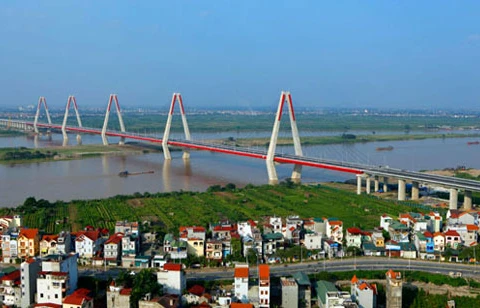
PM approves adjustments to Hanoi Capital Region Master Plan ảnh 1Illustrative image (Photo:VNA)


Hanoi (VNA) –
Prime Minister Nguyen Xuan Phuc has approved adjustments to the Hanoi Capital Region Construction Master Plan to 2030 with a vision to 2050.

The Hanoi Capital Region covers the capital city of Hanoi and the nine neighbouring provinces of Vinh Phuc, Bac Ninh, Hai Duong, Hung Yen, Ha Nam, Hoa Binh, Phu Tho, Thai Nguyen and Bac Giang, with a total area of around 24,314.7 sq.m.

Phu Tho, Thai Nguyen and Bac Giang were newly added to the plan under a decision on May 5, 2008.

The modified master plan aims to meet requirements for development, planning management and investment to develop the region, to ensure the effective distribution of national resources, to limit side effects of urbanisation on living environments and the impact of climate change.

The plan also seeks to meet demand for a modern integrated network of the region’s technical and social infrastructure, creating conditions for cities to drive the development of surrounding areas, to promote equal development between urban and rural areas and to ensure security.

The adjustments to the plan also created a basis for the creation and adjustment of plans for provincial regions, regions along belt roads, inter-provincial expressways, regions and functional areas of specific features, overall plans for cities, plans for new-style rural areas and specific planning for technical infrastructure.

Hanoi, Vinh Phuc and Bac Ninh, with their high rates of urbanisation, play central role with strengths in industry, human resources and infrastructure.

As the Capital, Hanoi serves as the country’s political and administrative centre, and important cultural, educational, scientific and technological hub, and one of the economic, tourism, trade and service centres in the Asia Pacific region.

By 2030, Hanoi’s urbanisation rate will reach 65-70 percent.

Hai Duong, Hung Yen and Ha Nam provinces in the southeast of the Red River Delta will develop their transport and gateway advantages towards the sea with the corridor Ha Noi – Pho Noi – Hai Duong – Hai Phong as well as the economic triangle in south of Hanoi (Hung Yen – Dong Van-Phu Ly). The provinces will develop clean industrial parks, supporting industries, logistics, trade centres, health, training, sports and agri-product processing.

Hoa Binh, Phu Tho, Thai Nguyen and Bac Giang are gateways for the Hanoi Capital Region to the midland and mountainous region in the north.

Hoa Binh serves as an ecological and environmental protection area and takes a key role on national and inter-regional technical infrastructure like providing electricity and water, controlling floods and protecting water resources.

Phu Tho will develop heritage cultural and ecological tourism areas while Thai Nguyen will develop health, education and training and tourism.

Bac Giang will become a gateway for transporting goods from the Capital Region to the Huu Nghi international border gate in Lang Son province. It will also develop tourism areas like Tay Yen Tu, Ho Khuon Than and Ho Cam Son, and a business hub with northeast provinces of the northern midland and mountainous region.-VNA

VNA

See more

Zambia's Minister of Agriculture Reuben Mtolo Phiri (first, left), learns about the OM19 rice variety grown at Tien Thuan cooperative in Thanh Quoi commune,, Can Tho city (Photo: VNA)

Can Tho shares agricultural transformation experience with Zambia

Rice production remains Can Tho’s key industry. Alongside maintaining production, Can Tho has encouraged value chain linkages among farmers, cooperatives and businesses, while accelerating the application of science and technology, mechanisation and digital transformation in farming.

Staff members of the Hanoi Public Administrative Service Centre handle administrative procedures for local residents. (Photo: VNA)

Hanoi: 95% of administrative procedures to be handled from home

The plan targets that at least 80% of administrative procedures under the city’s authority will be provided as fully online public services, while more than 95% of applications will be received and processed entirely online. By June 30, 2026, about 80% of administrative procedures are expected to be restructured based on integrated data systems, with the figure rising to 95% by the end of the year.

Delegates at the SEAN Future Forum NextGen Workshop 2026 held in Jakarta, Indonesia on March 9 (Photo: VNA)

Vietnam contributes youth perspectives to AFF NextGen initiative

The ambassador expressed confidence that fresh perspectives, innovative thinking and lessons drawn from the workshop will be proposed to AFF 2026, representing the voice of the younger generation in shaping ASEAN’s future in line with their aspirations.

A young volunteer donates blood during the 2026 Red Sunday programme. (Photo: VNA)

Nearly 5,000 people join blood donation campaign in Ho Chi Minh City

According to health authorities, Vietnam collected nearly 1.75 million units of blood in 2025, with 98% from volunteer donors, equivalent to around 1.75% of the population participating in blood donation. Large-scale campaigns such as Red Sunday have played a key role in achieving these results.

More than 30 kilogrammes of various drugs trafficked from Cambodia to HCM City were seized in a police operation in March 2025. (Photo: VNA)

Ho Chi Minh City aims to become drug free by 2030

Every commune, ward or residential area in Ho Chi Minh City is expected to meet official drug-free standards by the end of 2029, while schools, hospitals, government offices, businesses and social organisations across the city are to remain free of drug activity.

Military forces take a resident from a flooded area. Photo: VNA

Da Nang, Oxfam join hands to support flood victims

In the coming time, the Da Nang Red Cross Society will continue to coordinate with Oxfam to implement support activities in Nong Son commune, helping residents overcome difficulties and stabilise their livelihoods.

Training on response to reservoir incidents (Photo: VNA)

Central Civil Defence Fund established to bolster disaster response

The Central Civil Defence Fund is authorised to receive, manage and use voluntary contributions from domestic and foreign entities and individuals, plus transfers from provincial civil defence funds in line with the PM’s decisions and allocations from relevant state financial sources outside the state budget, all earmarked for incident and disaster response and recovery efforts.