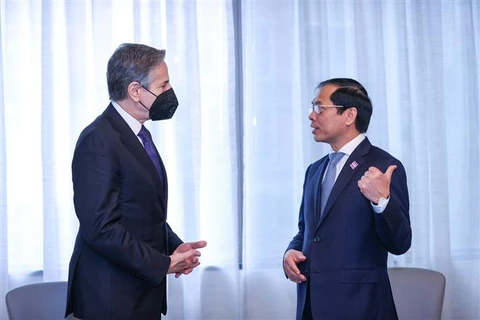
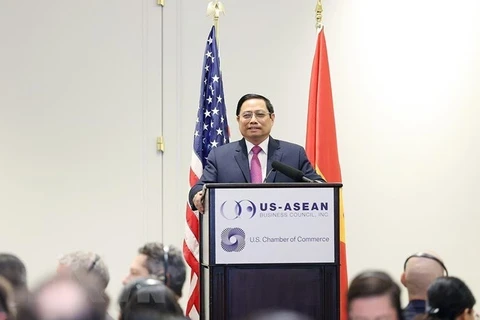
Prime Minister Pham Minh Chinh delivers a speech at Harvard Kennedy School. (Photo: VNA)
 In the speech, PM Chinh stressed the importance of independence laid out in the US’s Declaration of Independence “All men are created equal. They are endowed by their Creator with certain inalienable rights, among them are Life, Liberty, and the pursuit of Happiness,” and the spirit of which had been echoed in Vietnam’s Declaration of Independence penned by the late President Ho Chi Minh.
The Vietnamese founding father since the very beginning of the modern Vietnam had expressed the desire to set up equal, comprehensive relations with the US in his letter sent to US President Harry Truman in 1946.
The Vietnam-US relations have gone through so many vicissitudes and breakthroughs to achieve so much since the two nations officially normalised their ties in 1995. In the 27 years since then, four successive US presidents had visited Vietnam, PM Chinh said.
Vietnam and the US have overcome their differences and reached fundamental principles for their relations, as affirmed in the Vietnam-US Joint Vision Statement issued when General Secretary of the Communist Party of Vietnam Nguyen Phu Trong made an official visit to the US in 2015, which emphasised respect for "each other’s political institutions, independence, sovereignty, and territorial integrity,” PM Chinh noted, adding that Vietnam highly appreciated the US’s support for a strong, independent, and prosperous Vietnam over the years.
The Government leader affirmed Vietnam's consistent policy of reform, ‘open doors’, active, extensive, effective and practical international integration; facilitating and protecting the rightful interests of long-term, effective, sustainable businesses and trade partners in the spirit of ‘harmonised benefits, shared risks’ and observance of the laws.
Vietnam wants to be a good friend, a reliable partner, and a responsible member in addressing regional and international issues for the sake of global prosperity, PM Chinh stressed.
Thanks to these policies, Vietnam’s economy has witnessed astounding achievements from its low starting point. In 2021, Vietnam’s GDP reached 362 billion USD, compared to the mere 4.2 billion USD in 1986 when the Doi Moi (renewal) process began. The country has become the fourth biggest economy in the Association of Southeast Asian Nations (ASEAN), one of 20 countries with the largest trade volume in the world, the biggest exporter of rice and other agricultural products, and has 15 active free trade agreements with other countries and regions in the world.
Speaking on the reasons why there is a need to build an independent, self-reliant but deeply integrated economy, PM Chinh said that recently there have been a lot of complicated unpredictable developments in the world like intensifying strategic competition, financial and monetary risks and disruptions to the supply chains, the negative reactions to globalisation, and other traditional and non-traditional security issues such as climate change, pandemics, ageing population, depletion of natural resources, energy and food security, cybersecurity, and human security, etc.
These issues put countries at a place where they need to focus on boosting the self-reliance and independence of their economies to lessen the impacts of external shocks, but this should not mean a total close-off from the world, but it should go in tandem with an open-door policy and international integration, PM Chinh said.
Vietnam, like other developing countries, wants to build an independent, self-reliant economic foundation, step up industrialisation and international integration to overcome the middle-income trap to become a developed nation, he said.
According to the PM, to succeed, each country will have different suitable methods, roadmaps, and steps with consideration of their own characteristics and conditions, but special attention should be paid to some universal requirements. Accordingly, economic independence and self-reliance are associated with independence and self-control in terms of politics, foreign policy, and international integration. The respect for differences in conditions and characteristics of politics, economy, history, culture, and society will contribute to the diversity and richness of the global economy and national advantages, but along with that, there must be respect for the legitimate rights and interests of countries based on the UN Charter and international law.
The PM stated that Vietnam has both engaged in extensive international integration and made great efforts to improve its internal capacity, flexibly and effectively respond to external shocks such as the 1997-1998 Asian financial crisis, the global financial crisis in 2007-2008, and the global COVID-19 pandemic from 2020 to now.
In the current context, Vietnam needs to continue to promote the building of an independent and self-reliant economy associated with proactive and active international integration due to three main reasons: the first is to resolve Vietnam’s major challenges; the second is to ensure independence, sovereignty, and national interests; the third is to improve the country’s capacity and potential for and effective integration into the global economic system, and effective implementation of international commitments.
Measures to realise development goals
According to PM Chinh, the concept of building an independent and self-reliant economy, associated with proactive and active international integration, has been clearly defined and a consistent goal in Vietnam’s 2013 Constitution and the Party’s resolutions and national development platforms.
PM Chinh emphasised Vietnam’s strategic national development goals – to become a developing country with modern industry and high middle income by 2030, and to become a developed, high income country by 2045.
To realise these development objectives, the main goals of building an independent and self-reliant economy associated with proactive and active international integration are: building an effective, sustainable economy with reasonable structures; improving resilience and competitiveness; adapting flexibly and effectively to changes in international, regional, and domestic situations; taking full advantage of opportunities from international integration to create a driving force for rapid recovery in the short term and sustainable development in the medium and long term.
At the same time, special attention should be paid to social progress and justice, ensuring social security, and people’s lives, as General Secretary Nguyen Phu Trong has pointed out: “We must not sacrifice social progress and social equality in the pursuit of economic growth,” PM remarked.
Regarding the core thoughts, the PM stressed that building an independent and self-reliant economy associated with extensive, practical and effective international integration, is based on three pillars: Building a Socialist-oriented market economy, building a Socialist rule-of-law State, and building a Socialist democracy.
To realise these objectives, PM Chinh mentioned a number of missions and measures that need to be done.
First of all, the maintenance of independence, sovereignty, territorial integrity, socio-political stability, in order to have an environment conducive to the development of the economy is needed.
The second is to perfect the Socialist-oriented market economy institutions in a synchronous, modern and integrated manner, in line with international commitments.
The third is to maintain macroeconomic stability, ensure major balances and deepen practical international integration.
The fourth is to focus on restructuring the economy in association with profound renewal of growth model that will gear the economy towards the direction of science and technology, innovation, resource efficiency, and green growth.
The fifth is to mobilise all social resources, to promote the important role of domestic and foreign enterprises.
The sixth is human resource development and modern national governance.
Concluding his speech, PM Chinh highly appreciated the positive results of Fulbright University and the Vietnam Executive Leadership Programme (VELP) that is jointly implemented by the Harvard University and Vietnamese Government agencies, expressing the wish to replicate this model with other famous universities of the US and the world.
After the PM’s presentation, ministers and members of the delegation spoke and participated in a discussion with Harvard University professors on Vietnam’s development orientations./.
VNA