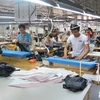
Workers in a factory manufacturing electronic components of Optrontec Vina Co Ltd in Binh Xuyen Industrial Park in Vinh Phuc province. (Photo: VNA)
 With more and more scientists predicting that COVID-19 may never disappear, global policymakers are trying to avoid further lockdowns and have shifted their focus to recovery. Thus, policies that drive the economy in the long term will be the centrepiece of the post-pandemic programme.
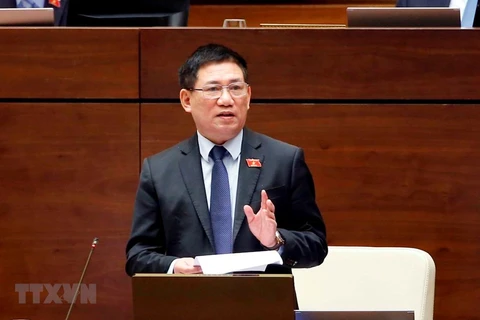
“A master programme on economic recovery and development at this time is very necessary and needs to be promulgated and implemented soon,” Phan Duc Hieu, a National Assembly deputy from Thai Binh province and Deputy Director of the Central Institute for Economic Management (CIEM), told Vietnam News.
The world has experienced unprecedented challenges from the COVID-19 crisis in the last two years and many governments, including Vietnam, have introduced extraordinary stimulus packages to revive their economies.
In Vietnam, the total amount of tax and State budget revenue that has been extended, exempted and reduced in 2020 reached 129 trillion VND (5.6 billion USD). In 2021, besides some policies issued in 2020, more support policies on taxes and fees have been introduced with an estimated scale of about 140 trillion VND.
The prolonged pandemic has significantly reduced the health of people and the financial capacity of businesses. The number of firms shutting down, dissolving, and leaving the market reached the highest level in many years. Several surveys also showed that businesses are facing both financial and market difficulties.
In the first session of the 15th National Assembly in July 2021, the Government was tasked to study and develop a programme on economic recovery and development.
“It should be noted that this is not simply a stimulus package and has yet to say how big it is. However, this economic recovery and development programme must be big enough and long enough to spearhead the economy in the long term,” Hieu said.
Support measures were mostly aimed at tackling urgent situations. The pandemic has posed unprecedented difficulties for policymakers to issue both timely and effective solutions, thus many policies in the latter stages have been issued based on experience from previous solutions.
The socio-economic recovery and development programme this time will be fundamentally different from the previous policies in terms of the overall goal and long-term vision.
Hieu said the plan must include both economic and social solutions, comprise different measures ranging from fiscal, monetary, and technical support and cover different subjects, industries, and fields to not only help restore production and business activities but also create room for sustainable development in the long run.
“In principle, this programme must ensure the basic requirements: support measures must be appropriate, meet the right needs and the right targets; in the long term create changes in the business model towards a strong digital transformation and sustainable development – with the goal of not following the old path but must develop strongly on the new road,” Hiếu said.
“Thus, there must be an effective, timely and comprehensive implementation mechanism.”
Policy space
The Government has only a few choices on its plate right now given shrinking space for fiscal and monetary policy.
According to Nguyen Minh Tan, Deputy Director of the State Budget Department under the Ministry of Finance, the efforts to keep the State budget deficit at 4 percent of GDP in 2021 (equivalent to about 5.1 percent of unadjusted GDP) according to the estimate approved by the National Assembly last November and expected 4 percent of GDP in 2022 is pressuring the State budget balance in the coming years.
Amid the pandemic challenge, the pressure is great to ensure the average budget deficit within 3.7 percent of GDP in the five-year period pursuant to the national financial plan, public borrowing, and debt payment plan for the 2021-25 period adopted in July this year.
Besides, the budget collection is also a challenge in the future given the fact that the businesses and economy need a longer time to recover. In its October report, the International Monetary Fund projected the world economy to grow 4.9 percent in 2022, lower than 5.9 percent in 2021.
Additionally, the continued implementation of tax exemption and reduction to support enterprises and enormous expenditure on disease prevention and control will also create pressure on the state budget balance, especially the central budget.
Some experts however believe there is still some room in the design of support measures.
According to Can Van Luc, Chief Economist of the Bank for Investment and Development of Vietnam (BIDV), the budget deficit and public debt have been controlled in the previous period and are lower than other countries in the region which will provide the opportunity to increase domestic debt (through the issuance of government bonds) to collect more resources to finance pandemic control and economic recovery.
Luc said the current scale of fiscal support is still quite modest so the public debt and budget deficit should be increased to supplement support packages, focusing on cash support, fee/cost reduction, credit guarantees and preferential loans (interest support) rather than tax deferrals and debt repayment obligations.
However, Hieu cautioned to calculate potential domestic and international macro risks and the efficiency of fiscal and monetary policies.
“An important point in minimising macro risks is to pay special attention to the effectiveness of this programme – the more effectiveness increases, the more risk decreases and vice versa,” he said.
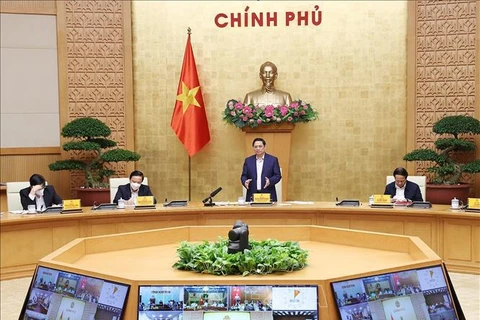
The Government has assigned the Ministry of Planning and Investment to coordinate with the Ministry of Finance and the State Bank of Vietnam and relevant agencies to complete the socio-economic recovery and development programme and report to the Government before submitting it to the National Assembly at its special session in December 2021.
The master plan aims at not only solving short-term problems but more importantly to bring Vietnam's economy back to a new growth cycle, re-establishing the growth momentum in the medium and long term./.
VNA