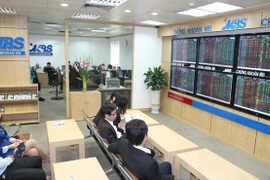
A trading session at MayBank Kim Eng Securities Company in HCM City (Photo: VNA)
 Hanoi (VNA) -Vietnamese shares plummeted as investor confidence was dampened by worries overthe increasing pace of the US central bank’s interest rate hike this year.
The benchmark VN Index on the HCM Stock Exchange tumbled 5.10 percent or 56.33points to end at 1,048.71 points. It lost a total 1 percent last week.
The February 5 loss was also the biggest decline for the benchmark index interms of percentage since May 8, 2014, when the VN Index plunged 5.87 percent.In terms of index score, the VN Index recorded the historical reduction.
The minor HNX Index on the Hanoi Stock Exchange dipped 4.06 percent to close at118.94 points after having dropped total 2.25 percent last week.
The UPCoM Index on the Unlisted Public Company Market (UPCoM) lost 3.25 percentto finish at 56.93 points. It also declined by a total of 1 percent in theprevious trading week.
More than 392.8 million shares were traded on the local stock exchanges, worth 10.1trillion VND (449.4 million USD).
The February 5 sell-off has reduced market total capitalisation by 161.4trillion VND to 3.06 quadrillion VND (136.2 billion USD), according tovietstock.vn.
All 20 sectors on the stock market ended in negative territory. Theworst-performing industries included finance-banking, real estate, energy andmining, and food and beverage production.
Market trading was totally negative as declining stocks on the three localexchanges outnumbered gainers by 571 to 152, while 85 others were unchanged.
Large-cap stocks also traded poorly as 27 of the 30 largest ones by marketcapitalisation in the VN30 basket saw their prices down.
Thirteen of the 27 declining stocks in the VN30 basket suffered a daily declininglimit of 6.9-7 percent each.
Among the worst decliners were property developer Vingroup (VIC), food andbeverage producer Masan (MSN), insurer Bao Viet Holdings (BVH), Bank forInvestment and Development of Vietnam (BID) and Vietcombank (VCB), and SaigonSecurities Inc (SSI).
According to Bao Viet Securities Company (BVSC), the shake of the market on February5 was caused by poor investor sentiment as investors were worried aboutmore-than-expected interest rate hikes made by the US central bank.
The US employment report on February 2 revealed upbeat data in January as wagesgrew at the fastest pace in eight years, boosting expected inflation in thenext few months to a high level.
The US data also suggested the US central bank could make more than three rate hikesthis year, which triggered a massive sell-off in global markets.
“Vietnam’s stock market, which has a closer relationship with the global stockmarket than in the past, I was also affected. It experienced a dramatic losstoday and could still suffer the influence in the next sessions,” (BVSC) saidin its daily report.
In addition, “buying demand was beaten by profit-taking pressure and marginreduction before the upcoming long-week holiday. Therefore, the market fellacross the board, causing a panic and fear in the market,” BVSC added.
The securities company forecast that “selling pressure will continue to rise inthe first half of the next session, then market demand and supply will turnmore balanced when the index declines to the 1,000-1,020 support zone.”-VNA
VNA