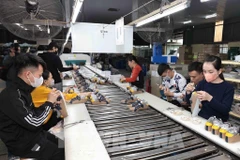
Garment exports slump in the first quarter of 2023. (Photo: VNA)
 Hanoi (VNS/VNA) – The value of textile and garment exports in the first quarter of2023 reached 7.1 billion USD, down 17% compared to the same period in 2022, dueto the impact of global inflation, according to the General Statistics Office(GSO).
This was thedeepest decline in the first quarter since 2009, the GSO said.
The globalinflation made consumers tighten spending on non-essential products, causingtextile and garment exports to major markets such as the US and EU to dropsharply.
There aremany forecasts saying that the domestic textile and garment industry's exportsgrowth will slump this year.
Since thefourth quarter of 2022, textile and garment enterprises have had ashortage of export orders, leading to a sharp drop in export turnover andfactories operating at below capacity.
Exportorders in the second and third quarters are still shrinking, and workers areworking reduced hours.
Than Duc Viet,General Director of Garment 10 Corporation, said the reduced demand fortextiles and garments this year was due to the impact of inflation, pandemic,and geopolitical tensions between Russia and Ukraine. In addition, concernsabout financial market instability and a banking crisis have alsoaffected demand.
In the firstquarter of this year, exports of May 10 were estimated todecrease by 10% compared to the same period last year.
Product volumein the second quarter is estimated to decrease by 20-30%, and until now, May 10has not received new orders for production in the third quarter, said Viet.
Viet ThangJean Co, Ltd (VitaJean), a large garment firm, has also reduced factory capacity,and temporarily closed a high-grade product production line because of a lackof orders.
Pham Van Viet,VitaJean Chairman and Vice Chairman of the HCM City Garment, Embroidery andKnitting Association, said that purchasing power has not recovered in Japan,the US and EU, while it has reduced by about 20-30% in February in the domesticmarket.
He said thatthe prospects of the textile and garment industry in the first half of 2023 arestill bleak. From the third quarter of 2023, the market may graduallyrecover, as the price of input materials decreases, reducing pressure onbusinesses.
However, allforecasts lack clarity because the conflict between Russiaand Ukraine has not cooled down yet.
Coping with the downturn
In thiscontext, textile and garment enterprises have to implement many solutions suchas restructuring enterprises, markets and products to maintain production andkeep workers while waiting for the market to warm up.
The VitaJeanchairman said that besides traditional markets such as the US and EU, hiscompany is trying to boost exports to Australia and Canada, and at the sametime, increase domestic consumption to partly compensate for the decline inexports to the traditional markets.
Meanwhile,Than Duc Viet said that May 10 has also restructured its businesses andsustainable development strategies. It also needs to review product position,market, management, technology, and production models to meet customerrequirements.
He also saidfor the domestic market, this business is looking for products to meet theneeds of customers in the context of the economic downturn.
For exports,May 10 is seeking new markets besides its traditional markets includingthe US, Europe and Japan.
Vietnam's 15signed free trade agreements (FTAs) bring a lot of opportunities to expandto new export markets, so South Africa, Africa, the Middle East and Chinaare likely to all be huge markets in the future, he said.
The May 10general director said now is also the time of sustainable developmentassociated with green production.
The world isencouraging green growth, and Vietnam committed to reduce carbon emissionsat COP26. Therefore, May 10 is switching to using green materials and greenenergy. As it increases the proportion of green products, thisbusiness will have many opportunities to promote production andexports in the future.
Vu DucGiang, Chairman of the Vietnam Textile and Apparel Association (Vitas), saidthat the textile and garment industry last year still exported product worthmore than 42.2 billion USD, up 8.5% over the same period theprevious year.
However,that result mainly came from export growth in the first sixmonths of the year. From the third quarter of 2022, exports began to show signsof weakness due to China's zero-COVID policy and the globalrecession.
The textileand garment industry's production continued to deteriorate in late 2022and remained in that situation until the first quarter of 2023.
In 2023,Giang forecasts that the textile and garment business will still have manychallenges. The most significant is the trend of increased layoffsand moving the workforce away from big cities.
Meanwhile,domestic enterprises have not been able to meet a number of complex orders.
Foreignmarkets also have requirements for recycled products and transparency inoperations. Those are issues that businesses cannot immediately respond to,especially small and medium sized enterprises.
According toGiang, the most important solution now is to diversify markets, products andbrands produced in Vietnam.
On the otherhand, businesses should use more green and recycled products, and haveinfrastructure investment plans and in-depth strategies to meet therequirements of foreign markets.
In addition,textile and garment enterprises need strategies to respond to the fastchanges of the market, such as fast delivery times, competitive prices, stablequality, and transparency in products.
Businessesalso need to build connection channels to grasp the challenges andopportunities of the global textile industry, digital technology trends and newpolicies.
Giang saidthat large-scale enterprises with production chains of yarn, weaving,dyeing and sewing, will survive, while businesses specialising in processingwill face great challenges./.
This was thedeepest decline in the first quarter since 2009, the GSO said.
The globalinflation made consumers tighten spending on non-essential products, causingtextile and garment exports to major markets such as the US and EU to dropsharply.
There aremany forecasts saying that the domestic textile and garment industry's exportsgrowth will slump this year.
Since thefourth quarter of 2022, textile and garment enterprises have had ashortage of export orders, leading to a sharp drop in export turnover andfactories operating at below capacity.
Exportorders in the second and third quarters are still shrinking, and workers areworking reduced hours.
Than Duc Viet,General Director of Garment 10 Corporation, said the reduced demand fortextiles and garments this year was due to the impact of inflation, pandemic,and geopolitical tensions between Russia and Ukraine. In addition, concernsabout financial market instability and a banking crisis have alsoaffected demand.
In the firstquarter of this year, exports of May 10 were estimated todecrease by 10% compared to the same period last year.
Product volumein the second quarter is estimated to decrease by 20-30%, and until now, May 10has not received new orders for production in the third quarter, said Viet.
Viet ThangJean Co, Ltd (VitaJean), a large garment firm, has also reduced factory capacity,and temporarily closed a high-grade product production line because of a lackof orders.
Pham Van Viet,VitaJean Chairman and Vice Chairman of the HCM City Garment, Embroidery andKnitting Association, said that purchasing power has not recovered in Japan,the US and EU, while it has reduced by about 20-30% in February in the domesticmarket.
He said thatthe prospects of the textile and garment industry in the first half of 2023 arestill bleak. From the third quarter of 2023, the market may graduallyrecover, as the price of input materials decreases, reducing pressure onbusinesses.
However, allforecasts lack clarity because the conflict between Russiaand Ukraine has not cooled down yet.
Coping with the downturn
In thiscontext, textile and garment enterprises have to implement many solutions suchas restructuring enterprises, markets and products to maintain production andkeep workers while waiting for the market to warm up.
The VitaJeanchairman said that besides traditional markets such as the US and EU, hiscompany is trying to boost exports to Australia and Canada, and at the sametime, increase domestic consumption to partly compensate for the decline inexports to the traditional markets.
Meanwhile,Than Duc Viet said that May 10 has also restructured its businesses andsustainable development strategies. It also needs to review product position,market, management, technology, and production models to meet customerrequirements.
He also saidfor the domestic market, this business is looking for products to meet theneeds of customers in the context of the economic downturn.
For exports,May 10 is seeking new markets besides its traditional markets includingthe US, Europe and Japan.
Vietnam's 15signed free trade agreements (FTAs) bring a lot of opportunities to expandto new export markets, so South Africa, Africa, the Middle East and Chinaare likely to all be huge markets in the future, he said.
The May 10general director said now is also the time of sustainable developmentassociated with green production.
The world isencouraging green growth, and Vietnam committed to reduce carbon emissionsat COP26. Therefore, May 10 is switching to using green materials and greenenergy. As it increases the proportion of green products, thisbusiness will have many opportunities to promote production andexports in the future.
Vu DucGiang, Chairman of the Vietnam Textile and Apparel Association (Vitas), saidthat the textile and garment industry last year still exported product worthmore than 42.2 billion USD, up 8.5% over the same period theprevious year.
However,that result mainly came from export growth in the first sixmonths of the year. From the third quarter of 2022, exports began to show signsof weakness due to China's zero-COVID policy and the globalrecession.
The textileand garment industry's production continued to deteriorate in late 2022and remained in that situation until the first quarter of 2023.
In 2023,Giang forecasts that the textile and garment business will still have manychallenges. The most significant is the trend of increased layoffsand moving the workforce away from big cities.
Meanwhile,domestic enterprises have not been able to meet a number of complex orders.
Foreignmarkets also have requirements for recycled products and transparency inoperations. Those are issues that businesses cannot immediately respond to,especially small and medium sized enterprises.
According toGiang, the most important solution now is to diversify markets, products andbrands produced in Vietnam.
On the otherhand, businesses should use more green and recycled products, and haveinfrastructure investment plans and in-depth strategies to meet therequirements of foreign markets.
In addition,textile and garment enterprises need strategies to respond to the fastchanges of the market, such as fast delivery times, competitive prices, stablequality, and transparency in products.
Businessesalso need to build connection channels to grasp the challenges andopportunities of the global textile industry, digital technology trends and newpolicies.
Giang saidthat large-scale enterprises with production chains of yarn, weaving,dyeing and sewing, will survive, while businesses specialising in processingwill face great challenges./.
VNA