Prime Minister asks ministries to drastically cut red tape

Prime Minister Nguyen Xuan Phuc has asked ministries and sectors to review and submit their plans to cut 50 percent of their business conditions before August 15.
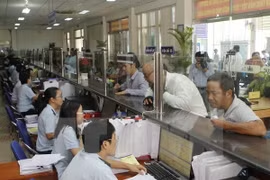
Prime Minister asks ministries to drastically cut red tape ảnh 1Customs officials check imported goods at Coc Nam Custom Sub-Department in the Lang Son border area. (Source: VNA)

Hanoi (VNS/VNA) - Prime Minister Nguyen XuanPhuc has asked ministries and sectors to review and submit their plans to cut50 percent of their business conditions before August 15.

This deadline is earlier than the previouscut-off date of October 30 as stipulated in a Government resolution datedJanuary 1.

The plans must include procedures to remove orsimplify regulations on at least half of the goods which are required toundergo special inspection. Each imported or exported product should be managedby a ministry or equivalent unit.

The management method may be changed frompre-check to after-check based on risk management and compliance with laws andregulations of organisations and individuals. Not every cargo will be subjectto inspection, excluding those which are subjected to special quarantine. 

The PM strictly prohibits ministries, agenciesand people’s committees from setting business conditions and inspectionprocedures which are contradictory to laws.

Ministries and ministerial-level agencies in thecourse of project formulation or drafting of legal documents shall have toensure rules are clear and easy to understand and implement. These should notcreate barriers to enter markets and should not force enterprises to incurcosts.

The Ministry of Justice and the GovernmentalOffice take responsibility for verifying legal documents that involveregulations and lists of goods that require special inspections. They will haveto make timely reports to authorities to prevent the issuance of regulationsthat could increase firms’ costs.

Vu Tien Loc, Chairman of the Vietnam Chamber ofCommerce and Industry (VCCI), agreed that there were big shortcomings inspecial inspections. Only 6 percent of products were removed from the specialinspection list. The average inspection time was 76 hours per procedure, threetimes higher than the average level in ASEAN-4 countries, even after reforms.

Loc also said most reform plans simply reviewedand supplemented business regulations in current decrees, while there remainmany unsuitable business conditions which should be removed or amended. 

Ministries are required to report on the numberand list of goods under special inspection as well as business conditionsquarterly. Each quarter, they must explain whether business regulations haveincreased or fallen.

In addition, the PM asked ministries andagencies to announce the results of administrative procedure simplification andeconomic benefits after the removal.

The Ministry of Planning and Investment in cooperationwith other ministries will review conditions to announce on the nationalinformation portal on business registration.

Earlier, on July 13, Minister - Chairman of the GovernmentOffice Mai Tien Dung said the reforms have been slower than the Prime Ministerrequested.

There are still delays in implementing specificsolutions to simplify administrative procedures and improve the businessenvironment in ministries and agencies.

According to VCCI, as of June 20, only theMinistry of Industry and Trade (MoIT) had issued a decree guiding thecutting of business conditions under its management, while other ministriessuch as the Ministries of Agriculture and Rural Development, Construction,Finance, Health and Natural Resources and Environment are still building theplans.

Specifically, the MoIT submitted a decree to cut675 regulations out of a total of 1,200. The Ministry of Health submitted adecree on alternative food safety management, reducing the amount of importedcargo subject to food safety inspection by 95 percent.

Throughout the VCCI’s survey, many businessesexpressed that some proposals to reduce and simplify business conditions do notmake much sense for businesses and their effect is negligible.

For example, most conditions relating topersonal identity such as ‘have civil act capacity’ are proposed to beabolished. In fact, this condition does not have any effect because businessesonly recruit people who have full civil act capacity.

Recently, seven associations including the VietnamAssociation of Seafood Exporters and Producers (VASEP), Food and FoodstuffAssociation of HCM City, Vietnam Dairy Association, Food TransparencyAssociation, Phu Quoc Fish Sauce Producing Association, American Chamber ofCommerce in Vietnam and the European Chamber of Commerce in Vietnam sentrecommendations related to the State management of product and service qualityconcerning the sector of health and healthcare, agriculture, science andtechnology to the Government.

The VCCI recommends within each ministry,ministers do not authorise departments that perform licensing to be the leadagency in drafting the administrative reform plan as these agencies will wantto retain their power. The reform provisions should be assigned to independentunits, responsible to ministers and consult with other relevant agencies.-VNS/VNA
VNA
See more

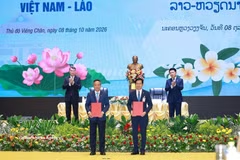
Vietnamese Prime Minister Le Minh Hung and Lao Prime Minister Saleumxay Kommasith witness the presentation of investment certificates and investment cooperation agreements between businesses of the two countries. (Photo: VNA)

Vietnam, Laos strengthen “strategic cohesion” in economic sector

The great friendship, special solidarity, comprehensive cooperation and strategic cohesion between Vietnam and Laos, and between Laos and Vietnam, are an invaluable asset of the Vietnamese and Lao Parties, States and people. It is the responsibility of today's generation to transform this invaluable political asset into new resources for the development of the two countries’ people.

West Food Hau Giang JSC’s factory at the Nam Song Hau Industrial Park – Phase 1, Can Tho city (Photo: VNA)

Southern industrial property market enters new phase of competition

Industrial site selection was previously driven largely by land prices, location and access to markets. However, as supply chains become more complex and manufacturing projects face higher technical requirements, businesses are increasingly assessing sites based on their long-term operational capabilities.

Members of the RoK delegation visit booths showcasing signature agricultural products of Da Lat – Lam Dong. (Photo: VNA)

Lam Dong seeks stronger economic, tourism links with RoK

Lam Dong is particularly interested in sectors in which Korean businesses have strengths, including agriculture, green energy, the circular economy, high-quality tourism, healthcare, education, human resources training and digital transformation, an official said.

Illustrative image (Photo: EVNNPT)

EVNNPT seeks over 224 mln USD in bank loans for grid expansion

Three projects account for part of the financing need, including 13.3 million EUR for the 220kV Ung Hoa substation and connection lines, 18.6 million EUR for the 220kV Tan Viet substation and the 220kV Tan Viet–Gia Loc–Pho Noi line, and 35.3 million EUR for the 220kV substation connecting the Dong Anh–Van Tri transmission line.

At a farm produce supermarket in Hue city (Photo: VNA)

Inflation control key to maintaining growth momentum

Average consumer price index (CPI) rose 4.52% in the first nine months, roughly in line with the National Assembly (NA)'s full-year target, while core inflation climbed 4.26%, the National Statistics Office (NSO) reported. CPI in some localities ran above the national average, including economic hubs Hanoi and Ho Chi Minh City.

According to experts, Vietnam’s relatively attractive valuation could help draw active investors. (Photo: VNA)

Capital-market channels widened after FTSE upgrade: expert

Vietnam officially entered FTSE Russell’s Secondary Emerging Market category on September 21 after reforms to trading, settlement and foreign-investor access. The reclassification gives Vietnamese equities access to a much larger pool of international capital, but also puts them in direct competition with other emerging markets.

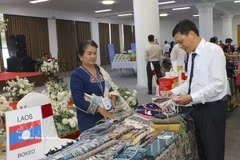
Lao products are promoted at a trade fair in Dien Bien province in September 2026. (Photo: VNA)

Vietnam, Laos seek to expand room for trade, investment cooperation

Vietnam and Laos aim to boost bilateral trade in 2026 towards the milestone of 10 billion USD by 2030, a target said to be challenging but feasible as both Governments work to remove trade barriers, improve border-trade mechanisms, and strengthen transport and logistics connectivity.

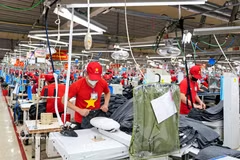
At a garment company in Bac Ninh city. (Photo: VNA)

Bac Ninh maintains its lead nationwide in import-export scale

Exports totaled almost 87.5 billion USD while imports hit 90.3 billion USD. The figures show output at the electronics manufacturing hub is still expanding. They also underscore the need for local companies to build capacity and capture more value in supply chains.

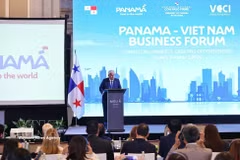
Panamanian President José Raúl Mulino speaks at the Panama-Vietnam Business Forum on October 7 in Hanoi. (Photo: VNA)

Vietnam, Panama seek to expand economic cooperation

In the presence of President Mulino, VCCI and the Chamber of Commerce, Industries and Agriculture of Panama signed a memorandum of understanding (MoU) to strengthen cooperation, enhance trade and investment promotion programmes, and support bilateral investment and trade.

Ministry updates on Vietnam-US reciprocal trade agreement talks

Ministry updates on Vietnam-US reciprocal trade agreement talks

The US is one of Vietnam’s major trading partners and holds paramount importance to the country’s exports. The conclusion of the bilateral trade agreement will help establish a stable and balanced trade framework toward sustainable development and open up greater opportunities for cooperation between the two countries.