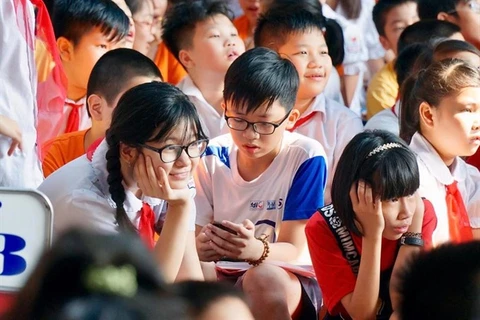
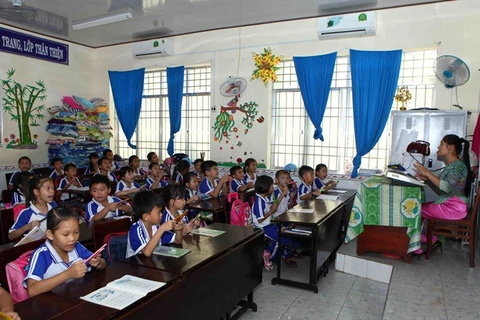
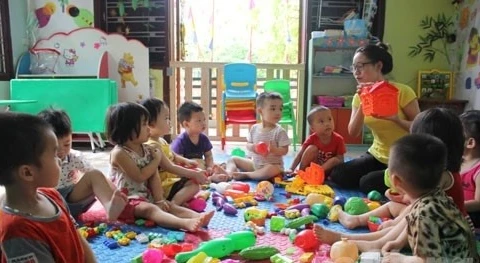
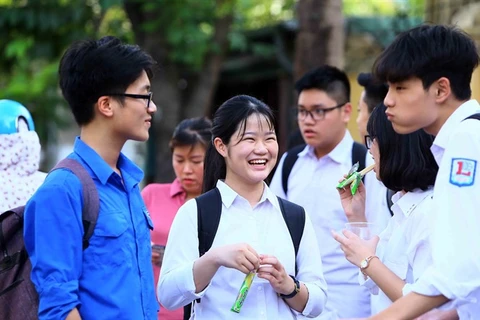
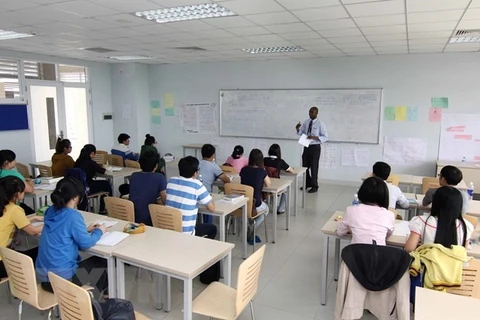
Inside Hong Bang International University (Photo: VNA)
 HCM City (VNS/VNA) - The Government recognises the importance of private schools to development of the national education system, Chairman of the National Assembly’s Committee for Culture, Education, Youth and Children Phan Thanh Binh has said.
“Private and public schools are the two wings of education,” Binh said at a forum held at Hong Bang International University in Ho Chi Minh City on May 6.
“They [private schools] also create a lever to lift public schools in development,” he said, adding that the country has issued legal policies to develop private education.
Dr Do Van Xe, Rector of Hung Vuong University, said that amended laws on higher education have helped remove barriers that private schools have faced.
“I have taken advantage of more open regulations in the amended laws, for example, to create training programmes meeting learners’ demands and to help lecturers become more creative in their teaching,” Xe said.
Such training and teaching can attract more students, he added.
With the contribution of private schools, the education sector in the country has become “competitive”, he said. “Quality is the decisive element in the competition.”
Dr Thai Ba Can, deputy general director on higher education development at Nguyen Hoang Group, and chairman of board of directors of the Hoa Sen University, said that many large enterprises had invested in education. They have focused on building modern facilities and training programmes meeting international standards, and have brought advanced training programmes from other countries to Vietnam.
Dr Dam Quang Minh, Rector of Phu Xuan University in Thua Thien-Hue province, said that although the Government recognises private schools as of one of “two wings” in education development, the difference between the two wings still exists, meaning that private schools have not been treated fairly as public schools.
In HCM City, for instance, the number of private schools has been increasing in both inner and outlying districts over the last five years to meet the burgeoning demand caused by overcrowding of public schools.
Many parents like Nguyen Thi Ly of district 2 do not want their children to study in a classroom with more than 50 students, a common occurrence in public schools.
Ly, who has a son who will enter first grade next year, is finding out about private schools in the vicinity.
Nguyen Thi Huong of Tan Phu district has moved her two children from a local public school to a private school, fearing the teaching methodology do not enable them to develop their comprehension skills.
These parents are willing to pay higher fees at private schools in exchange for the better and more modern facilities they offer and the small number of students in each classroom.
Ten years ago, private schools’ main aim was to create an environment for improving their students’ English, but that has changed now to soft skills and developing students’ talents and creativity, and curriculums are based on this now.
Dr Huynh Cong Minh, Chairman of the Founding Committee of EMASI School, told Sai Gon Giai Phong (Liberated Sai Gon) newspaper that, unlike public schools, private school teachers create conditions for students to be creative and curious.
For instance, they let their students solve math problems while teachers at public schools guide their students step by step as regulated by the Ministry of Education and Training.
Recently, many private schools have set up counselling boards to help improve the capacity of their teachers and assist principals and managers with adopting proper methodologies.
To meet the increasing demand, many private schools are opening more branches around the city.
The Asian International School is opening a campus in district 2’s Thao Dien ward in August.
The Vietnam Australia International School has eight campuses in districts 2, 3, 7, 10, Phu Nhuan, and Go Vap.
The paper quoted an unnamed Department of Education and Training official as saying the number of admissions at private schools has increased in the last few years.
In recent years, a number of universities have established or bought out schools to create a feeder system.
Tan Tao University, a private non-profit university in Long An province, opened along with a high school in 2010 for this purpose. But the school is not well known.
In September this year, Ton Duc Thang University will enroll students from grades 10 to 12 in its Vietnam Finland International School.
Its entire teaching equipment and aids have come from Finland and cost more than 25 million USD.
But according to a school spokesperson, the goal is not only to absorb the students directly into Ton Duc Thang University, but also to offer Vietnamese children good education.
Besides, the school will provide a place for the university’s teachers training students to gain practical experience.
In April, the HCM City University of Technology announced it had bought Royal International School in District 7, which was established in 2011 with an international bilingual model and training programme based on British curriculums.
Nguyen Tat Thanh University and others are scouting around for investing in buying out high schools.
Hoang Ngoc Vinh, former director of the Ministry of Education and Training’s vocational training department, said: “Universities should be encouraged to invest in school education if they can ensure quality in both their school and higher education systems.”
Some universities buy schools purely for commercial reasons, he added.
Pham Thai Son, director of the HCM City University of Food Industry’s admission and communication centre, said a university investing in schools is better than other investors doing so.
“It will really be a threat to education if investors … mainly invest to promote their brand … and then sell it again to recover the investment.”
It would be good only if education is placed at the forefront and not return on investment, he said.-VNS/VNA
“Private and public schools are the two wings of education,” Binh said at a forum held at Hong Bang International University in Ho Chi Minh City on May 6.
“They [private schools] also create a lever to lift public schools in development,” he said, adding that the country has issued legal policies to develop private education.
Dr Do Van Xe, Rector of Hung Vuong University, said that amended laws on higher education have helped remove barriers that private schools have faced.
“I have taken advantage of more open regulations in the amended laws, for example, to create training programmes meeting learners’ demands and to help lecturers become more creative in their teaching,” Xe said.
Such training and teaching can attract more students, he added.
With the contribution of private schools, the education sector in the country has become “competitive”, he said. “Quality is the decisive element in the competition.”
Dr Thai Ba Can, deputy general director on higher education development at Nguyen Hoang Group, and chairman of board of directors of the Hoa Sen University, said that many large enterprises had invested in education. They have focused on building modern facilities and training programmes meeting international standards, and have brought advanced training programmes from other countries to Vietnam.
Dr Dam Quang Minh, Rector of Phu Xuan University in Thua Thien-Hue province, said that although the Government recognises private schools as of one of “two wings” in education development, the difference between the two wings still exists, meaning that private schools have not been treated fairly as public schools.
In HCM City, for instance, the number of private schools has been increasing in both inner and outlying districts over the last five years to meet the burgeoning demand caused by overcrowding of public schools.
Many parents like Nguyen Thi Ly of district 2 do not want their children to study in a classroom with more than 50 students, a common occurrence in public schools.
Ly, who has a son who will enter first grade next year, is finding out about private schools in the vicinity.
Nguyen Thi Huong of Tan Phu district has moved her two children from a local public school to a private school, fearing the teaching methodology do not enable them to develop their comprehension skills.
These parents are willing to pay higher fees at private schools in exchange for the better and more modern facilities they offer and the small number of students in each classroom.
Ten years ago, private schools’ main aim was to create an environment for improving their students’ English, but that has changed now to soft skills and developing students’ talents and creativity, and curriculums are based on this now.
Dr Huynh Cong Minh, Chairman of the Founding Committee of EMASI School, told Sai Gon Giai Phong (Liberated Sai Gon) newspaper that, unlike public schools, private school teachers create conditions for students to be creative and curious.
For instance, they let their students solve math problems while teachers at public schools guide their students step by step as regulated by the Ministry of Education and Training.
Recently, many private schools have set up counselling boards to help improve the capacity of their teachers and assist principals and managers with adopting proper methodologies.
To meet the increasing demand, many private schools are opening more branches around the city.
The Asian International School is opening a campus in district 2’s Thao Dien ward in August.
The Vietnam Australia International School has eight campuses in districts 2, 3, 7, 10, Phu Nhuan, and Go Vap.
The paper quoted an unnamed Department of Education and Training official as saying the number of admissions at private schools has increased in the last few years.
In recent years, a number of universities have established or bought out schools to create a feeder system.
Tan Tao University, a private non-profit university in Long An province, opened along with a high school in 2010 for this purpose. But the school is not well known.
In September this year, Ton Duc Thang University will enroll students from grades 10 to 12 in its Vietnam Finland International School.
Its entire teaching equipment and aids have come from Finland and cost more than 25 million USD.
But according to a school spokesperson, the goal is not only to absorb the students directly into Ton Duc Thang University, but also to offer Vietnamese children good education.
Besides, the school will provide a place for the university’s teachers training students to gain practical experience.
In April, the HCM City University of Technology announced it had bought Royal International School in District 7, which was established in 2011 with an international bilingual model and training programme based on British curriculums.
Nguyen Tat Thanh University and others are scouting around for investing in buying out high schools.
Hoang Ngoc Vinh, former director of the Ministry of Education and Training’s vocational training department, said: “Universities should be encouraged to invest in school education if they can ensure quality in both their school and higher education systems.”
Some universities buy schools purely for commercial reasons, he added.
Pham Thai Son, director of the HCM City University of Food Industry’s admission and communication centre, said a university investing in schools is better than other investors doing so.
“It will really be a threat to education if investors … mainly invest to promote their brand … and then sell it again to recover the investment.”
It would be good only if education is placed at the forefront and not return on investment, he said.-VNS/VNA
VNA