Promising potential for using seaweed to treat Alzheimer's

Scientists from the Institute of Biotechnology under the Vietnam Academy of Science and Technology have successfully developed 69 extracts from 11 species, belonging to eight genera of seaweed for dietary use in Alzheimer's treatment.

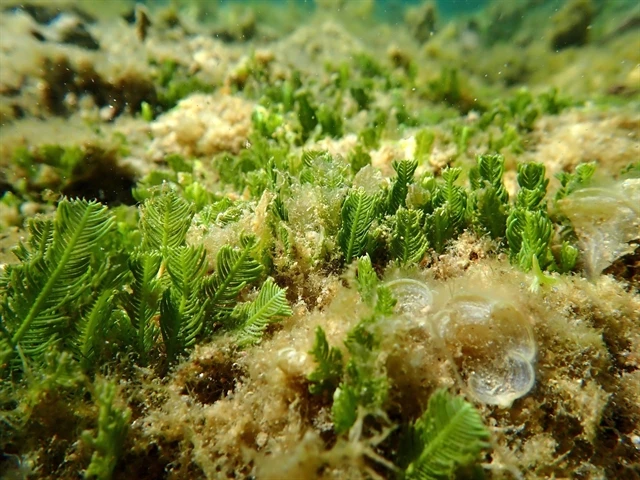
Seaweed and seagrass ecosystem in Nui Chua National Park's Marine Protected Area in Ninh Hai District, the coastal south-central province of Ninh Thuan. (Photo: VNA)

Hanoi (VNS/NA) - Scientists from the Institute of Biotechnology under the Vietnam Academy of Science and Technology have successfully developed 69 extracts from 11 species, belonging to eight genera of seaweed for dietary use in Alzheimer's treatment.

The achievement stems from the project 'Neuroprotective effects against Alzheimer's disease by some Vietnamese seaweed species'.

Within the scope of their research, seaweed from the eight genera, Ulva, Kappaphycus, Sargassum, Eucheuma, Gracilariopsis, Caulerpa, Gracilaria and Palzheimerina were examined.

Significantly, for the first time, the molecular mechanisms of action of fucoxanthin (a natural compound derived from brown seaweed) isolated from S. oligocystum (a widespread species in many Asian and American coastal regions) and ethanol extracts from Sargassum spp. (a genus of floating seaweed in the Sargassaceae family) were studied.

The compounds were found to possess antioxidant properties, inhibit AChE (acetylcholinesterase) and protect against cellular toxicity in an Alzheimer's-induced model using H2O2 on C6 nerve cell lines.

Professor Dang Diem Hong, the project leader, said that the research demonstrated that fucoxanthin extracted from S. oligocystum and 96% ethanol extract (with ultrasound) from Sargassum spp. are safe regarding acute and sub-chronic toxicity and can improve cognitive decline caused by scopolamine (similar to donepezil at a dose of 5 mg/kg body weight in mice) in experimental animal models.

The research team has published two scientific papers in international SCI-E indexed journals, one paper in a national journal (VAST02), presented one report at the ISS2023 international conference, and delivered a full paper at the 2022 National Biotechnology Conference.

The project received excellent evaluation and classification from the Vietnam Academy of Science and Technology.

With these promising results, Hồng hoped that the research project could continue and be tested to refine the natural, nutrient-rich health-protective products.

"The endeavour aims to contribute effectively to the treatment of Alzheimer's patients and those working under strenuous conditions in Vietnam in the near future," she said.

Vietnam has its extensive coastline spanning 3,260km and abundant biodiversity in both marine and non-marine resources.

The country has documented 878 seaweed species, consisting of 439 species of red algae (Rhodophyta), 196 green algae (Chlorophyta), 156 brown algae (Ochrophyta-Phaeophyceae), 87 cyanobacteria (Cyanophyta) and 15 seagrass species.

Genera such as Caulerpa, Sargassum, Gracilaria, Ulva, Kappaphycus and Eucheuma are economically important seaweed genera with substantial natural cultivation and extraction capabilities, yielding high outputs.

They provide a rich source of natural ingredients, suitable for food use and extraction of biologically active compounds, including those with neuroprotective effects and memory enhancement for humans.

Alzheimer's disease

Alzheimer's disease is one of the most common causes of memory decline in the elderly, typically appearing between the ages of 50 to 65.

It is characterised by the progressive loss of nerve cells and certain brain regions.

The disease tends to worsen over time, impacting daily activities, memory, language and cognitive functions of patients.

According to the academy, the number of Alzheimer's patients is expected to exceed 100 million by 2050.

Currently, there is no complete cure for the disease, while treatments mainly focus on early detection and prevention.

Prescription drugs used in the treatment and management of Alzheimer's (such as rasagline, rivastigmine and donepezil) are primarily related to inhibiting cholinesterase and β-secretase (BACE-1) enzymes, or inhibiting the N-methyl-D-aspartate (NMDA) receptor with memantine.

However, these drugs can have side effects such as nausea, vomiting, dizziness, liver toxicity and gastrointestinal disorders.

Consequently, a promising future treatment direction is the use of natural products rich in nutrients, with neuroprotective activity and fewer or no side effects compared to synthetic drugs./.

VNA

See more

Poor patients under treatment at the Ninh Thuan General Hospital receive meals from the "Hieu va Thuong" charity kitchen. (Photo: VNA)

Charity kitchen lends a hand to feed needy patients

For nearly two decades, the charity kitchen “Hieu va Thuong” (Understanding and Compassion) at the Ninh Thuan General Hospital, Khanh Hoa province, has kept its fires burning daily, providing free meals for poor patients and their relatives.

A working delegation from the Fire Prevention, Fighting and Rescue Police Department under the Ministry of Public Security pays a visit to Bratislava from March 9–12. (Photo: VNA)

Vietnam, Slovakia boost cooperation in firefighting and rescue

During the visit, the delegation led by Deputy Director of the department Colonel Hoang Ngoc Huynh worked with several Slovak institutions, including the command of the Fire and Rescue Force in Bratislava, an automobile installation and repair centre under the Ministry of Interior of Slovakia, and the Lest military training centre.

A transport infrastructure project in Ho Chi Minh City (Photo: VNA)

Ho Chi Minh City steps up actions to unlock private sector growth

Ho Chi Minh City’s authorities and businesses operating in the southern metropolis have stepped up strategic orientations and concrete action programmes to translate Resolution No.68-NQ-TW of the Politburo into practice and create conditions for the private sector to make breakthroughs and become a key growth driver.

Swiss Ambassador to Vietnam Thomas Gass (Photo: VNA)

Swiss ambassador hails Vietnam's 2026 election as milestone

The March 15 election is expected to be an important milestone for Vietnam. It is not only a constitutional exercise but also a means of ensuring that policies adopted at both national and local levels are enforced with a strong focus on citizens’ interests, said Swiss Ambassador to Vietnam Thomas Gass.

President of the Vietnamese Association in Mexico Nguyen Huu Dong (Photo: VNA)

Mexico-based scholar unveils ideas to optimise Vietnamese NA’s efficiency

Talking with Vietnam News Agency correspondents in Mexico City, Dong pointed to important strides in the NA’s outgoing tenure, including improvements to the institutional framework, operating methods and stronger oversight of major national issues. In his view, the NA has increasingly asserted its role as the highest representative body of the people and a central pillar in the process of building a socialist rule-of-law state.

The Cai Mep Ha free trade zone in Ho Chi Minh City currently has four seaports and four inland waterway ports in operation (Photo: VNA)

Strategic infrastructure – key driver for Ho Chi Minh City’s economic growth

Rapid population growth and urban expansion have exposed limitations in Ho Chi Minh City’s infrastructure, particularly traffic congestion at key gateways and in central areas. In response, the city is steeping up investment in major projects to improve connectivity, expand urban space and remove development bottlenecks.

Illustrative image: Authorities strengthen control at the Dinh Ba International Border Gate to prevent illegal entry and exit. (Photo: VNA)

Authorities warn against hiring foreign workers violating immigration rules

Investigations revealed that several foreign nationals had been sponsored by two companies headquartered in Ho Chi Minh City to apply for temporary residence cards under the category of investors. However, the individuals were not genuine investors but had completed procedures through intermediaries in order to remain in Vietnam.

Illustrative image (Photo: VNA)

Hanoi promotes family values to mark International Day of Happiness

The activities will take place from March 15 to 21, with the peak on March 20. The highlight will be a launch ceremony for the 2026 International Day of Happiness, calling on authorities at all levels, organisations and the community to join hands in building safe, equal and progressive family environments, while promoting love, sharing and responsibility among family members.

Delegates and students pose for a commemorative photo. (Photo: baocantho.com.vn)

Four more Can Tho schools earn French education accreditation

The recognition of six schools under the Label FrancEducation programme is expected to create momentum for expanding education cooperation between French and Can Tho institutions, contributing to human resources development and friendship between the two countries.