Quang Ninh: 108 million USD for infrastructure development in Ha Long city

Ha Long city in the northern coastal province of Quang Ninh has planned to spend 2.5 trillion VND (nearly 108 million USD) on 57 public works, especially transport infrastructure projects, in 2020.
Quang Ninh: 108 million USD for infrastructure development in Ha Long city ảnh 1Ha Long - Van Don expressway (Photo: VNA)
Quang Ninh (VNA) – Ha Long city in the northern coastal province of Quang Ninhhas planned to spend 2.5 trillion VND (nearly 108 million USD) on 57 public works,especially transport infrastructure projects, in 2020.

Accordingly, the construction of Tran Quoc Nghien coastal ring-road wasre-started after the Lunar New Year Festival and is expected to be completed inApril this year, creating a new tourism space in the city.

As many as 950 billion VND has been invested in upgrading and expanding streetsin Hong Hai and Hong Ha wards, connecting main transport routes.

Sidewalks for pedestrians in Dang Ba Hat street will be upgraded with a totalcost of 210 billion VND.

Additionally, the October 30 Square, the fishing port at Cao Xanh ward, and waterdrainage and lighting systems in the city will be also upgraded.

The city is resolved to complete on schedule land clearance work for keyprojects such as bridges Cua Luc 1 and Cua Luc 3, and roads connecting the HaLong – Van Don expressway and Hoanh Bo district, with the aim of promotingdevelopment in far-flung areas.

The municipal authority has also coordinated with relevant agencies to accelerateland clearance work for projects launched last year.

Ha Long city is angling to become a smart tourism city.

It plans to apply technologies in various sectors including health, education, governance, transport, finance-banking and taxation with an aim to provide convenient services to people and businesses.

Authorities plan to accelerate the smart city development process and make the city a modern metropolis by 2020.

Five smart-city projects have investment for the 2017-20 period, including plans to upgrade lighting system, set up online tax collection system and technology application in urban management and improve tourism safety on Ha Long Bay.

According to Nguyen Ngoc Son, chairman of the Ha Long city People’s Committee, authorities have completed drawing up plans of these projects.

Nearly 3,500 Light Emitting Diode (LED) lamps have been installed on 18 key roads of the city.

Le Thanh Quynh, deputy head of the city’s public service management board said a public lighting controlling centre has been built to supervise the operation of the city’s lighting system.

The LED lamps help save electricity and more will be installed in the areas far from the city centre, Quynh said.

To develop a smart city, local agencies have piloted smart tax collection system at 34 enterprises to avoid tax losses.

Nguyen Huu Ban, head of the city’s Taxation Department said his agency has applied technology in managing electronic bills of businesses, households and individuals. A total 986 out of 3,607 local enterprises have used electronic bills. More than 3,000 units pay tax online.

The city aims to apply electronic bills at 60 per cent of local businesses by this year and all by 2020.

The city also aims at administrative procedure reform and building e-Government as well as look paperless hospitals.

The provincial general hospital, Obstetrics and Pediatrics Hospital and Bai Chay Hospital are also using electronic health records.

Patients may use hospital-issued cards that show their personal information and health records to book medical check-up appointments.

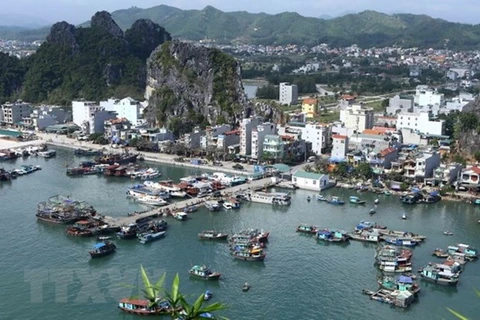
Ha Long City is home to Ha Long Bay which was twice recognised as a UNESCO World Natural Heritage site in 1994 and 2000.

Earlier Prime Minister Nguyen Xuan Phuc approved a master plan to develop the city into a world-class tourism and service hub by 2050.

Under the plan, Ha Long will be converted into a civilised and friendly sea tourism city with synchronous and modern socio-economic infrastructure systems./.

VNA

See more

Illustrative image (Photo: VNA)

Australia announces import conditions for Vietnamese pomelos

Australia’s formal publication provides an important legal basis, marking the completion of the review, assessment and agreement on technical requirements for fresh Vietnamese pomelos. This represents a significant step forward in market access, creating favourable conditions for relevant agencies, localities and businesses to prepare for export activities in the coming time.

Containers of fresh Vietnamese durian for export are subject to a full-chain traceability system. (Photo: VNA)

First “green lane” durian shipment exported to China

​Under the “green lane” process, quality control begins at the cultivation stage, including soil sampling and monitoring, and continues through harvesting and processing, with traceability labels attached to trees and applied to fruit at the time of picking. It also allows plant quarantine procedures and the issuance of certificates of origin (C/O) directly in the localities where the orchards are located.

Delegates at the Vietnam Expo 2026 (Photo: VNA)

Vietnam pushes for deeper auto supply chain ties with RoK

The RoK stood as Vietnam’s largest foreign investor with more than 95.2 billion USD in registered capital as of February 2026, or about 18% of all foreign cash flowing in, with thousands of active projects. In January-February alone, the RoK led the pack with nearly 2 billion USD in pledges, grabbing a whopping 32.7% of total registered capital and showing no signs of slowing down.

More than 600 tourism firms, 15 countries and territories, and 34 provinces and cities are promoting destinations and introducing tourism products at the fair (Photo: VNA)

Digital transformation key to elevating Vietnam’s tourism: official

Speaking at the opening of the Vietnam International Travel Mart (VITM) 2026 in Hanoi on April 10, Deputy Minister of Culture, Sports and Tourism Ho An Phong noted that despite challenges in 2025, Vietnam largely fulfilled its socio-economic development goals. Tourism remained a bright spot, recording 21.5 million foreign arrivals and 135.5 million domestic visitors, with total revenue exceeding 1 quadrillion VND (37.9 billion USD).

A drone sprays fertiliser over rice fields. (Photo: VNA)

Low-altitude economy emerges as new growth driver for Vietnam

The UAV technology is particularly effective in addressing challenges faced by ground infrastructure, especially in densely populated urban areas and remote regions. Smart aerial devices also enable real-time data collection, improving governance, decision-making and digital transformation across industries.

Passengers at Cat Bi Airport in Hai Phong city (Photo: VNA)

Aviation sector ensures fuel supply for April 30–May 1 peak

Aviation fuel suppliers are actively negotiating and diversifying supply sources both domestically and internationally, while strengthening coordination, storage and distribution capacity to meet immediate demand. These efforts aim to support airlines in optimising operations and maintaining stable flight schedules.