Quang Ninh appraises biodiversity preservation plan

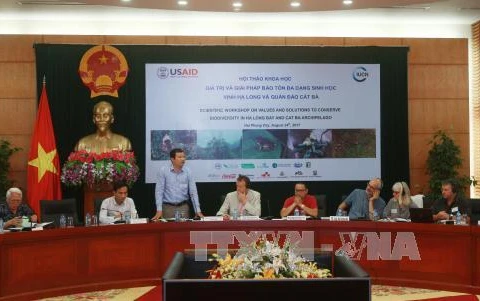
The north-eastern border province of Quang Ninh has held a meeting to appraise its biodiversity preservation plan through 2020, with a vision toward 2030.
Quang Ninh appraises biodiversity preservation plan ảnh 1A corner of Bai Tu Long (Photo VNA)

Hanoi (VNA) –
The north-easternborder province of Quang Ninh has held a meeting to appraise its biodiversitypreservation plan through 2020, with a vision toward 2030. 

The plan aims to promote biodiversitypreservation and development, especially the natural ecosystem and rare species,to serve sustainable development, environmental protection, climate changeadaptation, and ensure ecological security.

The province hopes to increase the forestcoverage by 55 percent by 2020 and 58 percent by 2030 and will prioritise theprotection of endangered species.

The plan will be carried out in three phases. In2018-2020, Quang Ninh will upgrade existing nature reserves and establish DongRui – Tien Yen wetland nature reserves, and Co To and Dao Tran marine naturereserves.

The province will launch Dong Son-Ky Thuong, YenTu and Bai Tu Long floral gardens and Bai Tu Long and Dong Son-Ky Thuong faunagardens in 2021-2025, along with mountainous and maritime biodiversitycorridors and Quang Hanh limestone nature reserve. 

The plan also sets measures for implementationregarding capital, human resources training, science-technology, policymechanisms, information communication, and livelihood improvement.

Vice Chairman of the provincial People’sCommittee Dang Huy Hau suggested reviewing the proposals to expand areas forthe Dong Son-Ky Thuong nature reserve and forecast risks and difficulties inimplementing the project such as socio-economic development speed, decliningwater resources in some lakes, and the extinction of rare species.

He stressed the need to implement the project toprotect the environment, preserve biodiversity and develop the local economy.

The official urged the consultant companyinvolved to complete the plan before November 15, 2017.

Quang Ninh is home to 4,350 species of fauna andflora, including 154 species listed in Vietnam’s Red Book. However, localecological systems are being damaged by human activities. Tigers, bears andhorses have vanished from the province while coral reefs have been spoilt.

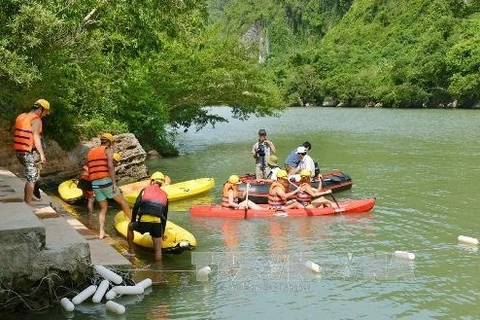
The province’s Bai Tu Long National Park, namedthe 38th ASEAN Heritage Park in 2017, has saved, taken care of and released tonature over 200 forest animals and five sea turtles. It has also worked withinternational organisations to preserve sea turtles, enhanced management capacityand biodiversity conservation, and supported eco-tourism and environmentaleducation.-VNA
VNA

See more

Official heritage plaque i sinstalled on the 12 recognised Shan Tuyet tea trees in Dong Phuc commune. (Photo: VNA)

Thai Nguyen: 12 ancient Shan Tuyet tea trees win national heritage status

The recognition honours the biological, cultural and historical values of these centuries-old Shan Tuyet tea trees – natural treasures deeply woven into the livelihoods, traditions and identity of local ethnic communities. The title affirms the community’s commitment to preserving and promoting the value of this iconic local tea variety.

Sarus cranes at Tram Chim National Park (Photo: VNA)

Return of sarus cranes: Hope takes wing in Dong Thap wetland

Beneath the wide Mekong Delta sky, Tram Chim National Park is racing against time, pouring heart and science into a decade-long (2022–2032) plan to rescue the Eastern sarus crane – an elegant, scarlet-headed bird listed as endangered on the International Union for the Conservation of Nature (IUCN) Red List and a living emblem of both the park and all of Dong Thap province

French Ambassador Olivier Brochet speaks at the press conference in Hanoi on December 11 to mark the 10th anniversary of the Paris Agreement on climate change and highlighting the COP30 outcomes. (Photo: VNA)

International community ready to support Vietnam in energy transition, climate response

In a video message to the press conference, UN Resident Coordinator in Vietnam Pauline Tamesis said the UN is ready to support Vietnam in building a pipeline of projects capable of absorbing financing mobilised under the Political Declaration on establishing the Just Energy Transition Partnership (JETP), as well as from global climate finance sources, including the Green Climate Fund and the Loss and Damage Fund.

Forest rangers in Son La province apply technological devices and software to forest management, monitoring, and protection. (Photo: nhandan.vn)

Digital technology application enhances forest management, protection

With a total forest area of over 14 million hectares, including more than 10 million hectares of natural forests, forests exist in all 34 provinces and cities across the country. Given the large area and limited workforce, applying digital solutions in forest management and protection has become a top priority for the forestry sector.

Sunda pangolins (Manis javanica), also known as the Javan pangolin, are listed in Group IB – critically endangered and strictly protected from all commercial exploitation (Photo: VNA)

Quang Ngai releases rare pangolin back into nature

Initial verification showed that the animal weighed 3.7kg and measured over 60cm. It was identified as a Sunda pangolin (Manis javanica), also known as the Javan pangolin, listed in Group IB – critically endangered and strictly protected from all commercial exploitation.

Residents of Tuyen Quang province take part in the One Billion Trees Programme. (Photo: VNA)

Tree-planting programme exceeds one-billion-tree goal

The total comprises 573.9 million scattered trees and 865.2 million trees grown in concentrated plantations, equivalent to 429,125 hectares of forest. Provinces posting the strongest results include Phu Tho with 177.9 million trees, Lao Cai with 108.8 million, and An Giang with 98.5 million.

Construction activity is one of the causes of air pollution in Hanoi. (Photo: VNA)

Hanoi takes urgent measures to curb air pollution

The city requires the enhanced application of advanced technologies and remote monitoring systems, including satellite remote sensing, drones, and AI-integrated traffic cameras, to monitor, detect, and strictly address the illegal burning of garbage, straw, and agricultural by-products.