Quang Ninh invests in seven major transport projects

The northeastern province of Quang Ninh has decided to invest in seven major transport projects to promote its socio-economic development in the period of 2020-2022.
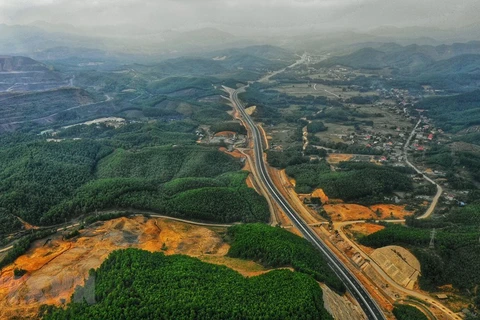
Quang Ninh invests in seven major transport projects ảnh 1A view of Hạ Long-Van Don Expressway in Quang Ninh Province (Source: VNA)

QuangNinh (VNA) - The northeastern province of Quang Ninh has decided toinvest in seven major transport projects to promote its socio-economicdevelopment in the period of 2020-2022.

The totalinvestment capital for these projects is expected to be more than 10.5 trillion(452 million USD).

Mosttransport projects are aimed at connecting traffic, promoting the capacity andefficiency of the newly completed Ha Long-Hai Phong and Ha Long-Van Donexpressways.

Projectsare hoped to improve the province’s transport infrastructure system, thuscontributing to the local socio-economic development and promoting localtourism and border- and marine-economic potential.

Particularly,the transport projects connecting Ha Long city with Hoanh Bo district will havethree bridges. The province will firstly invest in the construction of twobridges of Cua Luc 1 and 3.

Cua Luc 1bridge is designed to have a length of 4.2km and Cua Luc 3 bridge with a lengthof 2.4km. The bridges are expected to be completed in 2022.

These twobridges will meet the travel needs of local people, ensuring traffic in therainy season and reducing the overload on Bai Chay bridge in Ha Long city.

Cua Luc 2bridge is expected to be built in the near future with design of movablebridge to serve maritime traffic.
Quang Ninh plays an important role in the Hanoi-Hai Phong-Quang Ninh economic triangle and serves as a gateway for trade between Vietnam and the Association of Southeast Asian Nations (ASEAN) and China.
The province has made some breakthroughs to develop local infrastructure and meet the burgeoning economic growth.

According to Chairman of the provincial People’s Committee Nguyen Duc Long, it would take the province 10 years to complete its comprehensive, modern transport infrastructure if it only relied on State allocation and local budget. However, Quang Ninh has made a quantum leap with various measures taken to lure private investment.

Thanks to concerted efforts to improve the business climate, within three years, the locality secured 36 trillion VND (1.53 billion USD) in transport projects, three quarters of which were mobilised from the private sector. A line-up of investors have come to the province to branch out key transport projects under build-transfer (BT), build-operate-transfer (BOT), and public-private partnership (PPP) contracts.

Together with other local transport projects such as the Hai Phong-Ha Long and Ha Long-Van Don highways, as well as upgrades to National Highway 18, key projects are hoped to improve the province’s transport infrastructure system, thus contributing to local socio-economic development and promoting local tourism and increasing the potential of border and marine economies.

In addition, the Bach Dang bridge connecting the northern port city of Hai Phong and Quang Ninh was put into operation in early September 2018. It helps shorten the distance from Hanoi to Quang Ninh from 175km to 125km, thus cutting the travel time between the two localities.

Furthermore, the Van Don International Airport, invested at a total cost of nearly 7.5 trillion VND (319.47 million USD), has stayed in the limelight of the local infrastructure system. This is the very first airport project in Vietnam to apply the BOT investment model.

Vice Director of the provincial Department of Transport Bui Hong Minh said that the BOT projects have created momentum to develop tourism, enhance trade exchange, while also improving its competitive capacity and bettering the quality of life for local people.

BOT and PPP investment models should be applied in a flexible manner and local authorities should create a friendly business environment to make Quang Ninh a more attractive destination to powerful investors./.
VNA

See more

Electronic components are produced at a factory in Hanoi. (Photo: VNA)

Hanoi's imports surge 41% in first eight months of 2026

Hanoi aims to achieve average annual export growth of at least 12% during 2026-30, with the city seeking to diversify export markets, boost high-tech and value-added products and reduce reliance on traditional markets.

Ben Thanh Market in Ho Chi Minh City attracts a large numbers of domestic and international visitor.( Photo: VNA)

Vietnam targets 50 million international visitors by 2030

The Ministry of Culture, Sports and Tourism has outlined three scenarios for 2027–2030. Under the high-growth scenario, international arrivals would rise 15–18 percent annually to reach 45–50 million, while domestic tourism would reach around 160 million trips. Total tourism revenue is projected at 80–90 billion USD.

Factories and production facilities in the Chu Lai Open Economic Zone, Da Nang city, are equipped with modern production lines. (Photo: VNA)

Ready-built factories gain from new manufacturing FDI wave

Ready-built factories attracted 73% of new manufacturing FDI in northern Vietnam over the past two quarters, as foreign investment continued to surge at the region's industrial hubs during the first eight months of 2026. The trend points to growing demand for premises that can be put into operation quickly.

Vietnamese durian industry pivots from volume to value

Vietnamese durian industry pivots from volume to value

Durian has morphed from a high-value crop into a strategic Vietnamese export. But as output climbs and importing markets tighten rules on quality, food safety and traceability, the industry must pivot from volume growth to sustainable value chains, better quality and diversified markets.

A display area for Mid-Autumn Festival cakes at a supermarket (Photo: VNA)

Mid-Autumn Festival cake market heats up at affordable end

Industry insiders say competition is no longer just about the cake itself. Product quality, packaging, brand reputation, delivery services and personalisation are increasingly shaping consumer choices in a market crowded with both domestic and foreign players.

Minister of Foreign Affairs Le Hoai Trung (Photo published by VNA)

Vietnam, India set 25 billion USD trade goal

Vietnam and India agreed to make better use of complementary strengths, ease market access difficulties and facilitate business activities toward achieving the 25 billion USD bilateral trade target.

Delegates at the meeting between Vietnamese businesses operating in Cambodia and the Council for the Development of Cambodia (CDC) on September 14. (Photo: VNA)

Vietnamese businesses seek to expand investment in Cambodia

Vietnam currently has 223 investment projects in Cambodia with total registered capital of nearly 3.4 billion USD. Vietnamese companies operate in agriculture, particularly large-scale farming, finance and banking, telecommunications, aviation, processing, trade and services.

Children visit President Ho Chi Minh's hometown and learn about his childhood. (Photo: VNA)

Vietnam's tourism sector faces labour shortage

A 2026 survey by Hoteljob.vn found that nearly 90% of tourism businesses planned to recruit. In Ho Chi Minh City alone, 89.7% of businesses were hiring, while 71.8% said recruitment was difficult or very difficult. The biggest shortages were among frontline workers, particularly in housekeeping, engineering, food service, front-office operations, and kitchens.