Record number of documents adopted within AMM 53: Deputy PM

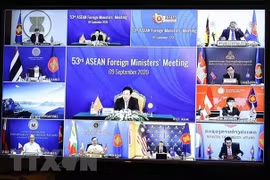
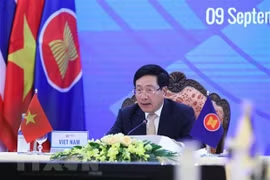
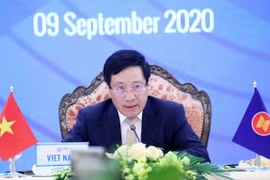
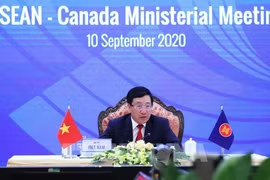
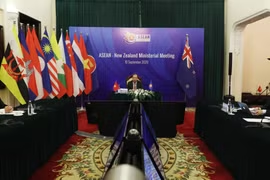
Up to 42 documents have been adopted within the framework of the 53rd ASEAN Foreign Ministers’ Meeting and Related Meetings held from September 9-12 via video conferences, a record in the history of ASEAN foreign ministers’ meetings.
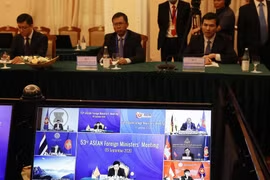
Record number of documents adopted within AMM 53: Deputy PM ảnh 1Deputy PM and Foreign Minister Pham Binh Minh chairs the international press conference (Photo: VNA)


Hanoi (VNA)
– Up to 42 documents havebeen adopted within the framework of the 53rd ASEAN Foreign Ministers’ Meeting and Related Meetings heldfrom September 9-12 via video conferences, a record in the history of ASEAN foreignministers’ meetings.

The figure was announced by Vietnamese Deputy Prime Ministerand Foreign Minister Pham Binh Minh at an international press conference inHanoi on September 12 following the conclusion of the meetings.

Minh said AMM 53 has been a success, which reflects ASEAN’s responsiveness anddetermination that help Vietnam productively organise the video conferences amid the complicated developments of the COVID-19 pandemic.

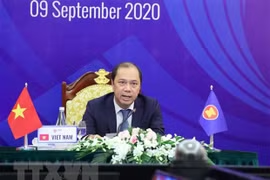
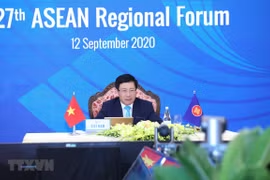
In the framework of AMM 53, the ASEAN foreignministers, guests and partners attended 19 meetings, including AMM 53,Special Session of the ASEAN Coordinating Council Meeting on Sub-regionalDevelopment, the 10th EastAsia Summit Foreign Ministers’ Meeting, the ASEAN Foreign Ministers’ MeetingInterface with ASEAN Intergovernmental Commission on Human Rights (AICHR)Representatives, the ASEAN  MinisterialDialogue on Strengthening Women’s Role for Sustainable Peace and Security, andthe 27th ASEAN Regional Forum.

Forty two documents have been adopted, the biggestnumber of documents adopted in the history of ASEAN Foreign Ministers’ Meetings.They include the Joint Communique' of AMM 53 and the ARF Hanoi Plan ofAction II (2020-2025).

The ASEAN Foreign Ministers continued affirm strong determinationand commitment to fully and effectively implementing goals and priorities onthe spirit of “Cohesive and Responsive” ASEAN 2020.

In parallel with that are efforts to containthe COVID-19 pandemic, ASEAN needs to  supportthe people and businesses to overcome the consequences of the disease, step bystep recover the economy and return their life to normal.

The ministers affirmed the determination to maintainSoutheast Asia as a region of peace, security, neutrality and stability whilestrengthening ASEAN’s centrality, unity and resilience, and promoting trust building, mutual respect and the rule of law in line with the spiritof the Foreign Ministers' Statement on the occasion of marking the 53rd founding anniversary of ASEAN on August 8, 2020.

Participants discussed measures to strengthenpartnerships of ASEAN for peace and sustainable development. Partnerscontinue support the central role of ASEAN in shaping an open, inclusive,transparent and rules-based regional architecture.

They affirmed that ASEAN and partners will continuepromoting effective cooperation in responding to emerging challenges, including theCOVID-19 pandemic and promoting comprehensive recovery.

ASEAN agreed to grant the status of development partnership to France and Italy, while admitting Columbia and Cuba in the ASEAN’s Treaty onAmity and Cooperation (TAC).

During the meetings, participants discussednon-traditional security challenges, such as terrorism, transnationalcrime, natural disasters and climate change, as well as international andregional issues of common concern.

The ministers reiterated ASEAN's principled position and emphasised the importance and benefits of peace, security, stability and freedomof navigation and aviation in the East Sea, which is the common benefits of allcountries and supported by ASEAN partners.

They affirmed the parties needto promote dialogue; build trust; and refrain from the acts that furthercomplicate the situation; and avoid militarisation, use or threat to use force; settle disputes through peaceful measures on the basis of international law,including the 1982 UNCLOS.

They expressed the hope the DOCwill be fully and effectively implemented and urged parties to soon finalise an effective and efficient COC in accordance with international law.

ASEAN Secretary-General LimJock Hoi spoke highly of Vietnam’s comprehensive and professional preparations and productive outcomes of AMM 53, with the biggest number ofdocuments adopted within the framework of ASEAN Foreign Ministers’ Meetings so far.

“Digital meetings, video conferences do not stop us creating an environment to produce one of the most productive meetings of ASEANforeign ministers,” he said, adding “this is the testament that we are able to dothis without face-to-face meeting.”

Minh said, as the ASEAN Chair 2020, Vietnam is actively preparing for the 37th ASEAN Summit slated for November this year, though the developments of the COVID-19pandemic are unpredictable.

Vietnam is exerting its utmost efforts to curb theCOVID-19 pandemic, Minh said, expressing his hope that ASEAN nations andpartners will overcome the pandemic so that ASEAN foreign ministers will beable to meet face-to-face in the upcoming 37th ASEAN Summit./.

VNA

See more

An overview of the ASEAN Leaders’ Interface with Representatives of the ASEAN Inter-Parliamentary Assembly (AIPA) in Manila on November 15 (Photo: VNA)

Vietnam proposes three key directions for ASEAN-AIPA cooperation

Prime Minister Le Minh Hung affirmed that close and effective coordination between the governments and parliaments of member states is a foundation and important driving force for ASEAN to realise its vision of a united, resilient, dynamic and people-centred community.

ASEAN signs Digital Economy Framework Agreement

ASEAN signs Digital Economy Framework Agreement

The Digital Economy Framework Agreement (DEFA), the bloc’s first standalone and legally binding digital economy agreement, establishes common rules covering digital trade, cross-border data flows, electronic payments, cyber security and artificial intelligence (AI).

An overview of the ASEAN Foreign Ministers’ Meeting on November 14, 2026 (Photo: VNA)

Vietnam backs ASEAN culture of consultation, dialogue, preventive diplomacy

Deputy Minister of Foreign Affairs Dang Hoang Giang stressed that amid conflicts and instability in various parts of the world, ASEAN should give top priority to strengthening the foundations of peace and stability, uphold the rule of law and promote the bloc’s principles and norms of conduct, particularly the Treaty of Amity and Cooperation in Southeast Asia (TAC).

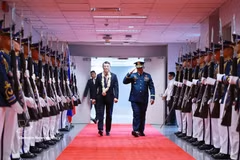
The welcome ceremony for Prime Minister Le Minh Hung at Ninoy Aquino International Airport on November 14 afternoon (Photo: VNA)

Vietnamese PM arrives in Philippines for 49th ASEAN Summit

PM Le Minh Hung’s attendance underscores Vietnam's sustained commitment to the bloc, which aligns consistently with the foreign policy set forth by the 14th National Party Congress, which defines ASEAN as a bloc of strategic importance and a top priority in Vietnam’s external relations.

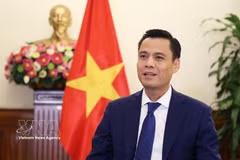
Deputy Minister of Foreign Affairs Dang Hoang Giang. Photo: VNA

Vietnam aims to promote ASEAN unity, resilience and practical cooperation: Deputy FM

Prime Minister Le Minh Hung's attendance at the 49th ASEAN Summit and related summits in Manila, the Philippines, from November 14-17 aims to concretise Vietnam's foreign policy of independence, self-reliance, resilience, multilateralisation and diversification, and reaffirm ASEAN's position as Vietnam's foremost strategic priority in its foreign policy.

A road is under construction in Dong Nai city, Vietnam. (Photo: VNA)

ADB: Southeast Asia needs 7.1 trillion USD in infrastructure investment by 2040

ADB estimates that the region will need an average of 476 billion USD in infrastructure investment annually during 2026–2040, equivalent to 8.7% of GDP. However, at current investment levels, government budget resources would cover only around 45% of this demand, leaving an annual financing gap of 264 billion USD.

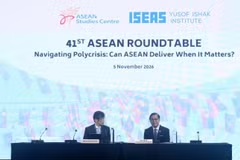
Thai Deputy Prime Minister and Minister of Foreign Affairs Sihasak Phuangketkeow (R) takes part in the Q&A session at the 41st ASEAN Roundtable. (Photo: VNA)

Thailand calls on ASEAN to proactively address polycrisis

Thai Deputy Prime Minister and Minister of Foreign Affairs Sihasak Phuangketkeow noted that no single member state could tackle challenges ranging from major-power competition and economic fragmentation to climate change and energy and food security on its own. Regional cooperation is therefore a strategic imperative, enabling ASEAN not only to overcome crises but also to sustain its development momentum.

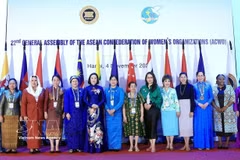
Participants in the 22nd General Assembly of the ASEAN Confederation of Women’s Organisations pose for a group photo. (Photo: VNA)

Women play key role in building united, resilient, sustainable ASEAN Community

Hosted by the Vietnam Women’s Union (VWU), the 22nd ACWO General Assembly marked another milestone in ACWO’s cooperation and development, allowing ASEAN women’s organisations to strengthen solidarity and mutual trust, share experience and identify cooperation priorities for the region’s next stage of development.

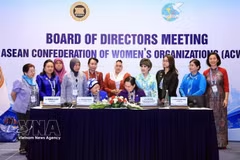
Delegates sign an agreement admitting the Timor-Leste Women’s Network Rede Feto as ACWO’s 11th member. (Photo: VNA)

ASEAN Confederation of Women’s Organisations holds Board of Directors meeting in Hanoi

Amid ongoing regional and global changes, which bring both new opportunities and challenges for women, the role of the ASEAN Confederation of Women’s Organisations in connecting organisations and promoting collective action has become increasingly important. This requires continued innovation in its operating methods, stronger ties among members and greater promotion of women's voices and roles in building a united, resilient, inclusive and sustainable ASEAN Community.