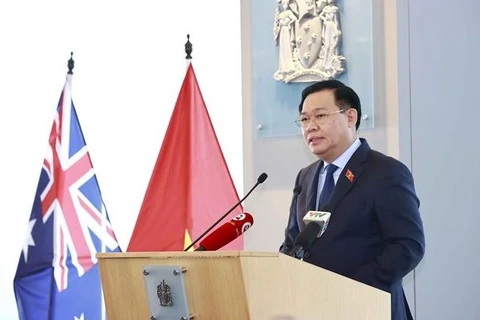
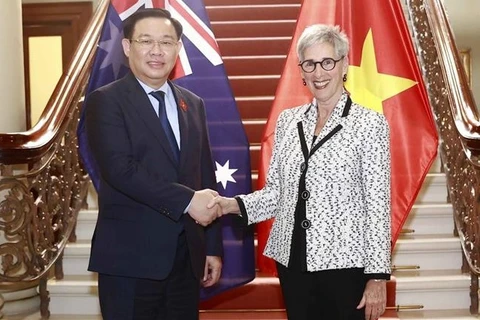
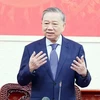
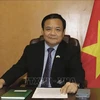
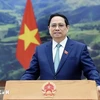
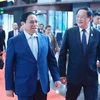
Chairman of the National Assembly Vuong Dinh Hue speaks at the event. (Photo: VNA)
 Following is the full text of the remark.
“ENHANCING VIET NAM – AUSTRALIA STRATEGIC PARTNERSHIP FOR PEACE, STABILITY, COOPERATION AND DEVELOPMENT
Professor Alec Cameron, President and Vice-Chancellor of RMIT University,
Distinguished guests,
Today, I am delighted to visit and address the Australia - Vietnam Policy Institute (AVPI), the first agency in charge of conducting policy research and providing recommendations specifically on the Vietnam - Australia ties.
The establishment and operation of the Institute thus far reflect Australia’s increasing attention to Vietnam, at a time when our two countries are entering a new phase of more robust and substantive development in terms of bilateral relations.
The AVPI has convened many diverse discussions on policy issues, and connectivity among businesses and localities from both sides.
I do hope that the Institute will soon become a leading research center on Vietnam in the region, and serve as an incubator for ideas on the means to further strengthen the Vietnam - Australia ties in the next 50 years.
In my remark, I would like to share with you my thoughts on three items:
First, the situation in the region and the world.
Second, Vietnam’s foreign policy, particularly pertaining to the Indo-Pacific.
And third, the Australia - Vietnam ties at present, and future prospects.
Distinguished guests,
1. The world is entering the third decade in the 21st century, with a myriad of unpredictable shifts. For the first time, humanity suffered from an unprecedented pandemic, with its consequences far surpassing any expectation. Since the Cold War, never before has the international political, economic and security landscape been faced with such a multitude of challenges.
The persisting and complicated impact of the pandemic, coupled with geopolitical tensions and conflicts, competition among major powers, turbulences in the food, energy, financial and monetary markets, and the disruptions to supply chains have wiped out several accomplishments in poverty eradication and development for many decades. They have also brought about tremendous and multidimensional hurdles, both in the short and long term, in many countries around the world.
Globalization is facing countless obstacles, while countries are under pressure of having to choose side amid geopolitical competition in the region and the world. There are also intensifying contradictions between cooperation and competition, independence and interdependence, and development andoutdatedness.
In addition, non-traditional security challenges, particularly the adverse impacts of climate change, are directly affecting the people, security, and development of all countries.
However, the broader picture of the world is not entirely doom and gloom. We can remain optimistic and hopeful in the future. The world is gradually overcoming COVID-19. The pandemic, rather than tearing us down, has helped us become stronger, and more united.
Such trends as digital transformation, green transition, and innovation are further promoted. While globalization is experiencing hardships, various new initiatives for economic connectivity and cooperation at a regional and global level were expedited. And a world without war and poverty continues to be the common aspiration and goal of international cooperation efforts.
The Indo-Pacific also continues to sustain its robust growth. This area comprises 4 out of 5 largest economies in the world. The majority of forecasts for the world today have one thing in common: This century belongs to Asia.
Distinguished guests,
The COVID-19 pandemic, and the increasing interdependence among countries, are testaments to the fact that no country, even major powers, can overcome all challenges by itself, and no country, however small, would lack opportunities for development.
In many cases, hardships constitute the driver for innovation and development. Over the past years, despite external challenges, Australia has made every effort in establishing resilient supply chains, diversifying its market, and bolstering the resilience of its economy.
Such is an invaluable experience for countries, including Vietnam, to learn from.
Peace and cooperation for common development continue to be the primary trend of our time. Such is the common aspiration of all countries and peoples worldwide.
Countries share the understanding that multilateralism, cooperation, connectivity, and integration in line with international law, rather than selfish nationalism or power politics, constitute the optimal means to overcome challenges.
In this context, Vietnam maintains its wish and strong resolve to work with other countries, including Australia, to pen new and brighter chapters in the chronicle of the region, thereby making substantive contributions to common peace and prosperity around the world.
Distinguished guests,
2.The second item I wish to raise is Vietnam’s foreign policy, particularly with regard to the Indo-Pacific.
After 35 years of conducting reforms, opening its border and engaging in international integration, under the able leadership of the Communist Party of Vietnam, we have recorded important achievements across the board.
Income per capita increased thirteen-fold, while GDP rose by 18 times in comparison with pre-reform figures (in 1986). From a country with limited external relations, Vietnam has now established diplomatic ties with 189 out of 193 UN members, as well as economic and trade relations with over 220 partner countries and economies.
The National Assembly of Vietnam also has relations with more than 140 parliaments worldwide. Vietnam takes pride in having assumed multiple international obligations. Vietnam has been a non-permanent member of the UNSC twice, member of the UN Human Rights Council, ASEAN Chair, and host country of the IPU General Assembly.
The Party, National Assembly, Government and people of Vietnam are making every effort to take Vietnam into a new phase of development, with a wide range of ambitious goals outlined at the 13th National Party Congress. These include:
By 2030 (the centenary of the foundation of the CPV), Vietnam will become a developing country with a modern industry and upper-middle income.
And by 2045 (the centenary of the Democratic Republic of Vietnam, now Socialist Republic of Vietnam), Vietnam will become a developed, high-income country.
“Prosperity of the people constitutes the strength of the nation.” We place the people at the heart of every guideline and policy. They are both the goal and driver for development, and for efforts toward social progress and equality. Vietnam is striving to harmoniously address the relationship between interests of different social strata, and continuously improve the living standard and happiness of the people.
To fulfill this noble aspiration, Vietnam, first and foremost, is building upon the internal strength of the entire nation, and remaining steadfast in implementing the foreign policy of independence, self-reliance, peace, friendship, cooperation and development.
In 1945, immediately following the establishment of the Democratic Republic of Vietnam, President Ho Chi Minh stated that Vietnam “wants to become friends with all democratic countries, and does not wish to be adversarial against anyone.” In 77 years of struggle of maintain independence and pursue national development, Vietnam has always unflaggingly upheld this noble mentality.
With the foreign policy determined at the 13th National Party Congress, we continue to pursue multilateralization and diversification of external relations, and proactive and actively engage in extensive and intensive international integration. Vietnam is a friend, a reliable partner, and an active, responsible member of the international community.
We respect the fundamental principles of the UN Charter and international law, including the respect for independence, sovereignty, territorial integrity, equality, cooperation, and mutual interest. We also uphold the principle of addressing disputes via peaceful means.
In our foreign policy, we very much appreciate neighboring countries in the Southeast Asia. Vietnam joined ASEAN in 1995. Twenty years later, we are joining hands with fellow ASEAN members in the building of the ASEAN Community, under the motto of “one vision, one identity, one community.”
Since 2019, in tandem with the building of a strong and united ASEAN Community, Vietnam is working with other ASEAN countries in realizing the “ASEAN Outlook on Indo-Pacific.” We are also upholding the ASEAN centrality, and cooperating with partners, including Australia, in contributing to regional peace, stability, and prosperity. This will continue to be Vietnam’s priority in its foreign policy in the time to come.
Apart from the “ASEAN family”, Vietnam is also constantly expanding its network of friends via Strategic and Comprehensive Partnerships. To date, we have 30 Strategic and Comprehensive Partners, including major powers, neighboring countries, regional states, and other important partners. In such connections, Vietnam considers Australia a close friend, and an important Strategic Partner.
Distinguished guests,
3.The third item I wish to point out is the Vietnam - Australia ties, and the prospects of this relationship. Over the past half century, despite the various ups and downs in history, cooperation for mutual development has always been the primary trend in our bilateral ties.
Vietnam’s reform would not be successful without the support and collaboration from international friends, with Australia being one of the first Western countries to resume ODA to Vietnam.
The two countries established a Comprehensive Partnership in 2009, Enhanced Comprehensive Partnership in 2015, and upgraded to Strategic Partnership in 2018. And at present, we are striving towards a new, better height. This bears testament to the fact that our bilateral ties have continued to mature and thrive over time.
Vietnam very much appreciates Australia’s role and stature in the region, and considers Australia a key partner in its foreign policy. We firmly believe that Australia will continue to make greater contributions to the maintenance of peace, stability, cooperation and development in the region.
Australia’s substantial initiatives have played a role in shaping the cooperation landscape in the region, such as APEC or Australia - Mekong Partnership.
Australia’s consistent support for ASEAN’s centrality, for the fundamental values of multilateralism, and for the international rules-based order will continue to reinforce our faith and expectation in Australia, a country and partner that is deeply aware of its responsibility and obligation towards the international community.
At present, the Vietnam - Australia ties have transitioned froma donor - recipient relationship to Strategic Partnership, in the spirit of equality and mutual interest. The two sides also share many common benefits and positions on regional development and security.
Cooperation in politics, defense and security continues to be expanded, becoming a strategic pillar in our bilateral ties. It has contributed to further bolstering mutual trust, and paving the way for encouraging progress in other areas of cooperation.
Economic, and trade ties have long been a highlight, adding further depth to the Vietnam - Australia ties, and bringing about substantive interests for the people and businesses from both sides.
Even amid the hardships caused by the pandemic, the trade turnover between the two countries last year still increased by over 49%, amounting to 12.4 billion USD, and this growth persists in 2022.
Cooperation in development, education, training, culture, tourism, and people-to-people exchange was further deepened, laying the social groundwork for the strengthening of bilateral ties. With over 30,000 Vietnamese students and research fellows currently studying in Australia, education cooperation has become a cultural bond connecting the friendship between the two countries.
In particular, Vietnam highly appreciates Australia’s timely and significant support of 26 million COVID-19 vaccine doses. This is truly in line with the saying of “A friend in need is a friend indeed.”
Distinguished guests,
The cooperation between the Vietnamese National Assembly and the Australian Parliament witnessed robust growth, playing an important role in the development of our bilateral ties. With the signing of multiple cooperation agreements, the two sides have maintained regular exchanges of parliamentary delegations, and experience sharing in parliamentary work, particularly in the building of institutions and legal systems.
In addition, both Parliaments have actively supported each other at multilateral forums to which both are members, such as IPU, APPF, and ASEP.
Strong bilateral ties can only be built on the basis of deep people-to-people connections. Thus, as representatives of the people, both Parliaments form the important bridge connecting development goals of both countries, and the aspiration to further bolster the friendship between the two peoples.
The Vietnam - Australia relationship is, at present, stronger than ever. After 50 years, generations of leaders and peoples from both countries have travelled a long way to reach the ties our two countries enjoy today. Few people can imagine that our two countries would be able to reap such success.
2023 marks the 50th anniversary of diplomatic relations. This is a time for the two ruling parties, national assemblies, governments, and peoples to bolster substantive cooperation, promote innovation, seize new opportunities, and together overcome all challenges. Such endeavors will help elevate our bilateral ties to a new height.
To this end, in tandem with the implementation of existing areas of comprehensive cooperation, I would like to underscore another three points:
First, it is necessary to bolster economic and trade ties, and consider this the core and driver of the two countries’ Strategic Partnership. In this connection, we should step up liberalization of trade and investment, improve maritime and aviation infrastructure connectivity under bilateral, multilateral, sub-regional, and regional frameworks. We should also work closely with ASEAN in making the most of initiatives for regional economic cooperation and connectivity.
Second, we should further deepen strategic, defense, and security cooperation. In such endeavors, the two countries should give priority to together strengthening regional and global cooperation in response to emerging challenges, such as climate change, diseases, food, energy and financial security, and maritime security.
We should also support each other in the pursuit of sustainable development, and greater resilience against climate change, particularly in the Mekong sub-region. In addition, we need to uphold ASEAN’s centrality, and encourage major powers and partners to make responsible contributions to peace, stability, cooperation and development in the Indo-Pacific and beyond.
Third, we need to successfully establish strategic cooperation pillars in education, training, and innovation, and support each other in the successful implementation of digital transformation and green transition towards sustainable development.
Vietnam wishes to bolster substantive and effective cooperation with Australia in such areas as green energy, green technology, green agriculture, green economy, and digital economy.
Distinguished guests,
I am hopeful about the Vietnam - Australia ties in the next 50 years. Our two countries are having tremendous opportunities to further strengthen bilateral relations, and elevate such relationship to a greater height.
As President Ho Chi Minh once said: “To be firm in principles, but flexible in their application.” I am fully confident that the close, mutually beneficial cooperation and mutual respect between Vietnam and Australia will continue to be the “consistent” factor in the two countries’ efforts to triumph over “unpredictabilities” in the region and the world.
I send my best wishes of greater success to the AVPI.
Thank you.”./.