Renovation plans proposed for old church

The Relics Preservation Institute, after examining 134-year-old Bui Chu Church in Nam Dinh, has proposed two possible renovation plans to the Ministry of Culture, Sports and Tourism.
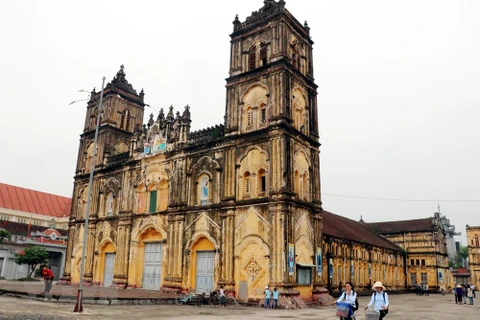
Renovation plans proposed for old church ảnh 1Bui Chu Church, one of the most magnificient old churches in the north of Vietnam, is in a state of serious disrepair. (Photo tintucnamdinh.vn)

Hanoi (VNS/VNA) - The Relics Preservation Institute, after examining 134-year-old BuiChu Church in the northern province of Nam Dinh, has proposed twopossible renovation plans to the Ministry of Culture, Sports andTourism.

The church, located in Xuan Ngoc commune,Xuan Truong district, Nam Dinh province, was built in the late 19th century bySpanish Bishop Wenceslao Onate Thuan. It was inaugurated in 1885and renovated in 1974 and 2000.

The first solutionaims to maintain the original structure and remove damaged parts to fix orreplace them, while the second option would see the church torn down andreplaced by a new structure modelled off the original.

Under the first plan,for example, workers would remove broken roof tiles. They would re-use onesthat can be salvaged and replace those that cannot with new tiles designedbased on the old ones.

The workerswould fix the damaged cement border on the roof to look like the originalarchitecture.

The worm-eaten woodenpillars would be replaced by wood of the same kind and cracked wallswould be fixed, maintaining their original decoration patterns.

The foundationwould be strengthened to save the inclined bell tower and walls. Theold floor tiles would be replaced by new ones based on the originals.

According to expertsfrom the institute, this solution would not last very long and furtherrenovation would be needed every year. It also would not meet thedemand for a larger space for gatherings inside the church.

The second solutioninvolves pulling down the whole building including the old foundation andfloor. Workers would build a new foundation using advanced techniquesto ensure the building will last longer.

The new churchwould mimic the old structure but would be slightly larger.

The new buildingwould reuse metal decoration frames, preserve tombs of priests and userenovated gold-gilded decorations, old stone stelae and two bronze bells.

The institutesaid the second solution would be more stable and long-lasting.

“It preserves basicfeatures and typical values of the original church while meeting demands of thecommunity for a larger area at a reasonable price,” the report to the cultureministry reads.

The instituteproposed the ministry choose a highly qualified agency with experience in renovatingrelics and building religious buildings. The chosen agency should make adetailed plan before dismantling any of the building.

As the ministryconsults experts to choose between the two options, some architects haveexpressed concerns.

Nguyen Hanh Nguyen, alecturer at HCM City Architecture University, told Thanh Nien (YoungPeople) newspaper she had voted for the first solution.

“This solution keepsthe key values of the building and avoids destroying materials that cannot bereplaced,” she said. “This solution preserves symbols of culture andhistory proving the initial period when Christianity was introduced in Vietnam.This is a way of preserving originality.”

She said she wasworried that after destroying the walls and foundation, it wouldbe impossible to find workers talented enough to recreate theold structure.

“We always remakebuildings that were totally destroyed by fire or bombs,” she said. “This is anintact building.”

Architect Nguyen NgocHoai Nam, a member of Yeu Di San (Love Heritage) Group, said hebelieves the first solution will cost much less than the second option.

Nam also suggestedanother solution: preserve the existing church while building a new buildingnext to the old one.

“We will both keepthe old one and have a more spacious area for the increasing demands of thelocal community,” he said.-VNS/VNA

VNA

See more

PM Le Minh Hung (R) and NA Chairman Tran Thanh Man at the meeting leaders of press agencies in Hanoi on June 14. (Photo: VNA)

PM, NA Chairman meet with leaders of press agencies

The press has taken a leading role in defending the Party’s ideological foundation, countering wrongful and hostile stances, and raising the volume and quality of mainstream information, contributing to a healthy, humane and responsible media environment, said NA Chairman Tran Thanh Man.

The UN Group of Friends for Combating Technology-facilitated Trafficking in Persons, makes its debut at a ceremony in New York on June 12 (Photo: VNA)

Vietnam joins UN group on combating technology-facilitated human trafficking

The ambassador affirmed that Vietnam attaches great importance to cooperation with countries, the UN, UNODC, and relevant partners in combating human trafficking. He also noted that the participation of several ASEAN countries as founding members reflects the region’s shared commitment to implementing the ASEAN Convention Against Trafficking in Persons, Especially Women and Children (ACTIP).

Prime Minister Le Minh Hung launches nationwide campaign for sustainable double-digit growth in Ho Chi Minh City on June 13. (Photo: VNA)

PM launches nationwide campaign for sustainable double-digit growth

Prime Minister Le Minh Hung called on ministries, sectors and localities to promptly translate the emulation movement into practical action plans and programmes, ensuring that emulation becomes not merely a campaign but a driving force for action, an ecosystem for discovering good models, replicating successful models and best practices.

NA Vice Chairwoman Nguyen Thi Thanh guides a student on how to use an English reading pen at the gift presentation event in Dien Bien province on June 12. (Photo: VNA)

NA Vice Chairwoman presents gifts to Dien Bien policy beneficiary families

Vice Chairwoman Nguyen Thi Thanh urged policy beneficiary families to carry forward revolutionary traditions, serve as role models for younger generations, and steer their children to follow Party’s guidelines and the State’s laws and policies, contributing to a more prosperous and civilised province.

The Vietnam Red Cross Society's members deliver gifts to needy people during the 2026 Humanitarian Month. (Photo courtesy of the VNRC)

Humanitarian Month raises nearly 762 billion VND

With the theme '80 Years - A Journey of Compassion for the Community', the campaign continues to affirm its role as a nationwide humanitarian initiative, mobilising participation across all levels, sectors, businesses, organisations, philanthropists and the general public to help those in difficult circumstances.

Participants of the 2026 Vietnam – China children’s exchange programme pose for a group photo (Photo published by VNA)

Vietnamese, Chinese children enhance mutual understanding, friendship

Participants gained deeper insights into the friendship between the revolutionary pioneers of Vietnam and China in their shared quest for national liberation, as well as a greater understanding that the achievements of national reunification in both countries were hard won and that the friendly neighbourly relationship and cooperation between them is of great value.

Border guards from Quang Tri and Khammouane provinces in the joint patrol (Photo: baochinhphu.vn)

Vietnam, Laos conduct joint patrol along shared border

Quang Tri and Laos’ Khammouane province agreed to strictly adhere to legal documents on border management, maintain delegation exchanges at all levels, increase cooperation in crime prevention and control, search and rescue, and run public awareness campaigns to encourage border residents to comply with border and border gate management regulations.

Students take Literature test (Photo: VNA)

Over 1.2 million students begin national high school graduation exam

Under the current examination format, candidates are required to complete the mandatory Literature and Mathematics tests, along with a combined test comprising two subjects selected from a range of options, including Physics, Chemistry, Biology, Informatics, Foreign Languages, History, Geography, Technology-Industry, Technology-Agriculture, and Economics-Law. Students may also choose to take a foreign language different from the one studied at school.