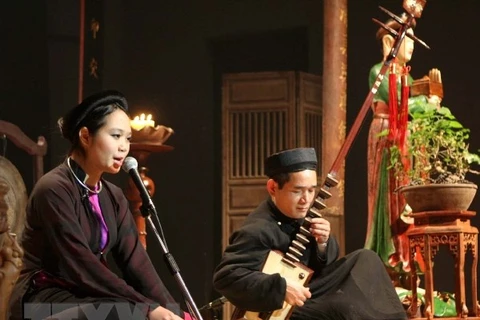
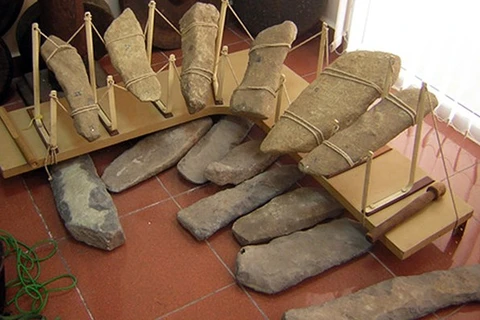
Nguyen Quang Tue (right) often makes field trips to Ba Na villages to record old people singing epics (Photo VNA)
 Hanoi (VNA) - Researchers fear the epics of ethnic minority groups in the Central Highlands might get lost into oblivion. So they are spending their time and energy to visit the elders in local communities to record epics, and are even hiring people to translate and print the lyrics for preservation.
Epics are stories describing the early days of an ethnic group. They talk about the valour of the group’s ancestors in fighting with adversaries and struggling to survive in the wild. The stories have both good and bad characters, with the good folks winning at the end. Epics are either sung or read out loud like stories. Community elders can sing night after night. In the past, the Ba Na used to gather at the village communal house to listen to epics recited by elders.
The epic of the Ba Na in Gia Lai province was recognised as the National Intangible Cultural Heritage in 2014.
Dedication to preserve heritage
Nguyen Quang Tue, head of the Culture Heritage Management Department under Gia Lai province’s Department of Culture, Sports and Tourism is a dedicated staff.
He is a member of the Kinh majority group that is highly respected by the local Ba Na people. He is often found at the houses of epic reciters to listen to their songs and record them.
Ask him about his work, and he will answer with a smile, “The task chose me, and I love it.”
For Tue, the traditional epics of ethnic groups are like priceless gems. “Ba Na people’s epics have been vocally handed down through generations and are recorded in the minds of the group’s elders. Sadly, the young ones are not interested in learning the epics. I love the traditional cultural stock and will be very sad if the epics disappear. So, I want to record them and print the lyrics to popularise them,” Tue said.
He started his travels to record Ba Na artists some 30 years ago, setting out with a backpack.
“Their houses are often located in remote areas. One person lives hundreds of kilometres away from another,” Tue said. “The roads are often difficult to travel on. When I started, it was not easy to buy a recorder. I saved for a long time to buy a cassette.”
“Each epic lasted long, as the elders could not sing non-stop. So I had to record and wait for them to rest. Sometimes it took me several days to record an epic,” said Tue.
He started by recording epics on cassettes and stored them in styrofoam boxes. Later, when he had enough money, he bought a record player and camcorder, which made the task easy for him. But there were still challenges.
“The tapes would get spoilt by humidity, so I decided to get them translated into Vietnamese and print them,” Tue said.
He chose translators who were fluent in both Kinh and Ba Na languages.
So far, Tue has printed 10 books of Ba Na epics, some paid for by the Government and some by himself.
He printed 500 copies of the latest epic book at a total cost of 60 million VND (2,640 USD). He has been able to pay only 15 million VND so far; the rest, he said, he will need to loan.
Two years ago, Tue initiated a charity programme to support old reciters who could no longer work.
To date, he has raised a fund of 105 million VND. He uses this money to pay the monthly salary of eight old reciters in Gia Lai and Kon Tum provinces. Each of them receives 300,000 VND every month. All of them are more than 65 years old and do not enjoy any privileged policies.
Carrying on a father’s legacy
In the house where renowned late artist Dieu Kau of the M’Nong ethnic group used to live in Dak Ndrung commune in Dak Song district, Dak Nong province, all material that he had collected, compiled and translated into Vietnamese language have been neatly arranged by his daughter, Thi Mai.
Mai, now 43, is the only person in her community who knows to recite and translate Ot Ndrong (epics of M’Nong group) into Vietnamese.
She is trying to complete what her father had started, and wants to run a school someday to teach Ot Ndrong to young M’Nongs.
“These are all my father’s treasures,” she said while giving out the M’Nong - Vietnamese Dictionary, M’Nong Stock of Old Sayings and Verses, M’Nong Folk Songs and M’Nong Family Annals to reporters.
“Before my father passed away, he was still collecting old sayings, folk songs and family annals of the M’Nong who used to and are still residing from Binh Phuoc to Dak Lak and Dak Nong,” Mai said. “These are works that my father had spent lots of time and energy on and collected during field trips to other M’Nong villages.”
“He was left with translating two epics and recording 50 others,” Mai said.
Thanks to her father’s hard work, as many as 120 epics have been recorded, 40 of which have been written in M’Nong language and are ready to be translated into Vietnamese.
“My duty is to continue to write down and translate the remaining 80 epics,” Mai said, “What I am worried about is that there are 20 epics that have not been recorded. K’Lung, in his late 70s, the only elder who can sing them, is growing weaker day by day. His eyesight is deteriorating. If we do not record urgently, we may never be able to do so if he passes away.”
Mai said the Culture Research Institute staff had asked K’Lung to sing for them in 1995 for the purpose of recording and had paid him 150,000 VND per tape.
“My children are young and I am busy with daily chores. I have no budget to record him. I hope the concerned agencies help me in this regard and also open courses to facilitate teaching M’Nong epics to the younger generation so that I can fulfil my father’s dream,” Mai said. - VNA
VNA