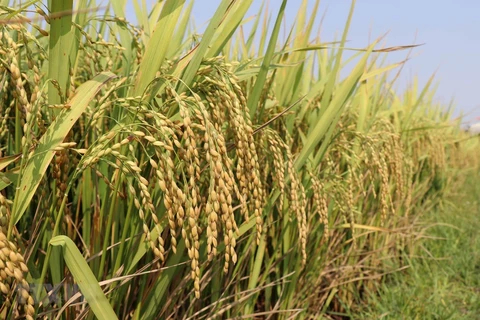
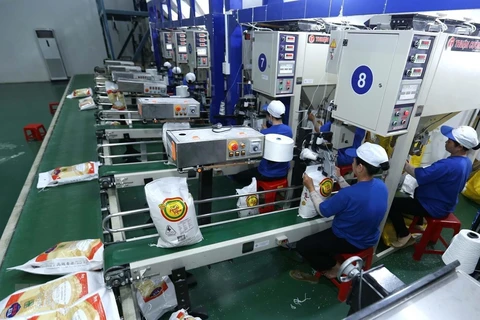
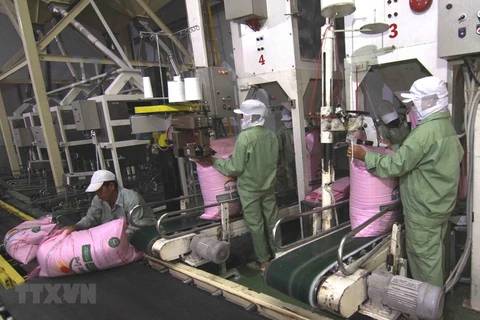
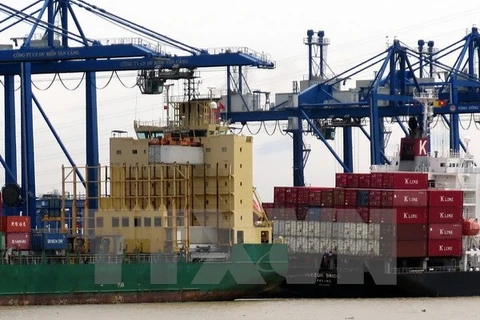
Vietnam's rice export volume surged by 12 percent to 3.09 million tonnes in the first five months of this year (Photo: anninhthudo.vn)
 Hanoi (VNS/VNA) - Higher rice supply in the domestic market has made the export price of Vietnam’s broken rice drop to 450 USD per tonne on June 19, the lowest level in the past two months.
The Vietnam News Agency reported that domestic supply is increasing due to harvesting the summer-autumn rice crop. Vietnam am can export 2.3-2.5 million tonnes of rice from this rice crop after ensuring sufficient domestic consumption.
The export price on June 4 hit the highest level of 475 USD per tonne, as rainfall affected the harvest.
Meanwhile, India's export rice prices last week also dropped to the lowest level in two months due to weakness of the rupee and lower rice demand. The prices of five percent broken parboiled rice in India fell to 366-372 USD per tonne on June 18, the lowest level since March 26.
Prices of Thai five percent broken rice also plunged to 505-525 USD per tonne on June 18 from 505-533 USD per tonne the previous week.
According to the General Department of Customs, Vietnam in the first five months of this year gained growth in volume and value of rice exports compared to the same period last year.
Specifically, rice exports surged by 12 percent in volume to 3.09 million tonnes and by 26.6 percent in value to 1.5 billion USD. While the average export price rose by 13 percent to 485.1 USD per tonne.
In May, the nation shipped 953,950 tonnes of rice, earning 492.54 million USD while the average export price reached at 516.3 USD per tonne.
They were up 87 percent in volume, 93.6 percent in value and 3.6 percent in price compared to April. They also increased by 40.6 percent, 67.6 percent and 19.2 percent, respectively compared to May 2019.
During the first five months, Vietnam exported the most rice to the Philippines with a total volume of 1.3 million tonnes, earning 598.6 million USD. Exports rose by 22.4 percent in volume and 41.4 percent in value year on year.
Rice exports to the Philippines accounted for about 41 percent of the national rice export volume and about 40 percent of the national rice export value.
China was the second largest market with an export volume of 429,261 tonnes and a, export value of 257.4 million USD, accounting for about 14 percent of the total volume and 17.2 percent of total value. The exports increased by 92.4 percent in volume and 131.2 percent in value over the same period of last year.
Vietnam also gained strong growth to many markets, including Senegal (18.3 times), Indonesia (192 percent) and France (171.6 percent).
However, it saw sharp reductions in other markets, such as Brunei (92 percent), Algeria (89 percent), Angola (89 percent), Turkey (83 percent) and the US (69.2 percent)./.
The Vietnam News Agency reported that domestic supply is increasing due to harvesting the summer-autumn rice crop. Vietnam am can export 2.3-2.5 million tonnes of rice from this rice crop after ensuring sufficient domestic consumption.
The export price on June 4 hit the highest level of 475 USD per tonne, as rainfall affected the harvest.
Meanwhile, India's export rice prices last week also dropped to the lowest level in two months due to weakness of the rupee and lower rice demand. The prices of five percent broken parboiled rice in India fell to 366-372 USD per tonne on June 18, the lowest level since March 26.
Prices of Thai five percent broken rice also plunged to 505-525 USD per tonne on June 18 from 505-533 USD per tonne the previous week.
According to the General Department of Customs, Vietnam in the first five months of this year gained growth in volume and value of rice exports compared to the same period last year.
Specifically, rice exports surged by 12 percent in volume to 3.09 million tonnes and by 26.6 percent in value to 1.5 billion USD. While the average export price rose by 13 percent to 485.1 USD per tonne.
In May, the nation shipped 953,950 tonnes of rice, earning 492.54 million USD while the average export price reached at 516.3 USD per tonne.
They were up 87 percent in volume, 93.6 percent in value and 3.6 percent in price compared to April. They also increased by 40.6 percent, 67.6 percent and 19.2 percent, respectively compared to May 2019.
During the first five months, Vietnam exported the most rice to the Philippines with a total volume of 1.3 million tonnes, earning 598.6 million USD. Exports rose by 22.4 percent in volume and 41.4 percent in value year on year.
Rice exports to the Philippines accounted for about 41 percent of the national rice export volume and about 40 percent of the national rice export value.
China was the second largest market with an export volume of 429,261 tonnes and a, export value of 257.4 million USD, accounting for about 14 percent of the total volume and 17.2 percent of total value. The exports increased by 92.4 percent in volume and 131.2 percent in value over the same period of last year.
Vietnam also gained strong growth to many markets, including Senegal (18.3 times), Indonesia (192 percent) and France (171.6 percent).
However, it saw sharp reductions in other markets, such as Brunei (92 percent), Algeria (89 percent), Angola (89 percent), Turkey (83 percent) and the US (69.2 percent)./.
VNA