Saline intrusion hits shrimp farmers

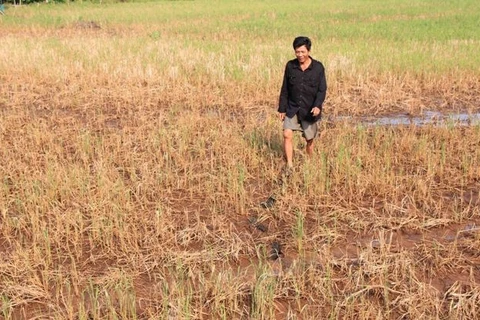
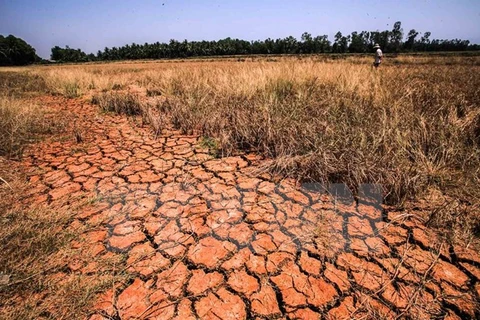
Many farmers who breed brackish-water shrimp in the Mekong Delta have cut back on production because of high salinity this year.
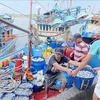
Saline intrusion hits shrimp farmers ảnh 1 Many farmers who breed brackish-water shrimp in the Mekong Delta have cut back on production because of high salinity this year. (Photo: VNA)

HCM City (VNA) - Many farmers who breed brackish-water shrimp in the Mekong Delta have cut back on production because of high salinity this year.

Ly Thanh Dan, who has four ponds to breed shrimp in Bac Lieu Province’s Hoa Binh District, is now breeding shrimp in only one pond.

“I have stored water with low salinity since the last rainy season, but the water is only sufficient for breeding shrimp in one pond,” Dan said. “Shrimp will grow very slowly in water with a high level of salinity.”

The industrial shrimp area in Bac Lieu covers about 2,500ha, accounting for less than 15 percent of the province’s total area devoted to shrimp breeding, according to the province’s Aquaculture Sub-department.

Pham Hoang Son, head of the province’s Aquaculture Sub-department, said the salinity is expected to continue to be high in the coming time.

“We have warned farmers not to breed a new shrimp crop until the beginning of the rainy season,” he said.

Saline intrusion has entered up to 70km deep inland on rivers in many areas in the delta.

In most provinces that breed brackish water shrimp, farmers have reduced the cultivation areas by 50 percent because of high salinity, according to the Ministry of Agriculture and Rural Development’s (MARD) Aquaculture Department.

In Soc Trang, Ca Mau, Bac Lieu and Kien Giang provinces, salinity has exceeded 30 gram per litre. When the salinity is above 30 gram per litre, shrimp are easily affected by disease.

Le Van Su, director of the Ca Mau Province Department of Agriculture and Rural Development, said hot weather has affected not only industrial and semi-industrial shrimp farming areas but also extensive shrimp farming areas.

In Ca Mau Province, which has the country’s largest shrimp cultivation area, more than 2,678 ha of extensive shrimp farming areas have been affected by disease with a damage of 30-70 percent so far this year, up 1,864 ha against the same period last year.

Solutions

The MARD’s Animal Health Department has told provinces to increase environmental surveillance to promptly warn farmers about major changes in salinity and other environmental factors.

Provinces should instruct farmers about safe breeding techniques, focusing on factors that cause disease like salinity, temperature and water depth in ponds, said the Animal Health Department.

Farmers should follow relevant agencies’ warnings and schedules when breeding shrimp, it said.

Vu Van Tam, MARD Deputy Minister, has required that MARD’s Animal Health Department set up a national programme to prevent and control diseases on brackish water shrimp, considered to be one of Vietnam’s most important aquaculture species.

The country exports about 3 billion USD worth of brackish water shrimp a year.

The delta’s natural conditions are suitable for breeding this kind of shrimp, accounting for 80 percent of the country’s brackish water shrimp output.

Shrimp-rice cultivation has expanded in the delta’s coastal provinces, reaching 160,000 ha, according to the MARD’s Directorate of Fishery.-VNA

VNA

See more

Officers release the rare elongated tortoise (Indotestudo elongata) back into its natural habitat in the Ta Thiet historical forest area. (Photo: VNA)

Rare elongated tortoise released into the wild in Dong Nai

The elongated tortoise is one of the most beautiful and rare terrestrial tortoise species, listed in both the Vietnam Red Data Book and the International Union for Conservation of Nature (IUCN) Red List of Threatened Species. It typically inhabits tropical and subtropical forests and plays an important role in maintaining ecological balance. However, due to illegal trade and habitat loss, its wild population has been declining sharply.

Cai Khe ward of Can Tho city is under water after a storm (Photo: VNA)

Can Tho pushes JICA-funded drainage project to deliver results in 18 months

The Japan International Cooperation Agency (JICA)-funded technical cooperation project on drainage management for climate resilience in Can Tho aims to improve planning capacity for wastewater collection, enhance operations and management of existing treatment plants, and the city’s ability to run public awareness campaigns.

Plastic waste poses a growing challenge to communities and societies around the world, including Vietnam. (Illustrative photo: VNA)

Wide range of activities planned for 2026 environment and marine awareness campaign

A series of environmental and marine-related events to held in the central province of Nghe An from June 4-6 will generate a broad social impact, helping transform awareness into action and commitments into concrete results, and contributing to Vietnam’s goals of green growth, circular economy development, net-zero emissions and harmonious coexistence between people and nature.

At the working session (Photo: VNA)

AFD, Lang Son move to fast-track climate resilience project

The climate resilience and sustainable infrastructure project in Lang Son consists of two main components, focusing on sustainable infrastructure and environmental improvement; and technical assistance and capacity building, with AFD experts expected to train project management officials and local agencies in disaster response and climate adaptation.

People wear sun-protective clothing when going outside in Quang Ninh province. (Photo: VNA)

Forecast of more intense heat and complex typhoons in summer

The number and activity of tropical cyclones and depressions over the East Sea, internationally known as the South China Sea, and their direct impacts on mainland Vietnam are expected to be comparable to the multi-year average. The long-term average over the East Sea is 5.2 typhoons, with 1.9 making landfall.

An overview of the seminar reviewing the project’s implementation during the 2021–2026 period (Photo: VNA)

Hue project prevents over 933 tonnes of plastic waste leakage

Launched in 2021 with funding from the Norwegian people through WWF-Norway and WWF-Vietnam, the “Hue – Plastic Smart City in Central Vietnam” project aims to help Hue protect rivers, wetlands and coastal ecosystems from plastic pollution while building the city into a model plastic-reduced urban area in central Vietnam.

Deputy Minister of Agriculture and Environment Nguyen Quoc Tri speaks at the event. (Photo: VNA)

Vietnam diversifies financing mechanisms for nature conservation

Initiatives on biodiversity finance, carbon credits, public – private partnerships, nature-based tourism, and private sector investment are creating more opportunities to increase resources for ecosystem conservation and restoration, said an official.

The Dong Thap Muoi Ecological Reserve spans more than 106 hectares and is set to be expanded by an additional 60 hectares in the near future. (Photo: VNA)

Local initiatives drive Vietnam’s push to protect biodiversity for sustainable future

Vietnam has established a network of 180 terrestrial and marine nature reserve covering more than 2.67 million hectares. These sites are being further strengthened to improve ecological connectivity, restore habitats and conserve endangered species. Forest cover remains stable at over 42%, contributing to water protection, climate adaptation and carbon absorption.

All the animals underwent health checks and assessments of their ability to adapt to the natural environment before being safely released. (Photo: VNA)

Quang Tri releases 13 wild animals back into nature

The animals included two masked palm civets, four stump-tailed macaques, and seven rhesus macaques. All belong to Group IIB under Circular No. 85/2025/TT-BNNMT issued by the Ministry of Agriculture and Environment on the management of endangered, precious and rare species, as well as the implementation of the Convention on International Trade in Endangered Species of Wild Fauna and Flora (CITES).

The clouded monitor (Varanus nebulosus) weighs approximately two kilograms and measures around 70 centimetres in length. (Photo: VNA)

Quang Tri hands over rare clouded monitor to rescue centre

The animal was identified as a clouded monitor (Varanus nebulosus), weighing approximately two kilograms and measuring around 70 centimetres in length. The species belongs to Group IB — a category of endangered and rare forest wildlife species given the highest level of protection in Vietnam, with all forms of commercial exploitation and use strictly prohibited.

The female stump-tailed macaque undergoes a health check by authorities before being released back into the wild. (Photo published VNA)

Rare stump-tailed macaque released into the wild

The stump-tailed macaque, scientifically known as Macaca arctoides, is classified as a rare and endangered species under Group IIB in Vietnam’s regulations on endangered wildlife management.

A graphic image of the Nui Thoong high-tech waste treatment and waste-to-energy plant project. (Photo: hanoimoi.vn)

Hanoi breaks ground on 200-million-USD waste-to-energy plant

Designed to process 2,000 tonnes of waste per day and generate 45MW of electricity for the national grid, the project is the first high-tech waste-to-energy plant in southwestern Hanoi, where large-scale solid waste treatment facilities have long been lacking.