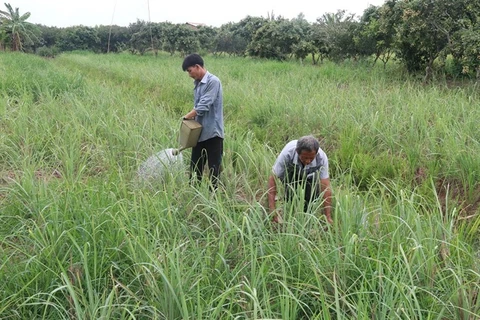
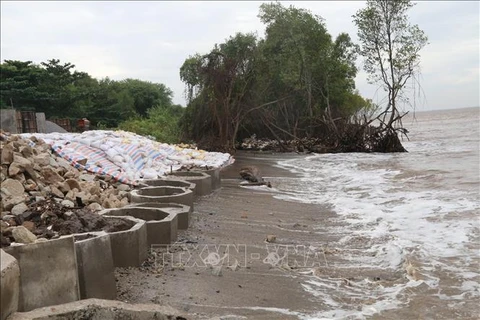
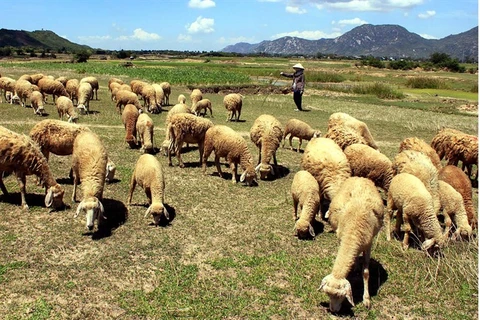
The Mekong Delta region could suffer serious salt intrusion by the end of this month, according to the Southern Irrigation Institute (Photo: VNA)
 Hanoi (VNS/VNA) - Vietnam’s Mekong Delta region could suffer serious salt intrusion by the end of this month, according to the Southern Irrigation Institute.
Saltwater could penetrate 40 to 50km inland, the institute said.
The Mekong River basin is entering the dry season. Water flow into the region has been above the average level since December last year.
Meanwhile, the institute said the amount of water flowing from Tonle Sap – the biggest lake in Cambodia linked closely to the Mekong River – is lower than in previous years.
The institute’s forecast says the amount of water coming to the delta through Cambodia’s Kratie irrigation system would remain at a high level, with the average discharge rate sitting at 4,000-5,000cu.m per second this month.
The rate will likely drop to 4,000-3,000cu.m per second next month.
The change is dependant on the operation of upstream hydropower plants.
According to the National Centre for Hydro-meteorological Forecasting, the temperature of the region will be 0.5 to 1 degree Celsius higher than the previous year and rainfall will be roughly the same as in 2018.
While the upper part of the Mekong Delta region is benefiting from an abundance of water at the moment, other parts of the delta are at risk of shortages.
Water levels in the middle part of the delta remain favourable for cultivation, but farmers must take precautions to prevent abnormal saltwater intrusion, which would damage crops.
The coastal area of the delta is at risk of suffering from a shortage of fresh water, and salt intrusion may be worse than in 2017 dry season.
By the end of this month, saltwater will have intruded into an area within 30-40km of the mouth of the Mekong River, with the salinity rate exceeding 4g per litre.
In February, saltwater will reach 40–50km from the river mouth, especially during high tides coupled with northeasterly winds. The salinity may suddenly increase higher than forecasted levels.
In March, April and May, the saline intrusion in estuaries is likely to decrease and areas more than 50km inland will enjoy abundant freshwater.
The saline intrusion will occur at high tide, the institute said. -VNS/VNA
Saltwater could penetrate 40 to 50km inland, the institute said.
The Mekong River basin is entering the dry season. Water flow into the region has been above the average level since December last year.
Meanwhile, the institute said the amount of water flowing from Tonle Sap – the biggest lake in Cambodia linked closely to the Mekong River – is lower than in previous years.
The institute’s forecast says the amount of water coming to the delta through Cambodia’s Kratie irrigation system would remain at a high level, with the average discharge rate sitting at 4,000-5,000cu.m per second this month.
The rate will likely drop to 4,000-3,000cu.m per second next month.
The change is dependant on the operation of upstream hydropower plants.
According to the National Centre for Hydro-meteorological Forecasting, the temperature of the region will be 0.5 to 1 degree Celsius higher than the previous year and rainfall will be roughly the same as in 2018.
While the upper part of the Mekong Delta region is benefiting from an abundance of water at the moment, other parts of the delta are at risk of shortages.
Water levels in the middle part of the delta remain favourable for cultivation, but farmers must take precautions to prevent abnormal saltwater intrusion, which would damage crops.
The coastal area of the delta is at risk of suffering from a shortage of fresh water, and salt intrusion may be worse than in 2017 dry season.
By the end of this month, saltwater will have intruded into an area within 30-40km of the mouth of the Mekong River, with the salinity rate exceeding 4g per litre.
In February, saltwater will reach 40–50km from the river mouth, especially during high tides coupled with northeasterly winds. The salinity may suddenly increase higher than forecasted levels.
In March, April and May, the saline intrusion in estuaries is likely to decrease and areas more than 50km inland will enjoy abundant freshwater.
The saline intrusion will occur at high tide, the institute said. -VNS/VNA
VNA