Satellite rollouts mark major steps forward for Vietnam’s aerospace industry

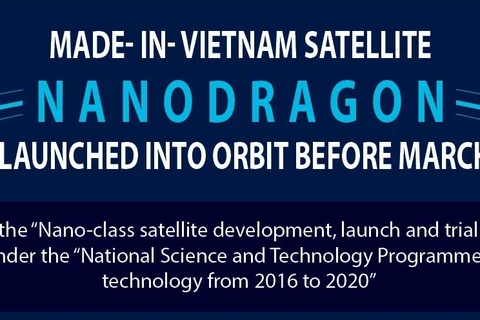
NanoDragon, a nano-layer cubesat satellite developed by the Vietnam National Space Centre (VNSC) under the Vietnam Academy of Science and Technology, is scheduled to be launched into orbit from Japan on October 1.
Satellite rollouts mark major steps forward for Vietnam’s aerospace industry ảnh 1Illustrative photo. (Source: VNA)

Hanoi (VNA) – NanoDragon, a nano-layer cubesat satellite developed by the Vietnam National Space Centre (VNSC) under the Vietnam Academy of Science and Technology, is scheduled to be launched into orbit from Japan on October 1.

The 3.8-kilogramme satellite will be sent into outer space from the Uchinoura Space Center in Japan’s Kagoshima prefecture, following the launch of the 1-kilogramme microsatellite PicoDragon and the 50-kg satellite MicroDragon, also developed by the VNSC, in 2013 and 2019, respectively.

In 2023, LOTUSat-1, an earth observation satellite manufactured by Japan under a VNSC project, is expected to be launched, making it the first radar observation satellite of Vietnam.

These mark the first major steps forward taken by the country’s fledgling aerospace industry.

PicoDragon was completely built in Vietnam by a group of local researchers who had zero experience in the field, said VNSC General Director Assoc. Prof., Dr. Pham Anh Tuan. They were experts in different areas of the science-technology industry before gathering for the project, so they got shaky at first and started to learn everything from scratch, he said.

MicroDragon, meanwhile, was created in a more professional environment in Japan with 36 Vietnamese engineers in support of Japanese professors and more advanced technologies, according to Tuan.

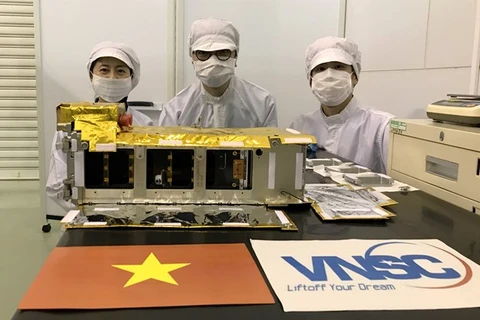
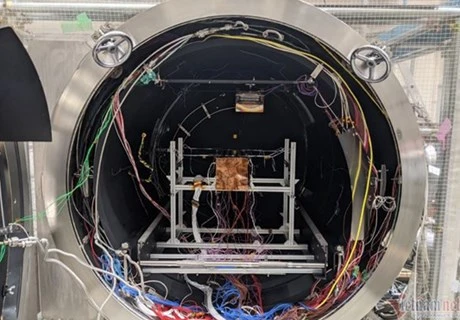
Satellite rollouts mark major steps forward for Vietnam’s aerospace industry ảnh 2NanoDragon, a nano-layer cubesat satellite developed by the Vietnam National Space Centre (VNSC) under the Vietnam Academy of Science and Technology, is scheduled to be launched into orbit from Japan on October 1. (Photo: VNSC)

NanoDragon was completely made in Vietnam and by Vietnamese engineers from the VNSC, from the stage of design through manufacturing, testing and others.

Dr. Le Xuan Huy, VNSC Deputy Director and a member of the research team, said NanoDragon is yet to reach expectation as it was developed with limited infrastructure. To partly fix the problems, the team had to ask for cooperation from foreign partners to have some parts of the project done overseas, he added.

The developers expect the satellite will function well to monitor marine vehicles with an automatic identification system and send relating data back to the ground.

Vietnam should view the aerospace as one of the five spaces it must master to be capable of safeguarding the national interests, Tuan said. Aerospace technologies require big resources, from capital to human resources and time, to ensure its balanced and sustainable development, he noted, adding that to boost the space science and industry, the country needs to stimulate demand for related technologies.

NanoDragon is the result of a project to design, manufacture, launch and test operation of a nano-sized microsatellite under the national space science and technology programme in the 2016-2020 period.

The government has recently approved a strategy for the development and application of aerospace science and technology by 2030 with an aim to expand the use of these technologies, master the design and manufacturing technologies of earth observation satellites, and support start-ups in the field.

Vietnam’s mission of conquering the space will be of the future generation but the mission to form an innovation culture and nurture passion for science among young people belongs to that of today, Tuan stressed./.
VNA

See more

Viettel Digital Talent and Viettel Future Changemakers are open for registration until March 15, 2026. (Photo: Viettel)

Viettel launches talent search to develop young workforce for core technologies

Unlike conventional internship or management trainee schemes, both programmes are designed and implemented directly by Viettel, integrating training with real-world work in a global technology group. Participants are entrusted with solving major challenges that directly impact Viettel’s research, production and business operations.

A close-up view of the UAVs used in the Can Gio - Vung Tau delivery route on Fenruary 12, 2026 in Ho Chi Minh City (Photo: CT UAV)

Vietnam’s first cross-sea UAV delivery route inaugurated

The event marked the debut of the country’s first cross-sea unmanned postal route, representing a pioneering step in smart mobility solutions aimed at boosting the digital economy and easing pressure on road transport infrastructure in Ho Chi Minh City.

According to the Vietnam National Authority of Tourism (VNAT), which cited the Google–Temasek–Bain & Company e-Conomy SEA 2025 report, tourism remains one of the key drivers of Vietnam’s economy. (Photo: VNA)

Digital transformation in tourism for comprehensive, sustainable growth

Vietnam is well positioned to become a leading digital tourism destination in the region. By capitalising on current growth momentum and implementing targeted support measures for small and medium-sized enterprises, the country can build a smart and sustainable tourism ecosystem aligned with global digital transformation trends.

Party General Secretary To Lam ( second, from left) visits an exhibition showcasing the government's achievements in science, technology, innovation, and digital transformation. (Photo: VNA)

Fund mechanisms positioned to unlock greater resources for innovation

Resolution No. 57-NQ/TW of the Politburo defines fund-based mechanisms as the core financial tool for advancing science, technology and innovation. Under the resolution, State budget funding for research and development is prioritised for allocation through funds, alongside reforms in financial management, expanded autonomy, streamlined procedures, and acceptance of the risks and time lags inherent in research activities. It also calls for the establishment of venture capital funds and science and technology development funds to steer, mobilise and unlock social resources for innovation.

UAV Cup PV GAS 2025 looks for solutions to boost the low-altitude economy (Photo: qdnd.vn)

Digital economy helps power breakthrough growth

The application of digital technologies, big data, artificial intelligence, e-commerce and digital platforms is creating new opportunities for businesses and citizens across production, business activities and social governance. Sectors such as e-commerce, digital finance, smart logistics and digital platform-based services are generating significant added value, while online public services, cashless payments, digital education and digital healthcare are increasingly improving quality of life and the transparency and efficiency of state management.

Camera manufacturing at Sunny Opotech Vietnam Co., Ltd. in Yen Binh Industrial Park in Thai Nguyen province. (Photo: VNA)

Resolution No. 57: Vietnam moves to create favourable legal framework for technology transfer

The Ministry of Science and Technology has sought feedback on a draft decree amending the Government's Decree No. 76/2018/ND-CP, aiming to strengthen the legal framework for technology appraisal and transfer, improve support policies for participating entities, and enhance risk management to ensure sustainable development, environmental protection and public health.

A visitor experience the robot receptionist at the Spring Fair 2026. (Photo: VNA)

Glorious Spring Fair 2026: technology underpins product quality

With the Politburo's rollout of Resolution No. 57-NQ/TW on breakthroughs in science, technology, innovation, and national digital transformation, along with Resolution No. 68-NQ/TW on developing the private economic sector, a key focus is on applying scientific and technological advances to produce essential consumer goods.

A large volume of goods of unclear origin is found in An Giang province (Photo: VNA)

PM orders tougher IP enforcement under new decree

The move aims to promptly combat, curb, and minimise IP violations; safeguard the legitimate rights and interests of citizens and businesses; build a transparent and healthy business environment; spread the nation’s image and prestige to advance rapid and sustainable development.

An overview of the seminar (Photo: VNA)

Vietnamese intellectuals in France join hands to advance science, technology at home

Held amid the nationwide efforts to implement the Resolution of the 14th National Party Congress and the Politburo’s Resolution No. 57-NQ/TW on breakthroughs in science, technology, innovation, and national digital transformation, the seminar served not only as an academic forum but also as a platform reflecting the sense of responsibility, intellectual engagement and aspiration to contribute among overseas Vietnamese intellectuals in the nation’s new development era.

The robotics team from Cau Giay Secondary School, Hanoi, performs at the event (Photo: VNA)

STEM Innovation Petrovietnam helps cultivate knowledge in technological era

The programme connected three sites in Hanoi, Nguyen Hue High School in Lao Cai, and Chau Thanh High School in Ho Chi Minh City, bringing together educators, students, representatives of businesses, and industry–energy engineers, and those directly supporting schools in implementing STEM (science, technology, engineering, and mathematics) education in practice.

Top 10 start-ups from Vietnamese universities receive innovation support from Singapore. (Photo: VNA)

Top 10 university start-ups in Vietnam secure innovation backing

The selected projects share a strong technology-driven orientation, particularly in artificial intelligence (AI), digital solutions and advanced materials. Their innovations address large-scale, real-world issues across sectors including healthcare, education, legal services, agriculture, energy, environmental protection and public governance.

Khanh Hoa province is accelerating digital transformation in tandem with building a smart city. (Photo: VNA)

Breakthroughs under Resolution No. 57 affirm leadership in digital era

After one year of implementing the Politburo’s Resolution No. 57-NQ/TW on breakthroughs in science, technology, innovation, and national digital transformation, numerous digital models and knowledge-based initiatives have been rolled out, bringing digital transformation to communities and contributing to the fulfilment of socio-economic development targets.