Short film calls for end to rhino horn use

Education for Nature Vietnam (ENV) on July 23 launched its latest short film entitled “When Rhinos Lose Their Face, Consumers Lose Face Too”.
Short film calls for end to rhino horn use ảnh 1Education for Nature Vietnam (ENV) released its latest short film entitled “When Rhinos Lose Their Face, Consumers Lose Face Too”.

Hanoi (VNA) - Education for Nature Vietnam (ENV) on July 23 launched its latest short film entitled “When Rhinos Lose Their Face, Consumers Lose Face Too”.

The Public Service Announcement (PSA) emphasises how respect is earned through honorable acts, not by trying to impress others with rhino horn.

In the comedic film, the protagonist is a young, ambitious businessman on his way to an important meeting. Immediately, the audience is drawn to him, a respectable person who helps strangers through acts of kindness. 

However, while his good deeds are well-intentioned, he is motivated by a futuristic app that gives him a point for each good deed. As he tries desperately to earn more and more points, he eventually makes a fatal flaw rooted in ignorance, and shamefully presents a rhino horn to a business partner.

Demand for rhino horn in Vietnam is driven by a false belief that it will benefit social status, said Nguyen Phuong Dung, ENV Vice Director and Head of Public Awareness. 

“Those who buy rhino horn for honor or gifts must soon realise that respect is not earned through superficial animal products, but rather by living life through moral and ethical actions,” she added.

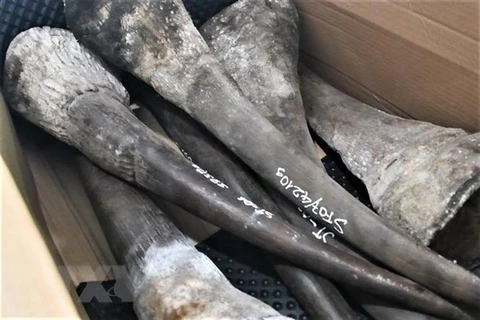
Vietnam is one of the biggest consumers of rhino horn in the world. The illegal trafficking, trade, and possession of rhino horn continues to be a headache for wildlife conservation. 

During the period between January 2020 and March 2021, the ENV recorded 99 violations related to rhino horn with 194,69 kg of horn confiscated by competent agencies. Eleven traffickers were arrested in such cases, four of whom have been prosecuted and received sentences ranging from 6 to 12.5 years in prison.

This is the ENV’s 47th PSA that aims to put an end to demand for wildlife and encourage public reports of wildlife crime to the organisation’s Wildlife Crime Hotline. 

The amount of daily reports to the hotline more than doubled, from 4.7 wildlife crime cases a day in 2019 to nearly 10 a day in 2020./.


VNA

See more

Construction workers reinforce steel and pour concrete to cover the underground drainage channel, helping collect rainwater and tackle flooding in Da Nang. (Photo: VNA)

A new “shield” against climate change

Smart urban areas are no longer simply about technology; they are becoming a tool that enables authorities to forecast risks, adapt quickly and protect their residents.

Vietnam is exerting efforts to cope with climate change. (Illustrative photo: VNA)

Vietnam approves carbon credit pact with Singapore under Paris Agreement

Signed on September 16, 2025, the Implementation Agreement on carbon credits collaboration under Article 6 of the Paris Agreement on climate change affirms Vietnam and Singapore’s pioneering role and commitment to close cooperation in the international carbon market, making a substantive contribution to global climate response.

A view of Vo Cuong ward, Bac Ninh province (Photo: VNA)

Bac Ninh earmarks over 1.7 billion USD for environmental protection

By 2030, Bac Ninh aims to ensure that all operating industrial clusters and industrial parks have centralised wastewater treatment systems meeting standards, while at least 95% of wastewater in Grade-I urban areas and 70% in Grade-II urban areas is collected and treated to required standards.

Many inland canals in Can Tho city dries up following a prolonged period of extreme heat. (Photo: VNA)

Government adopts action programme on environmental protection, climate resilience

The programme aims to translate the Party's orientations into concrete actions while strengthening environmental governance, enhancing climate resilience, and promoting a green, circular and low-carbon economy. It will serve as the basis for ministries, sectors and localities to formulate implementation plans for the 2026–2030 period, with a vision to 2045.

Dray Sap Waterfall lies within the UNESCO Dak Nong Global Geopark in Nam Da commune, Lam Dong province. (Photo: VNA)

Lam Dong steps up efforts to retain UNESCO global geopark status

Covering nearly 4,760 square kilometres across 22 communes and wards in western Lam Dong (equivalent to 73.1% of the former Dak Nong province's natural area), the geopark was shaped by millions of years of geological activity and successive volcanic eruptions.

A stump-tailed macaque (Macaca arctoides) is handed over to the Cam Lo–Dong Ha forest ranger station in Quang Tri province on January 27, 2026 (Photo: VNA)

Rare primate handed over to Phong Nha - Ke Bang National Park

A stump-tailed macaque (Macaca arctoides) was handed over to the Centre for Rescue, Conservation, and Development of Creatures under the Management Board of Phong Nha - Ke Bang National Park in Quang Tri province on July 21, for rehabilitation and eventual release into the wild.

Two Red Lories (Eos rubra) found among the 104 wild animals being kept without documentation proving their lawful origin in Phuoc Thanh commune, Tay Ninh province. (Photo published by VNA)

Criminal proceedings launched against case of illegal keeping, trading of 104 wild animals

They recorded a total of 104 wild animals, comprising 92 African spurred tortoises (Geochelone sulcata) of various sizes, six Red Lories (Eos rubra) and six Green-cheeked Parakeets (Pyrrhura molinae). Authorities said the animals are subject to management under Vietnam's forestry legal regulations and are listed in Appendix II of the Convention on International Trade in Endangered Species of Wild Fauna and Flora (CITES).

BUYO Bioplastics' biodegradable plastic products are made from brewer's grains and sugarcane bagasse. (Photo: nhandan.vn)

Vietnam urged to shift from plastic waste treatment to full life-cycle management

For years, efforts to tackle plastic pollution in Vietnam have focused mainly on waste collection, recycling and disposal. However, as sustainable development and green trade standards become increasingly important, specialists argued that a broader approach is needed, covering everything from product design and material selection to production, consumption and recycling.