South Africa – gateway for Vietnamese rice to Africa

South Africa is a promising market for Vietnamese rice exporters as it consumes about 850,000 tonnes of rice a year, said an official from Vietnam’s Ministry of Industry and Trade (MoIT).
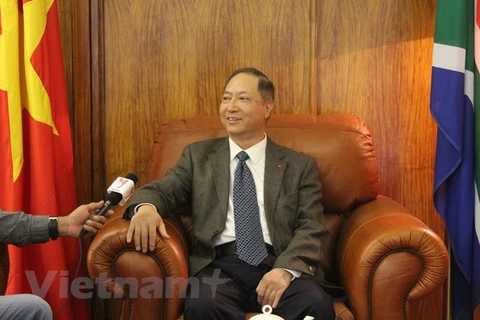
South Africa – gateway for Vietnamese rice to Africa ảnh 1Tran Quoc Toan, deputy head of the Ministry of Industry and Trade (MoIT)’s Import and Export Department speaks at the rice export promotion conference. (Photo: VNA)

Pretoria (VNA) – South Africais a promising market for Vietnamese rice exporters as it consumes about 850,000tonnes of rice a year, said an official from Vietnam’s Ministry of Industry andTrade (MoIT).

South Africa’s demand for rice is expectedto rise in the context that its natural conditions are unfavorable for ricefarming while the number of tourists and labourers from Asia, where rice is themain staple, coming to the country is on the rise, Tran Quoc Toan, deputy headof the MoIT’s Import and Export Department said.

Toan led a delegation to seek export markets for Vietnamese rice in SouthAfrica from December 10-11. The trip is also part of trade promotion activitiesaiming to realise the target of improving trade between the two countries frompresent 1 billion USD to 1.5 billion USD in 2020 set by South African PresidentCyril Ramaphosa during his visit to Vietnam in 2016.

At a working session with the South African Department of Trade and Industry(DTI) on December 10, Toan said as the locomotive economy in Africa, SouthAfrica serves as a gateway for Vietnamese rice exporters to access the wider Africanmarket.

He, therefore, suggested Vietnamesebusinesses to expand relations with international partners operating in SouthAfrica.

At the meeting, the official briefed SouthAfrican participants on regulations regarding tax and customs procedures forrice exported to their country and rice distribution channels in the market.

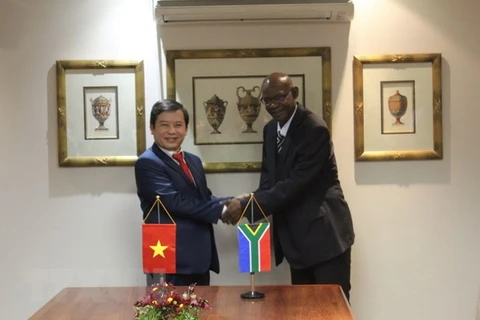
Madileke Ramushu, DTI Director of AsiaBilateral Relations, said South Africa always encourages and stands ready tocreate the best possible conditions for Vietnamese businesses to increase riceexports to the country.

It will help them to enter other markets in the continent, especially those inthe South African Development Community with a total population of 650 million,he said.

On this occasion, Madileke called onVietnamese firms to help their South African partners to raise processed contentsof their products delivered to Vietnam in order to improve their values.

He also suggested Vietnamese enterprisesinvest in the processing sector in South Africa, thus promoting their productsin Africa.

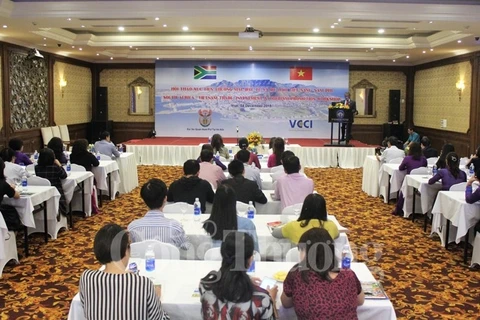
While in South Africa, the Vietnamese delegationand the Vietnamese Embassy in the country joined hands with the DTI’s office inJohannesburg city to organise a workshop on rice export promotion in Vietnam.-VNA
VNA
See more

Ahmad Haikal Hasan, Head of the Halal Product Assurance Organising Agency (BPJPH) of Indonesia, speaks at the seminar (Photo: VNA)

Indonesia ready to cooperate with Vietnam in halal sector

Ahmad Haikal Hasan, Head of the Halal Product Assurance Organising Agency (BPJPH) of Indonesia, described Vietnam as a “potential supplier” of halal products with the capacity to play a larger role in the market, particularly in the fast-moving consumer goods (FMCG) sector. He revealed a plan to visit Vietnam next week to discuss the country’s progress in the global halal industry.

Delegates perform the opening ceremony. (Photo: VNA)

Thailand Week 2026 opens in Hanoi

The event brings together more than 100 companies, including Thai enterprises and Vietnamese importers, across about 120 booths. It features a wide range of Thai products aligned with consumer trends in Vietnam, including food and beverages, health and beauty, mother-and-baby and pet products, fashion and jewellery, household goods and tourism services.

Illustrative image (Photo: VNA)

Vietnam remains Singapore’s third-largest seafood supplier in 2025

Data released by the Accounting and Corporate Regulatory Authority of Singapore (ACRA) show that Singapore spent 125.5 million SGD (97.7 million USD) importing seafood from Vietnam last year, up 10.7% year on year, accounting for 10.3% of the city-state’s total seafood import market.

Workers assemble mobile phone components at Diem Thuy Industrial Park in the northern province of Thai Nguyen. (Photo: VNA)

Electronics exports surpass 107 billion USD in 2025

With an export turnover of 107.75 billion USD in 2025, computers, electronic products and components not only maintained their position as Vietnam’s largest export by value, but also contributed more than half of the overall increase in the country’s export turnover in 2025.

Experts said that Vietnam’s economic outlook continues to be underpinned by stable foreign direct investment inflows and public investment, which is playing an important role in driving growth. (Photo: thoibaotaichinh.vn)

Foreign investors maintain strong confidence in Vietnam’s market

Looking ahead to 2026, prospects remain bright as manufacturing, economic growth and foreign investment in Vietnam are expected to stay robust, with the country forecast to post the highest growth rate in the region this year, according to Adam Sitkoff, Executive Director of the American Chamber of Commerce (AmCham) in Vietnam.

Toy production at a Hong Kong-invested factory (Photo: VNA)

Vietnam targets deeper market penetration in Hong Kong in 2026

Vietnam-Hong Kong trade hit 62.3 billion USD in the first 11 months of 2025, soaring 73.1% annually. Vietnamese exports to Hong Kong amounted to 36.8 billion USD, a 90.6% hike, ranking fourth among Hong Kong’s import sources, while imports from Hong Kong stood at 25.5 billion USD, up 52.9% and ranking third.

Vietnam’s start-up market enters restructuring phase

Vietnam’s start-up market enters restructuring phase

In 2026, venture capital inflows into Vietnam’s start-up ecosystem are expected to recover gradually, though in a more selective manner. VinVentures forecasts that capital will focus on start-ups that have survived the rigorous screening of 2024–2025, possess clear business models, strong commercialisation capacity, and the ability to generate real cash flows.