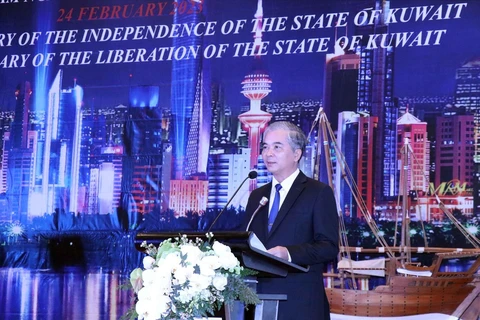
Speakers at a workshop on the development of the south-eastern region in HCM City on Friday.(Photo tuoitre.vn)
 HCM City (VNS/VNA) - Experts have called for continued efforts to improve the traffic infrastructure and implementation of reforms needed to make the southeastern region a leading economic engine of the country.
Speaking at a workshop on March 10, Prof Dr Su Dinh Thanh, rector of the University of Economics of Ho Chi Minh City, said the southeastern region, including HCM City and the provinces of Dong Nai, Binh Duong, Ba Ria-Vung Tau, Binh Phuoc, and Tay Ninh, had played a major role in Vietnam’s economic growth.
It contributed more than 30% of the country’s GDP and 45% of state revenues though it had only 23% of the population, he said.
The region was, however, facing problems related to traffic infrastructure, which had not been developed, causing high freight costs, affecting businesses.
It is the country’s most urbanised and economically vibrant region, according to Thanh.
HCM City and Binh Duong and Dong Nai provinces in particular, which have 40% of migrant workers, are facing huge urban and social infrastructure challenges.
Under a plan for until 2030 the region will have 970km of highways, but now has only 10% of that due to a lack of public investment and land acquisition challenges.
Prof Dr Nguyen Trong Hoai, editor-in-chief of the Journal of Asian Business and Economic Studies, said: “The region has great potential for long-term development, but there are signs of slowing down due to bottlenecks.”
There was a lack of skilled workers in the region.
R&D activities remained modest compared to the size of the economy, he pointed out.
Public funding was limited, he said. “Regional governance issues have also been a major issue.”
Another issue was that while the region contributed enormously to Government revenues, the expenditure per capita here was much lower than the national average.
Recommendations
Experts called on the region to continue economic restructuring, step up connectivity and promote science-technology and innovations.
Priority should be given to stabilising the economy, controlling inflation, ensuring economic balance, handling weaknesses in the medical sector, disbursing public investment, and promoting socio-economic recovery programmes for the region, they said.
The Government should establish a regional collaboration mechanism with enhanced functions and roles for planning and co-ordinating multi-sectoral programmes and projects on a regional scale, they added.
Prof Dr Vo Thanh Thu of the University of Economics of HCM City said it was vital to have a better salary policy to attract talent, and improve mechanisms and policies to foster R&D.
The region would also need to pay more attention to socio-cultural development, improving people’s material and spiritual lives and consolidating national security, she added.
The workshop was part of activities aimed at implementing a Politburo resolution issued last year.
By 2030 the region will become a dynamic development area with a high economic growth rate and the country’s growth spearhead.
It will become a hub for science and technology, innovation, logistics, and high-tech industry, and targets becoming an international financial centre for Southeast Asia and the world.
The event was organised by the University of Economics of HCM City.
To mark the occasion, the university launched the Institute for Regional Development Research and Consulting for conducting applied research and providing consulting services for businesses, especially small and medium-sized enterprises.
It also launched a human resource training programme for HCM City and the five south-eastern provinces for providing senior managers for the region./.
Speaking at a workshop on March 10, Prof Dr Su Dinh Thanh, rector of the University of Economics of Ho Chi Minh City, said the southeastern region, including HCM City and the provinces of Dong Nai, Binh Duong, Ba Ria-Vung Tau, Binh Phuoc, and Tay Ninh, had played a major role in Vietnam’s economic growth.
It contributed more than 30% of the country’s GDP and 45% of state revenues though it had only 23% of the population, he said.
The region was, however, facing problems related to traffic infrastructure, which had not been developed, causing high freight costs, affecting businesses.
It is the country’s most urbanised and economically vibrant region, according to Thanh.
HCM City and Binh Duong and Dong Nai provinces in particular, which have 40% of migrant workers, are facing huge urban and social infrastructure challenges.
Under a plan for until 2030 the region will have 970km of highways, but now has only 10% of that due to a lack of public investment and land acquisition challenges.
Prof Dr Nguyen Trong Hoai, editor-in-chief of the Journal of Asian Business and Economic Studies, said: “The region has great potential for long-term development, but there are signs of slowing down due to bottlenecks.”
There was a lack of skilled workers in the region.
R&D activities remained modest compared to the size of the economy, he pointed out.
Public funding was limited, he said. “Regional governance issues have also been a major issue.”
Another issue was that while the region contributed enormously to Government revenues, the expenditure per capita here was much lower than the national average.
Recommendations
Experts called on the region to continue economic restructuring, step up connectivity and promote science-technology and innovations.
Priority should be given to stabilising the economy, controlling inflation, ensuring economic balance, handling weaknesses in the medical sector, disbursing public investment, and promoting socio-economic recovery programmes for the region, they said.
The Government should establish a regional collaboration mechanism with enhanced functions and roles for planning and co-ordinating multi-sectoral programmes and projects on a regional scale, they added.
Prof Dr Vo Thanh Thu of the University of Economics of HCM City said it was vital to have a better salary policy to attract talent, and improve mechanisms and policies to foster R&D.
The region would also need to pay more attention to socio-cultural development, improving people’s material and spiritual lives and consolidating national security, she added.
The workshop was part of activities aimed at implementing a Politburo resolution issued last year.
By 2030 the region will become a dynamic development area with a high economic growth rate and the country’s growth spearhead.
It will become a hub for science and technology, innovation, logistics, and high-tech industry, and targets becoming an international financial centre for Southeast Asia and the world.
The event was organised by the University of Economics of HCM City.
To mark the occasion, the university launched the Institute for Regional Development Research and Consulting for conducting applied research and providing consulting services for businesses, especially small and medium-sized enterprises.
It also launched a human resource training programme for HCM City and the five south-eastern provinces for providing senior managers for the region./.
VNA