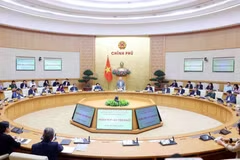
More than a year after Vietnam embarked on its sweeping administrative restructuring, the country's governance system has undergone significant changes. The administrative apparatus at all levels has been streamlined, intermediate layers reduced, and the functions, responsibilities and authority of state agencies gradually clarified. Greater decentralisation has also strengthened the role of grassroots authorities.
This also represents a shift in the mindset – merging not simply for streamlining but to achieve the ultimate goal of development and prosperity, Tuan said.
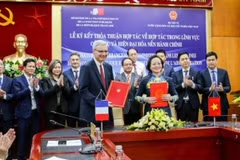
The Vietnamese Ministry of Home Affairs and the French Ministry of Public Sector Transformation and the Civil Service on March 31 signed a cooperation agreement in the field of public services and administrative modernisation.
Since the Center for Public Administration of Quang Ninh province was put into operation, all administrative tasks of the people have been shortened significantly.
The northern province of Vinh Phuc is pushing the review of functions, tasks, power and organization of provincial and district-level departments of the local administrations with a view to streamlining the apparatus.
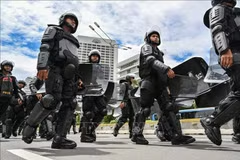
As many as 47,000 personnel from the Indonesian police, military and administration are mobilised to secure important landmarks across Jakarta on June 27 when the Constitutional Court (MK) is scheduled to announce its ruling on the presidential election dispute case.
The Vietnam Economic Yearbook 2019 points out two scenarios for the country’s economy this year, according to which the growth rate will be over 6.5 percent in the new context of the world.
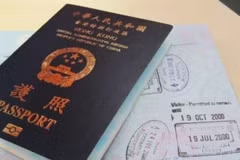
The Hong Kong Special Administrative Region of China has exempted Vietnamese diplomatic and official passport holders from visa requirements in the territory for 14 days.
The Ho Chi Minh City People’s Committee has ordered departments and district-level people’s committees to use electronic signatures when issuing electronic documents starting from June 1.