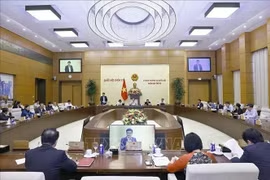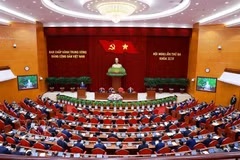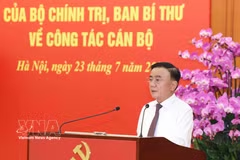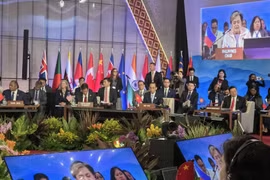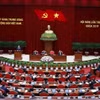
Hanoi (VNA) – In his keynote address at the third plenum of the 14th Party Central Committee on July 20, Party General Secretary and State President To Lam stressed that the meeting must turn the strategic directions set forth by the 14th National Party Congress into concrete policies to unlock the country's development resources with the first step being a shift from restructuring the organisational apparatus to improving the leadership and governance capacity and operational effectiveness of the Party, the State, and the political system.
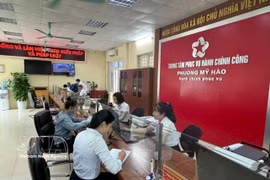
More than a year after Vietnam embarked on its sweeping administrative restructuring, the country's governance system has undergone significant changes. The administrative apparatus at all levels has been streamlined, intermediate layers reduced, and the functions, responsibilities and authority of state agencies gradually clarified. Greater decentralisation has also strengthened the role of grassroots authorities.
At the central level, the Government's organisational structure has been reduced from 22 ministries and ministry-level agencies to 17, while the number of the Government's subordinate agencies has fallen from eight to five. Ministries have also reviewed their internal structures, cutting the number of departments, sub-departments and equivalent units, while the former "general department" model has been abolished.
At the local level, Vietnam now has 34 provincial-level administrative units instead of 63. The country has reorganised its grassroots administration into 3,321 commune-level units, including 2,621 communes, 687 wards and 13 special zones, while the district-level administrations officially ended operations.
The restructuring of the state apparatus and the political system from the central to local levels is intended to reduce regular spending, which has long accounted for nearly 70% of the State budget - far higher than the 48-50% typically seen in countries with advanced public administration systems. Such a high share of regular expenditure leaves fewer resources for development investment, increasing the risk of slower growth, falling into the middle-income trap, weakening national competitiveness and undermining Vietnam's goal of becoming an upper middle-income country by 2030 and a high-income country by 2045.
However, streamlining the state apparatus is not the final objective. It is a means to achieve a much larger goal.
According to General Secretary and President Lam, streamlining the state apparatus is only the starting point for building a better "version" of the country - one where the Party exercises more effective leadership, the State governs more efficiently, the apparatus operates more quickly, public services become more responsive, and people's living standards continue to improve.
Objectively speaking, restructuring the administrative apparatus helps eliminate wastefulness, reduce bureaucracy and simplify organisational structures and procedures. Yet these efforts would lose their meaning if the system failed to become more dynamic, more efficient and more productive. Without better performance, the quality of public services would remain unchanged.
The current drive to streamline the state apparatus can only be considered successful if it delivers a genuine transition from merely reorganising institutions to substantially improving how they function in practice.
Vietnam's political system consists of the Party, the State, the Vietnam Fatherland Front and socio-political organisations, operating within a unified framework under the leadership of the Communist Party of Vietnam.
The first sign that this initial transformation is succeeding lies in the Party's ability to formulate timely and effective policies that meet the country's development requirements at each stage. Resolutions and directives should be capable of removing major bottlenecks that hinder national development.
Another indicator is the Party's ability to modernise its governing methods by ensuring that policies are implemented swiftly and effectively, ending the long-standing situation in which well-designed resolutions produce disappointing results because of weak implementation.
A well-governed State is also reflected in a shift away from fragmented management and localised mindset toward unified governance based on an integrated national development space. In this model, the State focuses on macro-level regulations while creating an open, transparent and fair investment environment.
Good governance also means that public agencies move from passively responding to problems to proactively forecasting and managing environmental, security and economic risks. Overlapping functions among agencies are eliminated, while public officials work according to clearly defined objectives, responsibilities, authority, resources, deadlines, expected outputs and measurable results.
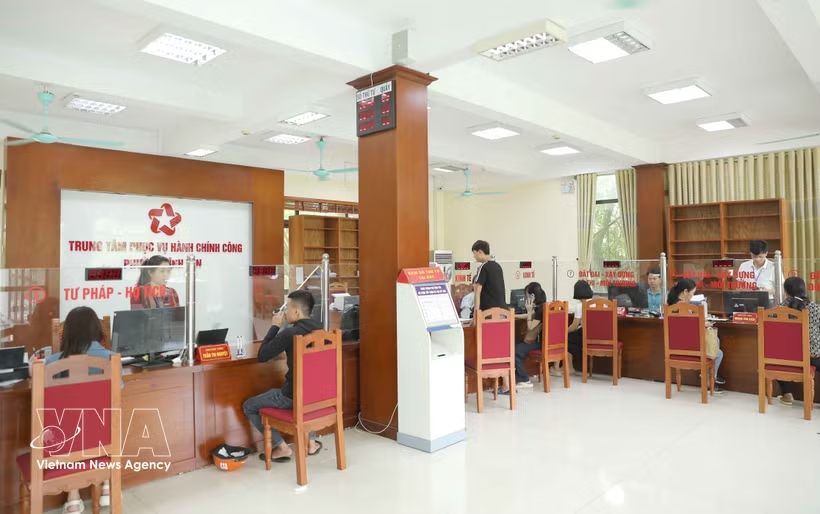
Another hallmark of effective governance is the wider application of technology in public administration, making procedures more convenient and placing citizens at the centre of public services.
Ultimately, the most important measure of good governance is public trust and satisfaction. That can only be achieved by replacing the traditional mindset of "State management" with that of a "State that serves and facilitates development."
Improving people's living standards is both the clearest indicator of effective governance and the ultimate objective of this first transformation. It also represents the central goal of Vietnam's national development strategy.
Every policy and decision of the Party and the State is aimed at serving the nation and its people while continuously improving their material well-being and quality of life.
As Party General Secretary To Lam stated at the first Congress of the Ho Chi Minh City Party Organisation on October 14, 2025: "The measure of development in the new era is not only the pace of economic growth, but also the quality of life, prosperity and happiness of the people"./.