Hanoi (VNA) – One year after Vietnam began operating its two-tier local administration model and carried out the country's biggest administrative restructuring in decades, the public administration has become leaner, with fewer intermediate levels and greater decentralisation to local authorities. Many procedures that once had to pass through several administrative layers can now be handled directly at the local level. But the realities over the past year also show that reducing the number of agencies is only the first step.
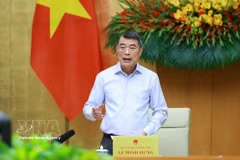
At a recent working session with the Central Steering Committee reviewing one year of the new organisational model of the political system and the three-tier administration model, General Secretary of the Communist Party of Vietnam (CPV) Central Committee and State President To Lam said the entire political system had completed an enormous workload and successfully reorganised the administrative apparatus within a short period of time.
That achievement is significant because the reform was carried out on several fronts at once. It involved restructuring the state apparatus, reorganising administrative units, and changing the local administration model.
The scale of the reform is evident in the numbers. The Government's organisational structure was reduced from 22 ministries and ministry-level agencies to 17. The Government's subordinate agencies were cut from eight to five. The "general department" model within ministries was abolished, and many intermediate units were removed. From July 1, 2025, Vietnam officially adopted a two-tier local administration system consisting of 34 provincial-level administrative units and 3,321 commune-level units, while all 696 district-level administrative units ceased operations.
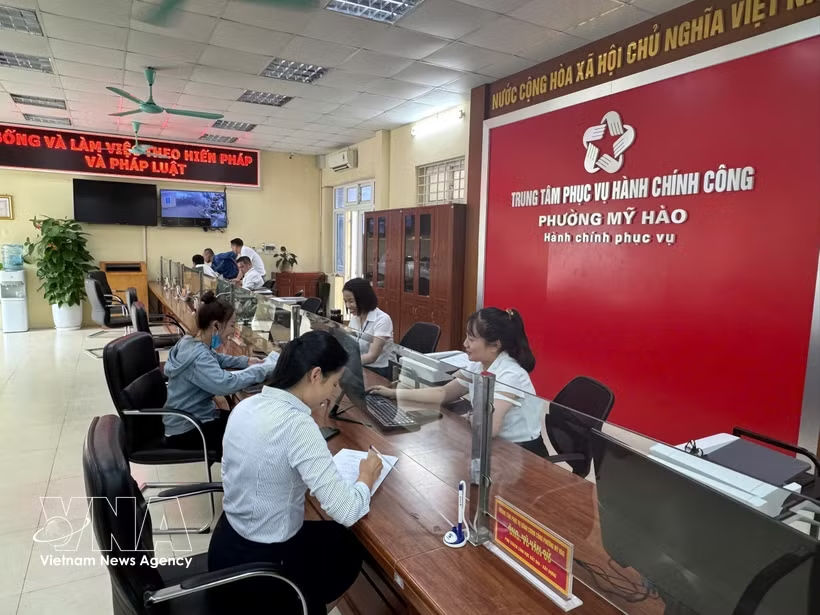
Removing one administrative layer has made it easier to delegate more authority to local administrations. Many responsibilities that previously had to go through district authorities are now handled directly by provincial or commune administrations. This is an important change because the ultimate goal is to deliver faster public services, bring the administrations closer to the people, and make responsibilities clearer.
Alongside institutional restructuring, there is a major reorganisation of the public workforce. Between January 1 and December 31, 2025, as many as 209,598 officials, civil servants and public employees left their positions under the restructuring programme, the introduction of the two-tier local administration model and staff streamlining policies.
The number of part-time workers at the commune level also fell sharply, from more than 106,900 to just over 48,000 during the transition period before the positions are phased out according to the reform roadmap.
However, this reform is not simply about reducing staff numbers. The Party's policy is shifting from managing payroll quotas to managing human resources based on job positions. The Politburo's Regulation No. 183-QD/TW and Conclusion No. 40-KL/TW clearly reflect this new approach. Staffing is no longer viewed merely as a headcount but is linked to each agency's functions, assigned tasks, job positions, workload, digital transformation requirements, decentralisation responsibilities and actual performance.
This represents a major shift in mindset. In the past, many agencies sought additional staffing quotas. Now, the emphasis is on making better use of existing personnel, assigning the right people to the right jobs, and measuring performance through results.
At the same time, the central authorities have openly acknowledged the shortcomings revealed during the first year of implementation.
General Secretary and State President To Lam pointed out that while the administrative structure has been streamlined, its performance remains uneven. Although the number of organisational units has been reduced, governance quality has not yet met expectations. Authority has been decentralised, but many localities still lack the resources, capacity and tools needed to carry out their expanded responsibilities effectively.
The realities at the grassroots level reflects these challenges. Commune authorities are now responsible for a much heavier workload than before. They have taken on additional duties in land management, construction, finance, justice, agriculture, environmental protection and social affairs. Yet the capacity of local officials, infrastructure conditions and levels of development vary considerably across the country.
In many areas, digital infrastructure remains incomplete. Databases are fragmented, and specialised software systems are still unable to communicate with one another. Remote, mountainous and border regions continue to face difficulties in telecommunications and information technology. In some localities, commune-level officials are under heavy pressure as workloads increase while staffing remains limited and training has yet to catch up.
The central authorities have also warned of risks that must be addressed early. Administrative reform has so far focused mainly on reducing organisational units rather than ensuring better public services. Significant differences remain in the quality of public services between major cities and remote areas, and between places with strong digital capacity and those that are still lagging behind.
Grassroots officials often face excessive workloads, increasing the risk of hesitation and reluctance to make decisions. In some cases, newly established administrative boundaries do not align well with economic zones, urban areas, industrial parks, tourism destinations, ecological regions or development corridors. As a result, some residents now have to travel farther, spend more time and incur higher costs to access public services because service centres are not always located conveniently.
Many localities have actively sought ways to improve the operation of the new model.
The northern province of Hung Yen, for example, assigned 316 civil servants and public employees to strengthen commune-level administrations. The provincial Party Committee's Standing Board requested that experienced and capable officials must be deployed to areas with the heaviest workloads and the greatest difficulties. The province is also introducing policies to encourage young and talented officials to work at the grassroots level while preparing a new programme to improve the quality of commune-level personnel.
The Mekong Delta City of Can Tho has received 949 tasks delegated by central authorities. The city has issued 22 decentralisation decisions and 42 authorisation decisions across various sectors. It has completed organisational restructuring, transferred 103 local health stations to commune-level management and established 103 commune-level integrated public service centres. At the same time, it is reviewing staff assignments, accelerating digital transformation and pursuing its economic growth targets.
The northern province of Ninh Binh provides another example. Following the mergence of the former provinces of Ha Nam, Nam Dinh and Ninh Binh, the new province now operates on a much larger scale. During the past year, it issued 119 documents on decentralisation and delegated 79 responsibilities from the provincial to the commune level. All 2,026 administrative procedures have been integrated into the National Public Service Portal. In 2025, the province ranked fourth nationwide in administrative reform and first in digital transformation among state agencies.
Although Ninh Binh has achieved encouraging results, it has continued to acknowledge remaining difficulties. These include uneven quality among grassroots officials, digital infrastructure and shared databases that still fall short of demand, sector-specific regulations that have yet to catch up with the new governance model, and decentralisation that is not always supported by adequate resources or legal frameworks.
These are challenges shared by many localities across the country. Both central and local authorities agreed that the next stage of reform must focus on improving institutions, reviewing decentralisation policies, strengthening resources for grassroots administrations, accelerating digital transformation, building a professional workforce based on job positions, identifying and developing talented personnel, while enhancing accountability and ensuring effective oversight of public power.
The first year has been only the beginning of a far-reaching reform process. The challenges are becoming clearer, and solutions are being introduced in a more coordinated manner. As institutions continue to improve, resources are allocated more effectively, officials are placed where their abilities can be best used, and digital transformation advances further, Vietnam's two-tier local administration model is expected to deliver increasingly better results for both the State and its people./.
VNA