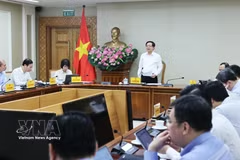
Hanoi (VNS/VNA) – A dedicated chapter on risk management in the funding and commissioning of science and technology projects has been introduced for the first time under a newly-issued Government decree.
The Decree No. 229/2026/ND-CP on the organisation and operation of the National Foundation for Science and Technology Development was issued on June 25 by the Government.
Associate Professor Dao Ngoc Chien, director of the National Foundation for Science and Technology Development, said risk management is embedded from the very beginning of the project selection process.
Each proposed research project will undergo a risk assessment based on evaluations provided by scientific advisory councils.
The decree also clearly defines the risk management responsibilities of organisations and individuals undertaking science and technology projects funded or commissioned by the foundation, as well as the foundation's own risk management obligations.
Specifically, when the foundation receives reports from host organisations or project leaders regarding emerging risks in funded or commissioned projects, it is required to conduct ad hoc inspections and assessments to evaluate response capabilities, mitigate consequences, and determine the causes and extent of the risks involved.
If evidence of fraud or deliberate legal violations is detected during project implementation, the foundation will report the matter and recommend that the competent authorities take action in accordance with the law.
"Our guiding principle is to accept risks in a controlled manner," Chien said.
Where a project fails to achieve its intended outcomes, organisations or individuals that have complied with professional procedures, management regulations and transparency requirements may be exempt from administrative liability, and funding will not be reclaimed under current regulations.
Chien also added that one of the decree's key features is its clearer definition of the foundation's operating model as an independent science and technology funding body that functions transparently and competitively in line with international standards.
He said the foundation's operations have also been redesigned to enhance autonomy while linking decision-making authority with accountability.
Funding, commissioning and support activities will be carried out through independent expert evaluations, ensuring academic freedom, objectivity, openness and transparency, while upholding scientific integrity and professional ethics in research and technological development.
Another major reform introduced by the decree is a new financial mechanism that grants the foundation greater operational autonomy by shifting from input-based management to an output-oriented funding model.
The decree also sets out provisions to support initiatives aimed at strengthening the country's science and technology capacity.
Under the new regulations, the foundation will support the development of the national science and technology workforce through schemes for young scientists, postdoctoral researchers and doctoral candidates.
It will also fund overseas research placements and short-term academic exchanges, invite distinguished international scientists to Vietnam for scholarly collaboration, and provide assistance to outstanding young scientists and talented young engineers.
Notably, the decree introduces support for research activities undertaken by leading scientists with outstanding achievements in scientific research and technological development, helping foster high-performing research groups and enhance national scientific and technological capabilities.
Another new provision, set out in Article 19 of Chapter IV on support for strengthening national science and technology capacity, stipulates that the foundation will finance technology validation activities for technologies derived from scientific research outcomes, patents, technical solutions, technology prototypes and transferred technologies requiring validation under Vietnamese conditions.
The objective is to assess their scientific and technical feasibility, complete validation data and ensure that technologies have reached the required level of readiness for further development or commercial transfer.
He said that technology validation support represents a crucial transitional stage for promising research ideas that have yet to become fully developed products.
“Assistance in refining technologies and evaluating their practical applications will enable research outcomes to reach the market more effectively and facilitate the establishment of technology-based start-ups,” he said./.
See more
Smart tourism takes hold nationwide
Under the country’s 2026–2030 digital economy and digital society development programme, the sector has been identified as one of the priority ones for accelerating digital transformation to improve governance efficiency, service quality, and visitor experiences.
Quang Ngai makes strides in digital transformation
All administration agencies from provincial to commune levels are now connected to a dedicated data transmission network, while all villages gain access to mobile and internet services.
Vietnam highlights science, innovation cooperation at ASEAN ministerial meeting in Laos
Vietnam called for enhanced cooperation and the establishment of common regional frameworks for emerging strategic technologies such as artificial intelligence (AI), big data, space technology and cybersecurity to create a secure digital business environment and improve ASEAN's overall competitiveness.
First national semiconductor chip prototyping support centre makes debut
Vietnam's semiconductor ecosystem now comprises around 60 chip design companies, some 7,000 chip design engineers and 166 universities offering semiconductor-related training programmes. Initial registrations from 12 organisations indicate demand for the prototyping of approximately 30,000 chips.
Dien Bien approves UAV sandbox for low-altitude economy development
The Dien Bien provincial People's Committee on June 23 authorised a controlled pilot programme for digital technology-based products and services using unmanned aerial vehicles (UAVs), targeting a flight safety rate of over 99% during the trial period.
Vietnam redefines growth through strategic technologies: Forum
Vietnam should stop simply using technology and start truly mastering artificial intelligence (AI), semiconductors, clean energy and advanced materials; swap a resource-driven economy for one fired by innovation, knowledge and talent; and ditch cheap labour as its main calling card in favour of real technological competitiveness that lifts the country into higher-value global supply chains.
Identifying right competitive advantages key to breaking through in AI era: Expert
Vietnam should develop a “borderless national intellectual network”, enabling Vietnamese professionals living abroad to contribute as visiting professors, strategic advisers, research leaders or co-directors of key laboratories. Such a model would help tap into global expertise without requiring specialists to return home permanently., according to Assoc. Prof., Dr Nguyen Thanh Phuong of the Department of Information Engineering, Computer Science and Mathematics (DISIM) at the University of L’Aquila in Italy.
Flexible policies key to unlocking Vietnam’s strategic technology ambitions: expert
According to Assoc. Prof. Dr. Tran Le Hung from Gustave Eiffel University (France), many countries have invested heavily in cutting-edge technologies but have failed to achieve expected results. The main constraints, he said, are often not capital or human resources, but regulatory bottlenecks, policy policies and implementation mechanisms.
Vietnam needs full-spectrum workforce for nuclear power development: insiders
Developing nuclear power therefore requires a comprehensive ecosystem in which every component is supported by highly skilled personnel.
Int’l cooperation boosts resources for science, technology, innovation
Strengthening international cooperation not only helps mobilise research resources but also enables Vietnamese scientists to integrate more deeply into global research networks, access advanced technologies and gradually enhance the country’s innovation capacity.
Vietnam advised to prioritise high-value tech links to strengthen global supply chain position
The expert said Vietnam should be particularly wary of what he described as the "technology protectionism trap" - investing heavily in developing products that serve only the domestic market but lack the competitiveness to succeed on the international markets.
Investment should prioritise strategic technologies: Deputy PM
Under the draft project, research infrastructure development will align with Vietnam’s science, technology and innovation strategy, focusing on strategic technologies. The system will follow a unified three-tier model, prioritising the upgrading, integration and shared use of existing facilities, while ensuring operational efficiency, accountability, data security, intellectual property protection and national interests.
Vietnam, RoK drive semiconductor, AI training collaboration
Vice President of Hoseo University Sung Eun-hyun said her school is turning itself into a specialised semiconductors and AI training hub while seeking to expand cooperation with Vietnamese universities and colleges.
Can Tho students gain tools to navigate misinformation in digital era
Recently, the Can Tho campus of the Saigon College of Technology held a seminar on information literacy in the digital age. The programme focused on practical skills such as searching for, filtering and evaluating online information, while also introducing students to regulations on cybersecurity, intellectual property rights, digital citizenship and the responsible use of generative AI.
Vietnam needs unified national network to master quantum technology: Experts
Experts urged that developing post-quantum cryptography and protecting national digital infrastructure must begin immediately.
Solutions needed to turn science, technology, innovation into key growth driver
Development efforts should properly recognise and leverage the role of science and technology in creating new economic models based on emerging resources.
Season two of AI game show launched to cultivate tech talent
This is the largest prize ever offered in a Vietnamese AI competition, reflecting the bank’s long-term commitment to advancing science and technology, innovation and digital transformation in line with Politburo Resolution No. 57.
Vietnam News Agency launches first digital-specialised information platform
The VNA not only has a responsibility to communicate and promote the spirit of innovation across society but must also take the lead in applying technology, modernising journalism practices and developing practical, high-value media products for the public.
Vietnam accelerates tourism digitalisation via AI, data ecosystems
Under this blueprint, tourism is designated as a high-priority sector to enhance the use of digital technology to improve management capabilities, service quality, and the visitor experience.
Vietnamese tech firm showcases innovations at Eurosatory 2026
As the only Vietnamese tech firm exhibiting directly at the event, Gremsy's participation highlights the growing ability of domestic enterprises to integrate into global technology value chains and compete in high-tech international markets.