Vietnam needs full-spectrum workforce for nuclear power development: insiders

Developing nuclear power therefore requires a comprehensive ecosystem in which every component is supported by highly skilled personnel.

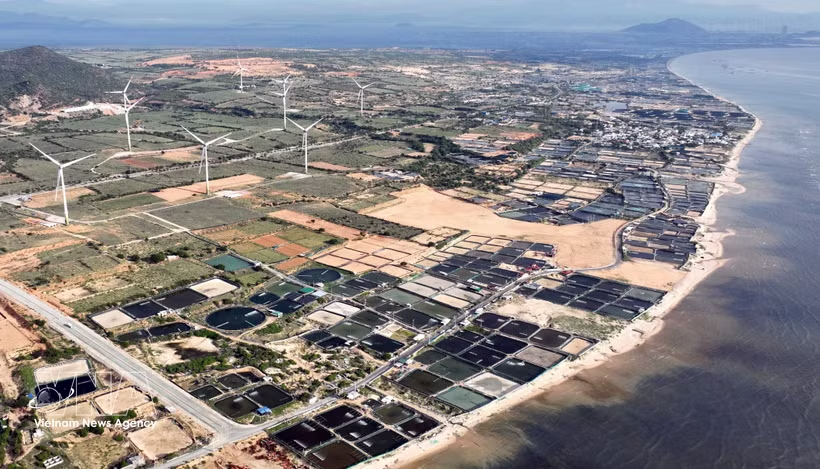
A view of the site designated for the Ninh Thuan 1 nuclear power plant project in Phuoc Dinh commune, Khanh Hoa province (Photo: VNA)

Hanoi (VNA) – Vietnam must not only train enough personnel for future nuclear power plants but also build the core capabilities needed across the entire national nuclear ecosystem, ensuring every link in the system is fit for purpose and staffed by appropriately qualified human resources, said insiders.

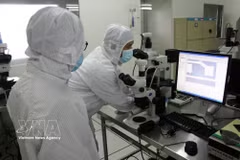
Nguyen Tuan Khai, Deputy Director of the Vietnam Atomic Energy Institute (VINATOM) under the Ministry of Science and Technology, said while nuclear power is often associated only with plant operators, a nuclear power programme in fact requires the participation of a much broader workforce, including research institutions, state regulatory agencies, domestic and international technical support teams, training institutions, and authorities in the localities where the project is implemented.

Developing nuclear power therefore requires a comprehensive ecosystem in which every component is supported by highly skilled personnel. Given this, the challenge is not limited to preparing operators for future plants but also to strengthening the country's overall nuclear capabilities, a goal Vietnam identified early in its preparations for nuclear power development.

Vietnam had previously invested in workforce training during the preparation for the Ninh Thuan nuclear power project before 2016, when Vietnam Electricity (EVN) sent around 400 staff members to Russia and Japan for training in nuclear technology, and plant operation and management.

However, Tran Chi Thanh, Director of VINATOM, said nuclear power is among the world's most technologically complex and safety-critical industries, requiring multidisciplinary expertise spanning nuclear science, engineering, technology and stringent safety standards.

Building a core operating workforce typically takes at least a decade of education and practical experience, he said, noting that personnel must acquire broad knowledge in nuclear and reactor physics, electrical engineering, automation, materials science, thermodynamics, chemistry, as well as plant design, operation and economic evaluation.

Energy experts said nuclear power development should be viewed as a long-term national capability-building process, requiring interdisciplinary expertise, practical experience and a strong safety culture.

The International Atomic Energy Agency (IAEA) likewise recommends treating nuclear power development as a national programme rather than a single construction project. Such a programme encompasses legislation, a regulatory system, research capacity, technical infrastructure, human resources and safety arrangements throughout the entire nuclear power lifecycle.

Alongside plans to restart the Ninh Thuan nuclear power project, Vietnam has introduced some special policies and mechanisms and approved a national human resources training programme serving nuclear power development through 2035.

However, restarting the nuclear power programme also requires strengthening the State's regulatory capacity, with improving the Vietnam Agency for Radiation and Nuclear Safety under the Ministry of Science and Technology regarded as a key priority, laying the institutional foundation for the country’s nuclear power development programme in the time to come.

The agency is responsible for nuclear safety, security and safeguards, but its current organisational structure has yet to meet specialised requirements for regulating nuclear power plants.

To address this issue, the Government has approved a plan to strengthen the capabilities of the agency through 2035, aiming to develop it into a fully empowered national nuclear regulatory authority with the legal mandate, resources, and technical capacity to effectively carry out state management of radiation safety, nuclear safety, and nuclear security.

Experts said Vietnam's parallel efforts to strengthen investment, workforce development and regulatory capacity demonstrate that nuclear power is being pursued as a long-term national programme extending far beyond plant construction, covering operation, lifetime extension, decommissioning and spent fuel management./.​

VNA

See more

Deputy Prime Minister Ho Quoc Dung chairs the meeting in Hanoi on June 23. (Photo: VNA)

Investment should prioritise strategic technologies: Deputy PM

Under the draft project, research infrastructure development will align with Vietnam’s science, technology and innovation strategy, focusing on strategic technologies. The system will follow a unified three-tier model, prioritising the upgrading, integration and shared use of existing facilities, while ensuring operational efficiency, accountability, data security, intellectual property protection and national interests.

A speaker from the Internal Political Security Division under the Can Tho Department of Public Security delivers a cybersecurity awareness session for students at Can Tho University. (Photo: VNA)

Can Tho students gain tools to navigate misinformation in digital era

Recently, the Can Tho campus of the Saigon College of Technology held a seminar on information literacy in the digital age. The programme focused on practical skills such as searching for, filtering and evaluating online information, while also introducing students to regulations on cybersecurity, intellectual property rights, digital citizenship and the responsible use of generative AI.

Vietnamese delegates visit a booth at the Eurosatory 2026. (Photo: VNA)

Vietnamese tech firm showcases innovations at Eurosatory 2026

As the only Vietnamese tech firm exhibiting directly at the event, Gremsy's participation highlights the growing ability of domestic enterprises to integrate into global technology value chains and compete in high-tech international markets.

Engineers monitor and operate the power system at the central control room at the Northern Power Corporation (EVNNPC)’s Thanh Hoa Power Company in May 2025. (Photo: VNA)

Vietnam boosts financial investment to drive innovation

Resolution No. 57-NQ/TW of the Politburo on the development of science, technology, innovation and national digital transformation states that these areas are becoming not only prerequisites but also a historic opportunity for the country to achieve prosperity and strengthen national competitiveness in a new era of development.

An automated robot demonstrates at the National Forum on the Development of Vietnamese Technology Enterprises in 2025. (Photo: VNA)

Vietnam targets at least 10 large strategic technology firms by 2030

Deputy Prime Minister Ho Quoc Dung has signed a decision approving a plan to develop large domestic strategic technology enterprises in the 2026–2030 period, aimed at advancing digital infrastructure, digital human resources, digital data, strategic technologies and cybersecurity.

Visitors explore technology exhibition booths during the Data & AI Forum in Ho Chi Minh City on May 8, 2026. (Photo: VNA)

AI, social media redefines corporate communications

It has become part of Vietnam’s national digital transformation agenda under Politburo Resolution No. 57-NQ/TW dated December 22, 2024, which seeks to establish data, technology, innovation and digital governance as new pillars of economic competitiveness.

Illustrative image (Photo: VOV)

Valuing IP: Global standards and Vietnam’s realities

Vietnam’s legal framework already enables intangible asset valuation, and international methodologies can be applied. Yet IP valuation remains a knotty problem for regulators, valuation firms, universities, research institutes and businesses, all of whom are hunting for clearer roadmaps.

Deputy Prime Minister Ho Quoc Dung speaks at the meeting on June 17 (Photo: VNA)

Deputy PM urges faster completion of science, technology, digital transformation regulations

Deputy PM Ho Quoc Dung stressed the need for close coordination among the Ministry of Science and Technology, the Ministry of Justice and the Government Office to finalise and submit for issuance key decrees guiding the implementation of the Law on High Technology and the Law on Digital Transformation within this month, thus enabling them to be brought into practice as soon as possible.

Can Tho city has guaranteed that at least 1% of its total budget expenditure will be allocated to science, technology, and innovation (Photo: VNA)

New tax incentives expected to boost science, technology enterprises

The incentives are also expected to attract and retain scientists and technology experts while providing enterprises with additional resources to enhance competitiveness in strategic sectors such as artificial intelligence, semiconductors, software and biotechnology.

An engineer at the Digital Transformation Centre under the Khanh Hoa provincial Department of Science and Technology performs equipment maintenance. (Photo: VNA)

Efforts needed to safeguard data security in digital era

Vietnam’s cybersecurity landscape has witnessed a notable shift in recent years. While the number of cyberattacks recorded in 2025 showed signs of decline, the proportion of organisations suffering actual damage rose to 52.3%. Cyberattacks increasingly target critical sectors, including banking, finance, energy, telecommunications, and government agencies.