New tax incentives expected to boost science, technology enterprises

The incentives are also expected to attract and retain scientists and technology experts while providing enterprises with additional resources to enhance competitiveness in strategic sectors such as artificial intelligence, semiconductors, software and biotechnology.

Can Tho city has guaranteed that at least 1% of its total budget expenditure will be allocated to science, technology, and innovation (Photo: VNA)

Hanoi (VNA) – New tax incentives taking effect in 2025 and 2026 are expected to provide significant support for science and technology enterprises, helping create new growth drivers in line with the Politburo's Resolution No. 57-NQ/TW on science, technology, innovation and digital transformation.

Stronger tax incentives

According to the Ministry of Finance, tax incentives for science, technology and innovation are now comparable to, or even more favourable than, those of many countries in the region.

Under the Corporate Income Tax Law, effective from October 1, 2025 and applicable to the 2025 tax year, enterprises may deduct research and development (R&D) expenses at up to twice their actual value for tax purposes.

The law also allows companies to allocate up to 20% of pre-tax profits to science and technology development funds, double the previous cap of 10%.

High-tech and strategic technology projects are eligible for a preferential 10% corporate tax rate for 15 years, a four-year tax exemption and a 50% reduction in payable tax for the following nine years.

The Personal Income Tax Law, effective from July 1, 2026, exempts income derived from scientific research, technology and innovation activities. Highly skilled technology professionals and high-quality digital technology workers will also enjoy a five-year exemption on employment income.

Import tax incentives have been expanded to cover machinery, equipment, materials and components used directly in science and technology activities and the digital technology industry. Scientific organisations, high-tech enterprises and newly established high-tech manufacturing projects will receive import tax exemptions for five years from the start of research or production activities.

Supporting talent, innovation

Associate Professor and Dr Ly Phuong Duyen of the Academy of Finance said the new measures reflect the Party and State’s commitment to attracting highly qualified human resources to priority sectors.

She noted that the revised PIT Law incorporates tax exemptions introduced under National Assembly resolutions on special mechanisms to accelerate science and technology, innovation, digital transformation and private-sector development.

Tax incentives are one of the most important tools for encouraging businesses to invest in research and development, Duyen said, adding that lower technology investment costs would encourage enterprises to commercialise research outcomes and strengthen competitiveness.

Nguyen Van Duoc, General Director of Trong Tin Accounting and Tax Consultancy Co., Ltd., said PIT incentives for science and technology professionals form an important part of broader policies aimed at promoting innovation, with human resources at the centre.

The incentives, he said, will improve workers’ income, help enterprises attract and retain skilled talent, draw foreign experts and reduce brain drain. However, clear implementation guidelines will be needed to ensure consistent application, he stressed.

Boosting business competitiveness

Nguyen Cao Giap, CEO of GHT Group, said tax incentives would give technology startups greater financial flexibility to reinvest in R&D, product development and market expansion, particularly during their early years.

The policies are also expected to encourage the establishment of new technology enterprises and innovation-driven business models, contributing to higher-quality growth in the private sector.

Nguyen Van Dung, General Director of Lancom JSC, said the corporate tax incentives would stimulate investment in science and technology while increasing resources for innovation and digital transformation.

He noted that the measures would help startups overcome early cash-flow challenges and strengthen Vietnam’s technology ecosystem in regional competition.

The incentives are also expected to attract and retain scientists and technology experts while providing enterprises with additional resources to enhance competitiveness in strategic sectors such as artificial intelligence, semiconductors, software and biotechnology./.

VNA

See more

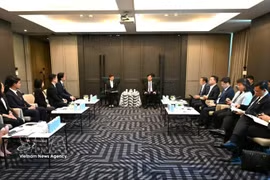
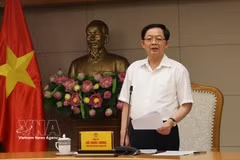
Deputy Prime Minister Ho Quoc Dung speaks at the meeting on June 17 (Photo: VNA)

Deputy PM urges faster completion of science, technology, digital transformation regulations

Deputy PM Ho Quoc Dung stressed the need for close coordination among the Ministry of Science and Technology, the Ministry of Justice and the Government Office to finalise and submit for issuance key decrees guiding the implementation of the Law on High Technology and the Law on Digital Transformation within this month, thus enabling them to be brought into practice as soon as possible.

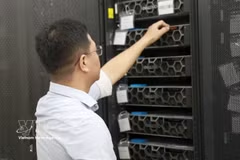
An engineer at the Digital Transformation Centre under the Khanh Hoa provincial Department of Science and Technology performs equipment maintenance. (Photo: VNA)

Efforts needed to safeguard data security in digital era

Vietnam’s cybersecurity landscape has witnessed a notable shift in recent years. While the number of cyberattacks recorded in 2025 showed signs of decline, the proportion of organisations suffering actual damage rose to 52.3%. Cyberattacks increasingly target critical sectors, including banking, finance, energy, telecommunications, and government agencies.

A worker from Hanoi branch of the Viettel Construction Corporation is connecting and installing 5G BTS station equipment. (Photo: VNA)

Vietnam expects digital economy to contribute 30% of GDP by 2030

The country also aims to support at least 500,000 small and medium-sized enterprises in digital transformation, develop a minimum of five digital technology companies capable of competing with counterparts in advanced economies, and establish at least five operational data exchanges.

The international conference takes place in Varna city, Bulgaria, from June 10 to 12. (Photo: VNA)

Vietnam hopes to enhance nuclear energy cooperation with Bulgaria: ambassador

Highly valuing Bulgaria's extensive experience in operating the Kozloduy nuclear power plant and training specialised personnel, Ambassador Nguyen Thi Minh Nguyet proposed boosting bilateral cooperation in specialist training, scientific research, and the sharing of management, operational, and nuclear safety expertise.

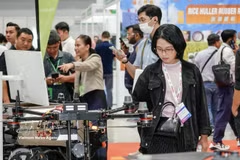
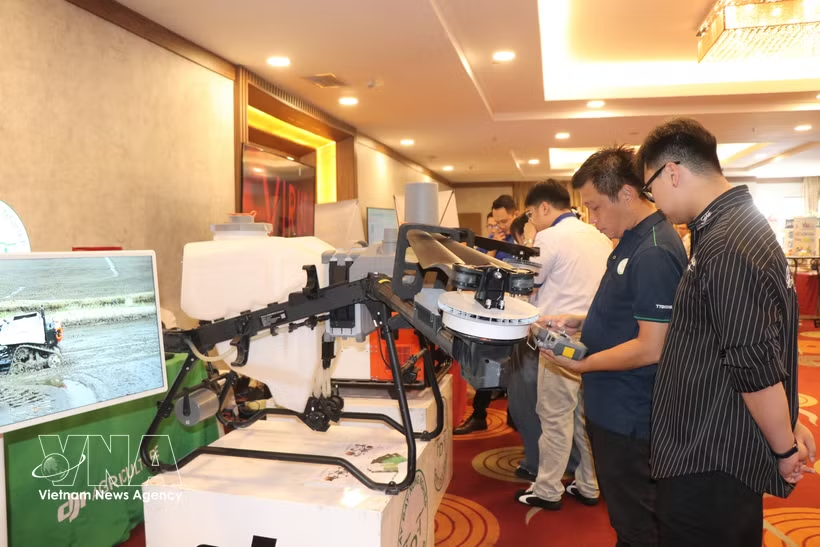
Visitors explore agricultural production equipment on display at Agri & Biotech Vietnam 2026 in Ho Chi Minh City. (Photo: VNA)

Agri-biotech exhibition series underway in Ho Chi Minh City

In addition to the exhibition activities, Agri & Biotech Vietnam 2026, lasting until June 12, is set to host a series of specialised forums and seminars. Topics of particular interest to businesses include farming exports, sustainable development of the pepper and spice industries, low-emission agriculture, carbon credits, the circular economy, biotechnology and innovative start-ups.

At Expo Tel Aviv in Israel (Photo: VNA)

Digital transformation fuels demand for cybersecurity talent

According to the National Cybersecurity Association (NCA), cyberattacks are rising in both frequency and severity. Attackers are targeting critical infrastructure, personal data, and public services with increasingly advanced methods. This isn't just a technical glitch, but a systemic vulnerability requiring a workforce that can analyse and respond in real time.

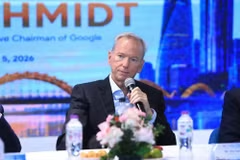
Billionaire Eric Schmidt, former Chairman and CEO of Google and former Chairman of the US National Security Commission on Artificial Intelligence (NSCAI) (Photo: NIC/VietnamPlus)

Vietnam well-positioned to become global AI hub: Eric Schmidt

Vietnam possesses significant advantages and strong potential to emerge as a global centre for artificial intelligence (AI), according to billionaire Eric Schmidt, former Chairman and CEO of Google and former Chairman of the US National Security Commission on Artificial Intelligence (NSCAI).

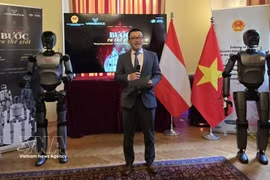
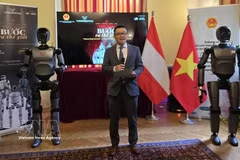
Vietnamese Ambassador to Austria Vu Le Thai Hoang speaks at the event. (Photo: VNA)

Vietnam shows off homegrown humanoid robots in Austria

The event paired a robotics showcase with an innovation networking session, spotlighting Vietnamese companies’ research, development and technological mastery in robotics, automation and artificial intelligence.

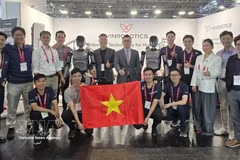
Vietnamese delegates at the 2026 IEEE International Conference on Robotics and Automation (ICRA 2026). (Photo: VNA)

Vietnamese tech draws attention at Austria robotics forum

Representing Vietnam were VinRobotics and VinDynamics, two tech subsidiaries of Vingroup. They showcased "Make in Vietnam" humanoid robots, demonstrating the country’s growing capacity to integrate into the global robotics value chain.

Deputy Prime Minister Ho Quoc Dung speaks at the meeting of the Government task force on strategic technology development on June 4. (Photo; VNA)

Deputy PM demands tangible results in strategic tech development

Deputy PM Ho Quoc Dung pressed ministries and agencies to rapidly convert their assigned tasks into concrete action plans with clearly defined responsibilities, and effectively launch projects that create strategic technology products capable of sharpening national competitiveness.