Vietnam well-positioned to become global AI hub: Eric Schmidt

Vietnam possesses significant advantages and strong potential to emerge as a global centre for artificial intelligence (AI), according to billionaire Eric Schmidt, former Chairman and CEO of Google and former Chairman of the US National Security Commission on Artificial Intelligence (NSCAI).

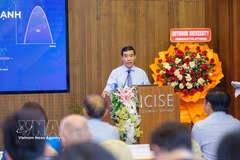
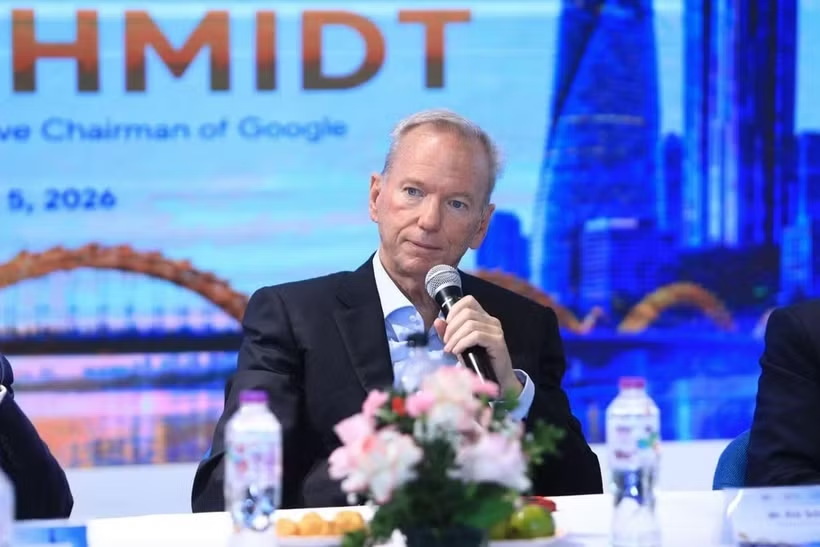
Billionaire Eric Schmidt, former Chairman and CEO of Google and former Chairman of the US National Security Commission on Artificial Intelligence (NSCAI) (Photo: NIC/VietnamPlus)

Hanoi (VNA) - Vietnam possesses significant advantages and strong potential to emerge as a global centre for artificial intelligence (AI), according to billionaire Eric Schmidt, former Chairman and CEO of Google and former Chairman of the US National Security Commission on Artificial Intelligence (NSCAI).

Schmidt recently led a delegation of international AI experts to Vietnam to discuss the country’s AI future. The visit was organised by the National Innovation Centre (NIC) in collaboration with the Global Artificial Intelligence Alliance.

Speaking at a dialogue on the future of AI in Vietnam, which brought together leaders of leading technology corporations, businesses, research institutes, universities, and top experts in technology, innovation, and AI in Vietnam, Schmidt said with its strong human capital, exemplified by Vietnam’s consistent ranking among the world’s top performers at the International Mathematical Olympiad (IMO), the country has significant potential to become a leader in artificial intelligence (AI) in the future.

Widely recognised as a leading technology investor and one of the figures shaping the future of AI and global technology, the visit by Schmidt, along with other international experts, is seen as an important milestone in strengthening connectivity and cooperation between Vietnam and some of the world’s foremost technology architects and enterprises in the AI sector.

The visit came as Vietnam is accelerating the implementation of the Politburo’s Resolution No. 57-NQ/TW on breakthroughs in science and technology development, innovation, and national digital transformation. AI has been identified as one of the country’s top priorities to enhance national competitiveness and create new drivers of economic growth.

In his opening speech, NIC Director Vu Quoc Huy said Vietnam is facing a historic opportunity to make breakthroughs in AI and other strategic technologies.

As the national focal point for innovation, the NIC is actively connecting the Government, businesses, research institutions, and universities with global technology corporations, investment funds, and international expert networks to promote innovation, accelerate AI transformation, and enhance the competitiveness of Vietnamese enterprises, Huy said.

He added that one of the NIC’s key priorities is to attract leading global technology giants, top-tier investment funds, scientists, and technology experts to Vietnam to help build a dynamic innovation ecosystem, and support Vietnamese businesses in gaining access to advanced technologies, high-quality capital, and global markets.

Through these efforts, the NIC seeks to nurture a new generation of internationally competitive Vietnamese technology companies and foster the emergence of fast-growing enterprises and technology unicorns in AI, semiconductors, quantum technology, robotics, unmanned aerial vehicles (UAVs), digital technologies, and green technologies, Huy said.

At the discussion, Schmidt highly valued Vietnam’s vision and direction for AI development. He also expressed his willingness to support Vietnam in establishing a private AI investment fund, connecting Vietnamese businesses and global talent networks; and provide scholarships for students.

He said that the proposed initiatives are expected to be implemented in cooperation with the NIC, Vietnamese universities, and relevant agencies in the near future, contributing to promoting the country’s AI and innovation ecosystem.

Participants at the event also exchanged views on opportunities and challenges facing Vietnam’s AI ambitions, including the development of computing infrastructure, data centres, sovereign AI, high-quality human resources, research and development (R&D), and the building of a national AI and innovation ecosystem./.
VNA

See more

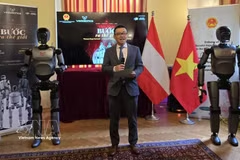
Vietnamese Ambassador to Austria Vu Le Thai Hoang speaks at the event. (Photo: VNA)

Vietnam shows off homegrown humanoid robots in Austria

The event paired a robotics showcase with an innovation networking session, spotlighting Vietnamese companies’ research, development and technological mastery in robotics, automation and artificial intelligence.

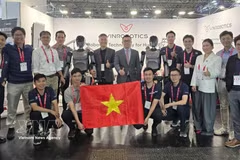
Vietnamese delegates at the 2026 IEEE International Conference on Robotics and Automation (ICRA 2026). (Photo: VNA)

Vietnamese tech draws attention at Austria robotics forum

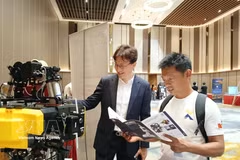
Representing Vietnam were VinRobotics and VinDynamics, two tech subsidiaries of Vingroup. They showcased "Make in Vietnam" humanoid robots, demonstrating the country’s growing capacity to integrate into the global robotics value chain.

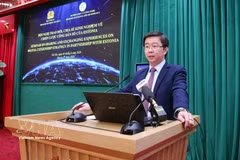
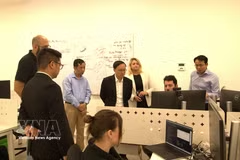
Deputy Prime Minister Ho Quoc Dung speaks at the meeting of the Government task force on strategic technology development on June 4. (Photo; VNA)

Deputy PM demands tangible results in strategic tech development

Deputy PM Ho Quoc Dung pressed ministries and agencies to rapidly convert their assigned tasks into concrete action plans with clearly defined responsibilities, and effectively launch projects that create strategic technology products capable of sharpening national competitiveness.

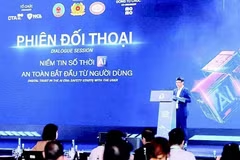
A panel discussion on “Digital trust in the AI era: Security starts with the users” at the Digital Trust in Finance 2026 forum (Photo: nhandan.vn)

Protecting users crucial in building digital trust: Experts

In Vietnam, digital transformation in the finance and banking sector is accelerating cashless payments, expanding access to financial services, improving market transparency and supporting economic growth and macroeconomic management.

Dr Nguyen Huu Ha, Deputy Director of the Gia Lai Department of Science and Technology, speaks at the scientific workshop on recent advances in the study of strongly correlated electron systems opened in the central province on June 1, 2026. (Photo: VNA)

Global physicists discuss strongly correlated electron materials advances

The workshop aims to achieve three key objectives providing a platform for academic exchange and strengthening collaboration between leading international scientists and young researchers, including doctoral students; promoting multidimensional scientific dialogue on major open questions in the field; and initiating new directions for international research cooperation with the active participation of Vietnam's physics community.

Tra Vinh University attracts a growing number of students and interns from Vietnam and abroad for study and research programmes. (Photo: VNA)

Fostering skilled workforce for innovation era: experts

Experts said close coordination among State management agencies, research institutes, universities, and businesses will improve training quality and serve the dual goals of quality education and practical research application.

Manufacturing cameras at the Sunny Opotech Vietnam Co., Ltd. in the Yen Binh Industrial Park, Thai Nguyen province. (Illustrative photo: VNA)

OV intellectuals pin hopes on stronger Vietnam – Singapore technology ties

OVs hope the two countries can establish an interconnected cooperation mechanism in the technology supply chain, from sharing research, testing, and development infrastructure to training human resources, thereby forming a technology alliance able to compete with others in the ASEAN region and the world.

Ho Chi Minh City: Rising hub for science, technology, innovation

Ho Chi Minh City: Rising hub for science, technology, innovation

Ho Chi Minh City currently hosts 143 science and technology enterprises, accounting for around 20% of the national total. Total factor productivity (TFP) contributes 59% to the city’s GRDP growth, with science and technology responsible for 74% of TFP growth.