Estonia’s digital citizenship strategy offers valuable lessons for Vietnam’s digital transformation

Vietnam and Estonia share similar approaches to digital citizenship development, placing citizens at the centre of digital transformation and using electronic identity systems and resident databases as foundations for online public services and digital transactions.

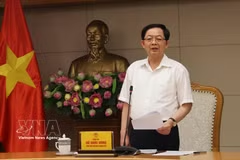
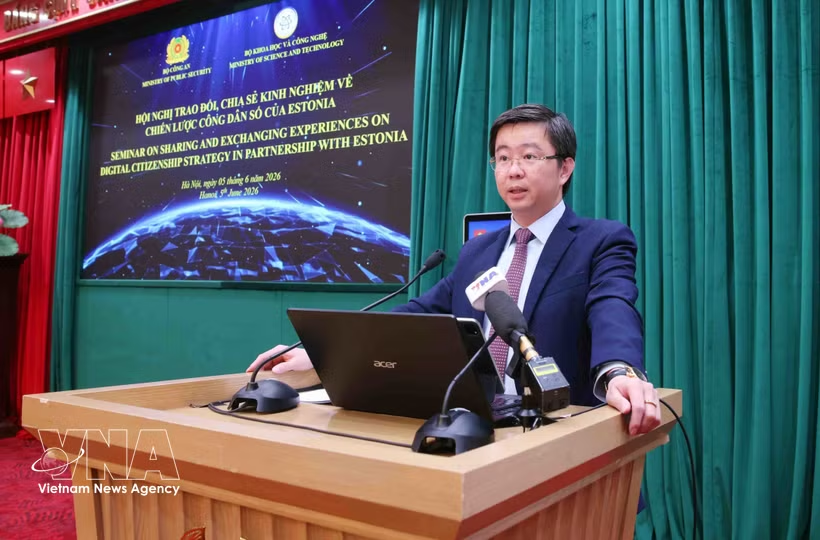
Deputy Minister of Science and Technology Bui Hoang Phuong speaks at the international conference in Hanoi on June 5 to exchange experiences on Estonia’s digital citizenship strategy. (Photo: VNA)

Hanoi (VNA) – The Ministry of Public Security, in coordination with the Ministry of Science and Technology, hosted an international conference in Hanoi on June 5 to exchange experiences on Estonia’s digital citizenship strategy as Vietnam is advancing towards a digital government, digital economy and digital society.

​Addressing the event, Deputy Minister of Science and Technology Bui Hoang Phuong said Vietnam has made significant progress in national digital transformation within a relatively short period.

​​He noted that the country has established a relatively comprehensive digital legal framework while digital infrastructure, national databases and digital identity platforms have been steadily developed. Citizens, businesses and state agencies are increasingly adopting digital technologies, particularly strategic ones such as artificial intelligence (AI) and big data.

​The Government has also introduced many mechanisms and policies to attract high-quality information technology professionals, including overseas Vietnamese and foreign experts, to support the country’s digital transformation efforts.

​However, Phuong stressed that people remain the central factor in the process.

​“A digital government can only be truly efficient when citizens actively use public services," he said, adding that a digital economy can only grow when people and businesses participate in economic activities in the digital environment, and a digital society can only take shape when digital skills and digital interactions become part of everyday life.

​For that reason, Vietnam has identified the development of digital citizenship as a core component of its national digital transformation agenda.

​Despite notable achievements, he acknowledged challenges, including gaps between policy and implementation, infrastructure investment and the value generated from such infrastructure, as well as public trust in digital services.

​Digital transformation, the official said, is not simply about digitising old processes but about creating new ways of working through technology to deliver greater efficiency.

​Phuong expressed his belief that Estonia’s experiences would provide valuable insights for Vietnam, given the European nation’s global reputation as a pioneer in digital government and digital citizenship.

​Sharing Estonia’s experiences, Hannes Astok, Executive Director and Chairman of the Management Board at the Estonian e-Governance Academy, shared his country’s journey in building a digital government, digital society and digital citizenship ecosystem.

​Estonia, he noted, also faced challenges related to digital identity, data access and social media, eventually concluding that the Government and its agencies are best positioned to provide secure and reliable electronic identity systems.​

vnanet-cong-nghe2.jpg
Hannes Astok, Executive Director and Chairman of the Management Board at the Estonian e-Governance Academy, shares Estonia’s experiences at the event. (Photo: VNA)

A report presented at the conference showed that Vietnam and Estonia share similar approaches to digital citizenship development, placing citizens at the centre of digital transformation and using electronic identity systems and resident databases as foundations for online public services and digital transactions.

​However, Estonia has advanced further in creating an integrated digital ecosystem where data is automatically shared among agencies under the “once-only” principle, meaning citizens only need to provide information once.

​The Estonian experience also shows that digital citizenship is not solely a technological issue but one involving governance, public trust and digital culture. The country places strong emphasis on personal data protection, digital literacy, universal internet access and the routine use of online services.

Experts suggested Vietnam continue developing interconnected data platforms, reducing data fragmentation among agencies, strengthening personal data protection, improving digital skills and enhancing public confidence in online transactions. They also recommended expanding VNeID into a multi-service platform beyond electronic identification.

​Concluding the conference, Sen. Lieut. Gen. Nguyen Van Long, Deputy Minister of Public Security, described Estonia’s practical experiences as a valuable source of reference for Vietnam in developing and refining its national digital citizenship strategy.

He called on the two countries to strengthen cooperation through training programmes and workshops on digital citizenship, data governance, electronic identification, cybersecurity, and digital government development. He also suggested Estonia continue sharing expertise in building and operating common digital platforms, databases and data sharing mechanisms while increasing expert exchanges and joint research to support Vietnam's digital transformation efforts./.


VNA

See more

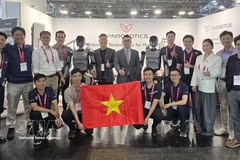
Vietnamese delegates at the 2026 IEEE International Conference on Robotics and Automation (ICRA 2026). (Photo: VNA)

Vietnamese tech draws attention at Austria robotics forum

Representing Vietnam were VinRobotics and VinDynamics, two tech subsidiaries of Vingroup. They showcased "Make in Vietnam" humanoid robots, demonstrating the country’s growing capacity to integrate into the global robotics value chain.

Deputy Prime Minister Ho Quoc Dung speaks at the meeting of the Government task force on strategic technology development on June 4. (Photo; VNA)

Deputy PM demands tangible results in strategic tech development

Deputy PM Ho Quoc Dung pressed ministries and agencies to rapidly convert their assigned tasks into concrete action plans with clearly defined responsibilities, and effectively launch projects that create strategic technology products capable of sharpening national competitiveness.

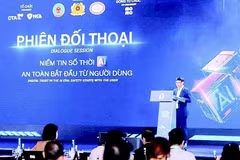
A panel discussion on “Digital trust in the AI era: Security starts with the users” at the Digital Trust in Finance 2026 forum (Photo: nhandan.vn)

Protecting users crucial in building digital trust: Experts

In Vietnam, digital transformation in the finance and banking sector is accelerating cashless payments, expanding access to financial services, improving market transparency and supporting economic growth and macroeconomic management.

Illustrative image

Proactive cybersecurity essential in age of AI-powered crime: experts

According to Dr. Le Minh Nghia, Chairman of the Vietnam Financial Consulting Association (VFCA), AI has become a key driver reshaping the global financial industry. In Vietnam, the technology is already widely used in banking and finance for credit analysis, electronic customer identification (eKYC), risk management, service personalisation and real-time transaction processing.

Dr Nguyen Huu Ha, Deputy Director of the Gia Lai Department of Science and Technology, speaks at the scientific workshop on recent advances in the study of strongly correlated electron systems opened in the central province on June 1, 2026. (Photo: VNA)

Global physicists discuss strongly correlated electron materials advances

The workshop aims to achieve three key objectives providing a platform for academic exchange and strengthening collaboration between leading international scientists and young researchers, including doctoral students; promoting multidimensional scientific dialogue on major open questions in the field; and initiating new directions for international research cooperation with the active participation of Vietnam's physics community.

Tra Vinh University attracts a growing number of students and interns from Vietnam and abroad for study and research programmes. (Photo: VNA)

Fostering skilled workforce for innovation era: experts

Experts said close coordination among State management agencies, research institutes, universities, and businesses will improve training quality and serve the dual goals of quality education and practical research application.

Manufacturing cameras at the Sunny Opotech Vietnam Co., Ltd. in the Yen Binh Industrial Park, Thai Nguyen province. (Illustrative photo: VNA)

OV intellectuals pin hopes on stronger Vietnam – Singapore technology ties

OVs hope the two countries can establish an interconnected cooperation mechanism in the technology supply chain, from sharing research, testing, and development infrastructure to training human resources, thereby forming a technology alliance able to compete with others in the ASEAN region and the world.

Deputy Prime Minister Nguyen Van Thang talks with technology enterprises on the sidelines of the event. (Photo: VNA)

Vietnam launches first national AI-native hackathon

Part of the Vietnam Innovation Challenge 2026, the programme goes beyond conventional coding competitions by requiring participants to develop AI-driven solutions to business challenges in real time.