Hanoi emerges as attractive destination for hospitality real estate investment

Hanoi is regarded as one of the most promising markets for hospitality investment, thanks to rising visitor numbers and its ability to sustain demand.

Foreign tourists visit Hoan Kiem Lake in Hanoi downtown. (Photo: VNA)

Hanoi (VNA) – Hanoi is emerging as an increasingly attractive destination for hotel and accommodation real estate investors thanks to its cultural, tourism, and service ecosystem that has been built up over many decades.

According to the Vietnam National Authority of Tourism (VNAT), the country welcomed 10.6 million international arrivals in the first five months of 2026, maintaining the strong recovery momentum of the tourism industry. Against this backdrop, Hanoi is regarded as one of the most promising markets for hospitality investment, thanks to rising visitor numbers and its ability to sustain demand.

While tourism growth remains an important indicator, long-term hotel investors increasingly focus on a destination’s capacity to generate stable accommodation demand over time.

Transport infrastructure plays a critical role in improving accessibility. However, experience from mature markets suggests that infrastructure usually offer initial advantage. Long-term appeal depends more on distinctive factors such as cultural identity, quality of life, public spaces and the overall service ecosystem.

According to the Savills Impacts Report, cities’ ability to attract long-term capital is increasingly linked to four key pillars including economic fundamentals, knowledge and technology development, environmental-social-governance (ESG) standards, and the quality of real estate markets and infrastructure.

For the hospitality sector, these factors help maintain stable demand and improve long-term asset performance. Hanoi stands out thanks to its diversified visitor base.

Nguyen Le Dung, Head of Investment Advisory at Savills Hanoi, said investors today look beyond location alone, placing greater emphasis on a project's connectivity to destinations and the quality of services and experiences available to guests.

As the country’s political, cultural and diplomatic centre, Hanoi attracts a broad spectrum of visitors, including leisure travellers, business visitors, MICE (Meetings, Incentives, Conferences and Exhibitions) tourists, diplomatic delegations and high-end travellers.

This diversity enables the city's hotel market to better withstand economic fluctuations than destinations dependent on a single customer segment.

At the same time, Hanoi is investing heavily in infrastructure and urban renewal under its long-term development plans. The Capital Master Plan to 2045, with a vision to 2065, identifies heritage preservation, public space expansion and effective use of natural landscapes as new growth drivers.

In particular, plans to develop the Red River landscape corridor are expected to create a new cultural, tourism and community axis, expanding visitor experiences while supporting future growth in hospitality, commercial and service activities.

In addition, the cultural identity factor is creating a hard-to-replace advantage for Hanoi. Globally, destinations that maintain high hotel and hospitality real estate values often combine favourable locations with comprehensive experience ecosystems.

Areas such as Ginza in Tokyo and the Huangpu River bank in Shanghai demonstrate how heritage, public spaces, commercial activities and cultural experiences can be integrated to create distinctive destinations. Their success lies in preserving and enhancing local identity while offering experiences that cannot easily be replicated elsewhere.

Hanoi possesses many similar strengths, including its centuries-old heritage system, the Old Quarter, a network of lakes, public cultural spaces and a well-established tourism services ecosystem. These assets help extend visitor stays, encourage repeat visits and support long-term operational performance and asset values.

Nguyen Anh Tuan, former Director of the Institute for Tourism Development Research, said that amid intensifying competition among destinations, long-term advantages increasingly depend on the ability to create unique experiences rather than simply expanding infrastructure or accommodation supply.

Today’s travellers are looking not only for a place to stay but also for opportunities to experience a destination’s lifestyle, culture and stories. When effectively preserved and promoted, these values become intangible assets that generate lasting appeal for investors, he said.

With its strong economic foundation, improving infrastructure, favourable living environment and deep cultural heritage, Hanoi is well positioned to attract long-term capital flows into the hotel and hospitality real estate market, particularly as investors increasingly seek assets capable of generating stable returns and sustainable cash flows./.​

VNA

See more

Czech Deputy Prime Minister and Finance Minister Alena Schillerová expresses her delight at meeting the Vietnamese community in Brno. (Photo: VNA)

MoU expected to support Vietnamese businesses in Czech Republic

The signing marked a new step forward in enhancing connectivity between Czech state management agencies and the Vietnamese business community and household businesses, helping citizens gain faster and more accurate access to legal regulations related to business activities in the Czech Republic.

Delegates at the France-Vietnam Business Forum 2026 (Photo: VNA)

FPT links Vietnamese, French businesses to advance AI transformation

Present in France since 2008, FPT now serves as a technology partner to major enterprises including La Poste, Air Liquide, Quadient, Sagemcom, SNCF and Geopost. It aims to become one of the top 50 IT firms in France while further expanding its footprint across French-speaking markets.

Participants at the signing ceremony (Photo: VNA)

Petrovietnam signs two major oil, gas agreements

The agreements underscore the commitment of Petrovietnam, the Petrovietnam Exploration Production Corporation (PVEP) and their partners to advancing oil and gas exploration, development and production activities, contributing to national energy security, optimising existing resources and creating new growth drivers for Vietnam’s energy industry.

At the investment promotion conference in Belgium on June 19 (Photo: VNA)

Tay Ninh seeks Belgian investment across sectors

Tay Ninh wishes to become a trusted partner of the Belgium business community, particularly in areas such as circular economy, clean energy, environmental technology, biotechnology and advanced agriculture.

The operation centre of the Vietnam International Financial Centre in Da Nang (Photo: VNA)

Da Nang seeks opportunities in emerging fintech, Web3 wave

With special policy mechanisms approved by the National Assembly, plans for a free trade zone, an international financial centre and regional semiconductor and AI hubs, Da Nang has significant opportunities to pilot new technology and financial models while maintaining effective risk controls.

The factory area of ​​Intel, a major investor in the Ho Chi Minh City High-Tech Park (Photo: VNA)

Ho Chi Minh City targets AI, semiconductor investment in new-generation FDI drive

To prepare for a new generation of FDI attraction in line with Resolution No. 10-NQ/TW on the development of the foreign-invested sector, the city is expanding its high-tech development space. A newly approved 194.84ha expansion area in Long Phuoc ward is being planned under a “Green–Clean–Digital” model, with the goal of achieving carbon neutrality before 2050.

A worker harvest VietGAP-certified vegetables at a greenhouse farm in Da Lat, Lam Dong province, supplying both domestic and international markets. (Photo: VNA)

Lam Dong eyes opportunities in multi-trillion-dollar Halal market

Lam Dong boasts a diverse range of high-quality agricultural products, including vegetables, flowers, coffee, tea, fruit and processed food products, providing a strong foundation for developing Halal-certified goods and services for markets in the Middle East, South Asia, Southeast Asia and Africa.

Vietnam has a total of 374,816 electric vehicles (EVs) in circulation nationwide as of the end of May 2026 (Photo: VNA)

Electric vehicle adoption accelerates in Vietnam

In the period leading up to 2030, the construction sector will prioritise areas with strong potential for reducing urban air pollution, particularly rail and road transport. Relevant agencies are developing criteria for green rest stops, green railway stations, green seaports, and green airports. These standards are expected to be finalised in 2026 and widely applied from 2027.

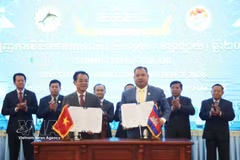
Within the framework of the conference, representatives from Cambodia's Stung Treng province and Phu Tai JSC of Vietnam's Gia Lai province sign a MoU on large-timber plantation investment research project (Photo: VNA)

Vietnamese, Cambodian localities boost investment cooperation

Permanent Vice Chairman of the Gia Lai People’s Committee Nguyen Tuan Thanh said the conference not only showcased Stung Treng’s investment potential and business environment, but also served as a practical platform for local authorities and enterprises of the two countries to exchange information, strengthen connections and explore new cooperation opportunities in investment, trade, agriculture, tourism, logistics and other sectors of mutual interest.

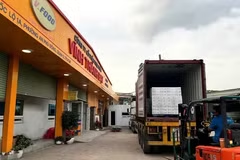
Container of ready-to-eat eggs exported to Japan by Vinh Thanh Dat (Photo: Thanhnien.vn)

Vietnamese poultry eggs enter Japanese market

The first shipment to Japan not only reflects Vinh Thanh Dat’s efforts to enhance the value of Vietnamese eggs but also opens new opportunities for processed egg products to access demanding international markets.

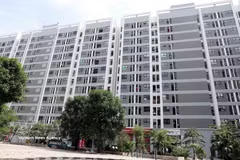
Vietnam is set to make long-term rental housing a key pillar of its social welfare strategy through 2030 - Illustrative image (Photo: VNA)

Vietnam advances long-term rental housing to meet growing housing demand

The accelerated development of social housing, along with the gradual formation of a long-term rental housing market, is expected to create a more diversified housing ecosystem that meets the needs of various groups, contributing to developing a more sustainable social welfare policy in the time to come