Hanoi adopts framework to boost night-time economy development

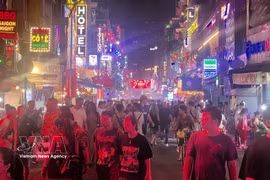
The resolution encourages a wide range of cultural, artistic and tourism activities, including performances, exhibitions, film screenings, presentations of traditional and intangible cultural heritage, and other programmes held in public spaces, pedestrian streets, heritage sites, theatres, cinemas and cultural venues.

A performance on The Huc bridge of the temple as part of a nighttime tourism programme to discover the Ngoc Son temple on Hoan Kiem Lake, downtown Hanoi. (Photo: VNA)

Hanoi (VNA) – The Hanoi municipal People’s Council on June 15 approved a resolution regulating investment and business activities for products and services operating at night, creating a legal framework to unlock the capital’s urban potential and promote tourism, cultural industries and economic growth.

Under the resolution, operating hours for night-time economy zones, routes and venues will be tailored to their characteristics and development objectives.

The time frame from 6:00pm to 10:00pm will be widely applied to night-time economic activities across the city. Operations from 10:00pm to 2:00am will be permitted in commercial and cultural development areas and other eligible night-time economy zones that meet required conditions and receive approval from competent authorities.

Businesses and individuals will be allowed to choose suitable services and activities, provided they obtain the necessary licences and comply with regulations on noise control, environmental sanitation, lighting, security and public order.

Meanwhile, operations from 10:00pm to 6:00am will be considered on a selective basis in designated areas that are physically separated from residential neighbourhoods and meet strict requirements regarding infrastructure, urban management, security and public safety. Authorities may also allow extended operating hours for specific events and activities, provided adequate measures are in place to minimise disruptions to local communities.

The resolution encourages a wide range of cultural, artistic and tourism activities, including performances, exhibitions, film screenings, presentations of traditional and intangible cultural heritage, and other programmes held in public spaces, pedestrian streets, heritage sites, theatres, cinemas and cultural venues.

Particular emphasis is placed on developing cultural and creative industries through contemporary art, interdisciplinary projects, technology applications and creative design initiatives that draw on Hanoi’s rich cultural resources. Tourism-related services such as night tours, cultural tourism programmes, experiential travel activities and tour guide services are also expected to play a central role in the city’s night-time economy.

The resolution also defines management models and recognition criteria for night-time economy zones. Such areas may be managed directly by state agencies, public service units, heritage site management boards, enterprises or organisations, or through coordinated management arrangements approved by competent authorities.

Earlier the same day, the municipal People’s Council adopted another resolution introducing support mechanisms and policies for organisations and individuals engaged in preserving, restoring and promoting cultural heritage values associated with historical sites, culturally significant areas and architectural works in Hanoi.

The city encourages private investment, sponsorship and public-private partnership (PPP) models in heritage conservation while promoting the integration of cultural heritage with education, cultural tourism, creative spaces and cultural industries, in line with the specific characteristics of each heritage asset./.

VNA

See more

Enterprises must disclose to investors the issuance plan, legal and investment risks and the rights and obligations of issuers and bondholders. (Photo: VNA)

Vietnam tightens rules on corporate bond issuance

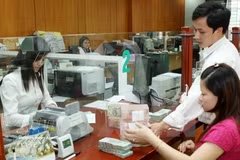
Under Decree No 200/2026/ND-CP, enterprises issuing bonds will continue to operate under the principle of self-borrowing, self-repayment and self-responsibility, meaning issuers are fully accountable for the efficiency of capital use, debt repayment capacity and any disputes arising from bond issuance, use of funds, and payment of principal and interest.

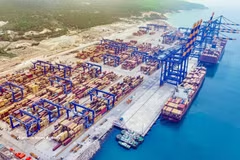
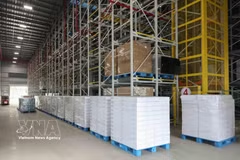
A cargo port in Thiruvananthapuram city, India (Photo: ANI/VNA)

Ample room remains for Vietnam–India logistics cooperation

The GTTCI expert noted that alongside logistics and integrated warehousing, e-commerce is expected to be a particularly high-growth sector in the coming years. He described it as a multi-billion-dollar market with significant untapped opportunities for cooperation between Vietnam and India.

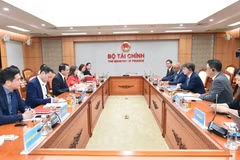
The meeting between Minister of Finance Ngo Van Tuan and Ambassador Julien Guerrier, head of the EU Delegation to Vietnam, on June 15. (Photo: thoibaotaichinhvietnam.vn)

Vietnam, EU enhance cooperation in green finance

Minister of Finance Ngo Van Tuan called on the EU to help facilitate Vietnamese firms' access to green finance, expand technical and financial assistance for green transition, and enhance cooperation in strategic technologies, innovation, digital finance and high-tech human resources development.

An overview of the working session between Deputy Finance Minister Tran Quoc Phuong and Kim Dongil, Director of ADB representing the Republic of Korea, Papua New Guinea, Sri Lanka, Taipei (China), Uzbekistan, Vanuatu and Vietnam. (Photo: Ministry of Finance)

Vietnam, ADB to advance strategic projects with strong economic impact

ADB has identified a pipeline of 27 projects for Vietnam through 2029, with total planned financing of approximately 4.6 billion USD. The projects focus on sectors that are among Vietnam’s priorities, including infrastructure, energy, urban development, agriculture and public sector management.

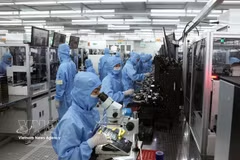
Illustrative photo (Photo: VNA)

Exports gain momentum from high-tech growth drivers

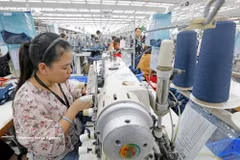
According to the Ministry of Industry and Trade, Vietnam’s exports reached 215.66 billion USD in the first five months of 2026, up 19.5% year-on-year. Twenty-six export items generated more than 1 billion USD in revenue each, including seven with turnover exceeding 10 billion USD.

Participants in the conference (Photo: VNA)

Vietnam, Tunisia target coffee, olive oil as trade ties deepen

Though geographically distant, the two countries share strategic locations in their respective regions, skilled human resources, and a strong commitment to expanding international trade, which form the bedrock for a lasting and mutually beneficial partnership.

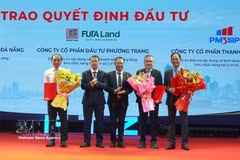
Da Nang People’s Committee Chairman Nguyen Manh Hung (second from left) presents investment policy approval decisions and investment registration certificates for three infrastructure projects in FTZ Zones 2, 3 and 4. (Photo: VNA)

Da Nang promotes investment links for pioneering Free Trade Zone

The conference also highlighted the role of digital technologies in building next-generation FTZs. Proposed solutions included the adoption of artificial intelligence (AI), the Internet of Things (IoT), big data, cloud computing and digital customs systems to improve operational efficiency, streamline logistics, accelerate customs procedures and enhance transparency for investors.