Vietnam seeks new export pathways to Middle East, South Asia

With a long-term market development strategy and effective utilisation of FTA benefits, Vietnamese enterprises will be well-positioned to deepen their integration into global value chains and distribution networks.

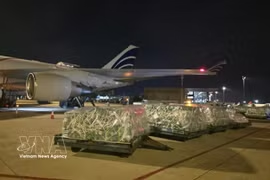
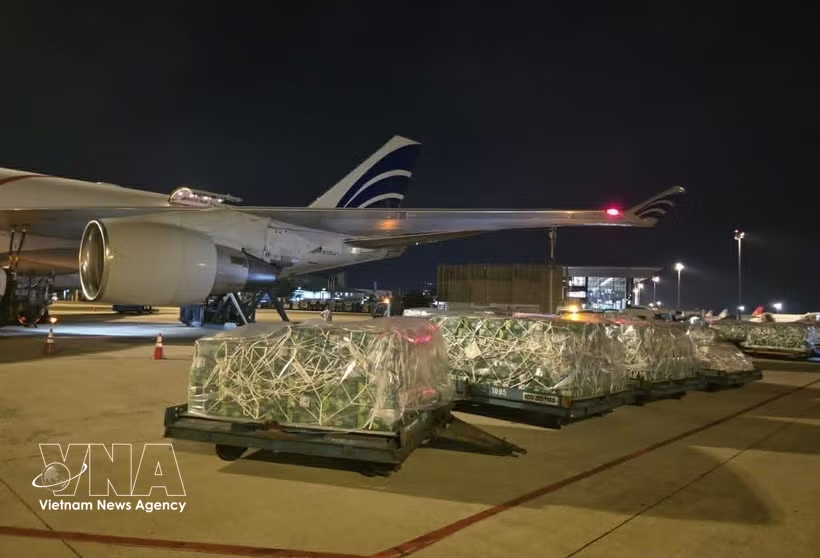
Vietnam's fresh fruits and vegetables exported to the UAE in April (Illustrative photo: VNA)

Hanoi (VNA) – As global trade continues to face mounting uncertainty, the Middle East and South Asia are emerging as promising destinations for Vietnamese exports, according to insiders.

Strong import demand, rising consumer purchasing power and new-generation free trade agreements (FTAs) are creating fresh opportunities for domestic businesses to expand markets, diversify partnerships and strengthen their position in global trade.

Tran Thanh Hai, Deputy Director of the Agency of Foreign Trade under the Ministry of Industry and Trade, pointed to several significant milestones, including the implementation of the Vietnam–Israel Free Trade Agreement (VIFTA) from early 2026 and the entry into force of the Vietnam– United Arab Emirates (UAE) Comprehensive Economic Partnership Agreement (CEPA) in February.

He noted that the latter marks Vietnam’s first FTA with a Gulf nation, opening access to one of the world’s most dynamic commercial hubs. For the first time, Vietnamese products can enter the UAE under preferential tariff arrangements. More importantly, the UAE serves as a gateway to the wider Middle East, a market of over 400 million consumers with a combined GDP exceeding 4 trillion USD. Ongoing negotiations on a Vietnam–Gulf Cooperation Council (GCC) FTA and efforts to upgrade the ASEAN–India Trade in Goods Agreement (AITIGA) are expected to further broaden economic cooperation.

The region’s substantial import demand presents considerable opportunities for Vietnamese exporters. GCC countries currently rely on external sources for 80–90% of their food requirements, creating strong demand for Vietnamese products such as rice, aquatic products, coffee, cashew nuts, fruits, vegetables and processed foods.

In South Asia, particularly India - the world’s fifth-largest economy and a country projected to become the third largest in the coming years, growing consumer spending and an expanding middle class are creating favourable conditions for Vietnamese goods.

However, experts stress that tariff preferences alone do not guarantee commercial success. As competition increasingly focuses on product quality, technical standards and market-specific requirements, businesses are advised to enhance their production capacity, management systems and competitiveness. In this context, the greatest value of new-generation FTAs lies not only in tariff reductions but also in the impetus they provide for enterprises to upgrade their production capacity and governance, and move up global value chains.

One of the most critical requirements for entering Middle Eastern markets is compliance with Halal standards. According to the Agency of Foreign Trade, the global Halal economy is already worth trillions of dollars and continues to expand rapidly. While Vietnam possesses strong advantages in agricultural, food and seafood production, gaining market share requires strict adherence to Halal certification and quality management systems throughout the entire supply chain.

In fact, several Vietnamese industries have already established a notable presence in the Middle East and South Asia. Vietnam currently accounts for around 60% of the Middle East’s pepper market and 40% of South Asia’s, while cinnamon commands approximately 90% of the South Asian market. Many Vietnamese companies, however, continue to export their products in raw or semi-processed form, or rely on intermediary importers to reach end markets. As a result, the added value generated and the visibility of Vietnamese brands remain below the level commensurate with the sector’s strong market position.

At present, geopolitical tensions in the Middle East continue to pose challenges through rising transportation costs, war-risk insurance premiums and fuel surcharges. Nguyen Duy Minh, Vice President of the Vietnam Logistics Business Association, therefore recommended that businesses diversify transport routes, strengthen cargo insurance coverage and establish distribution or warehousing facilities in Dubai to improve market access and reduce costs.

Experts also believed the Middle East and South Asia could become major growth drivers for Vietnam’s exports in the years ahead. While FTAs provide a favourable institutional framework and expanding market access, success will ultimately depend on businesses’ ability to invest in market research, branding, logistics capabilities, and compliance with international standards. With a long-term market development strategy and effective utilisation of FTA benefits, Vietnamese enterprises will be well-positioned to deepen their integration into global value chains and distribution networks./.


VNA
See more

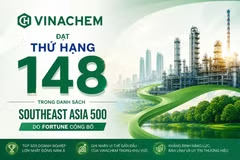
According to Fortune’s latest list, Vinachem ranks 148th among Southeast Asia’s top 500 companies in 2026. (Photo: vinachem.com.vn)

Vinachem makes Fortune Southeast Asia 500 for the first time

According to Fortune’s latest list, Vinachem ranked 148th among Southeast Asia’s top 500 companies in 2026. The ranking is compiled using key financial indicators including revenue, profit and total assets, and covers enterprises from seven regional economies, namely Vietnam, Indonesia, Thailand, Malaysia, Singapore, Philippines and Cambodia.

Lien Khuong International Airport in the central province of Lam Dong (Photo: VNA)

Lien Khuong Airport expected to reopen in August

The project is invested by ACV, with a total investment of over 1 trillion VND (38 million USD), including the repair of the entire runway, taxiways, safety strips, and technical infrastructure and equipment to ensure flight operations.

Representatives of Ho Chi Minh City's tax agency address concerns and clarify tax-related issues raised by the FDI business community. (Photo: VNA)

Ho Chi Minh City moves to ease tax hurdles for FDI firms

The Ho Chi Minh City tax agency said it will maintain regular dialogue with businesses, push ahead with administrative reform and digital transformation, and identify implementation bottlenecks to recommend policy adjustments, facilitating investment and business activities for FDI enterprises.

A workshop on the Halal market is held in Ho Chi Minh City on June 16, 2026. (Photo: VNA)

Growing Halal market offers opportunities for Vietnamese businesses

The Halal market is becoming a promising avenue for businesses in Ho Chi Minh City. With its well-developed manufacturing, trade and service ecosystem and dynamic business community, the city is well positioned to strengthen its role in regional and global Halal supply chains.

Wistron Infocomm Vietnam Co., Ltd, an FDI enterprise, has invested in Dong Van III Industrial Park of Ninh Binh province since 2021, creating jobs for more than 12,800 workers. (Photo: VNA)

Vietnam seeks to position itself as leading destination for foreign investment

A significant shift in the recently issued Resolution 10 is the move from a strategy of attracting “more capital” towards attracting “higher-quality FDI”. The objective is no longer limited to investment volume but extends to absorbing advanced technologies, increasing domestic value creation, strengthening innovation capacity and accelerating modernisation in the economy.

Enterprises must disclose to investors the issuance plan, legal and investment risks and the rights and obligations of issuers and bondholders. (Photo: VNA)

Vietnam tightens rules on corporate bond issuance

Under Decree No 200/2026/ND-CP, enterprises issuing bonds will continue to operate under the principle of self-borrowing, self-repayment and self-responsibility, meaning issuers are fully accountable for the efficiency of capital use, debt repayment capacity and any disputes arising from bond issuance, use of funds, and payment of principal and interest.

A performance on The Huc bridge of the temple as part of a nighttime tourism programme to discover the Ngoc Son temple on Hoan Kiem Lake, downtown Hanoi. (Photo: VNA)

Hanoi adopts framework to boost night-time economy development

The resolution encourages a wide range of cultural, artistic and tourism activities, including performances, exhibitions, film screenings, presentations of traditional and intangible cultural heritage, and other programmes held in public spaces, pedestrian streets, heritage sites, theatres, cinemas and cultural venues.

A cargo port in Thiruvananthapuram city, India (Photo: ANI/VNA)

Ample room remains for Vietnam–India logistics cooperation

The GTTCI expert noted that alongside logistics and integrated warehousing, e-commerce is expected to be a particularly high-growth sector in the coming years. He described it as a multi-billion-dollar market with significant untapped opportunities for cooperation between Vietnam and India.

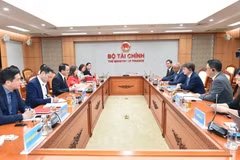
The meeting between Minister of Finance Ngo Van Tuan and Ambassador Julien Guerrier, head of the EU Delegation to Vietnam, on June 15. (Photo: thoibaotaichinhvietnam.vn)

Vietnam, EU enhance cooperation in green finance

Minister of Finance Ngo Van Tuan called on the EU to help facilitate Vietnamese firms' access to green finance, expand technical and financial assistance for green transition, and enhance cooperation in strategic technologies, innovation, digital finance and high-tech human resources development.

An overview of the working session between Deputy Finance Minister Tran Quoc Phuong and Kim Dongil, Director of ADB representing the Republic of Korea, Papua New Guinea, Sri Lanka, Taipei (China), Uzbekistan, Vanuatu and Vietnam. (Photo: Ministry of Finance)

Vietnam, ADB to advance strategic projects with strong economic impact

ADB has identified a pipeline of 27 projects for Vietnam through 2029, with total planned financing of approximately 4.6 billion USD. The projects focus on sectors that are among Vietnam’s priorities, including infrastructure, energy, urban development, agriculture and public sector management.