Hanoi (VNS/VNA) - The European Union’s planned implementation of the Digital Product Passport (DPP) from 2028 is pushing Vietnam’s textile and garment industry to begin building the data infrastructure needed to meet the new requirements.
The EU has set out a mandatory roadmap for the DPP, making it a prerequisite for apparel products entering the bloc from mid-2028. The move has created significant time pressure for exporting countries while Vietnam’s textile sector remains in the early stages of digital transformation.
“Mid-2028 is less than two years away. Meanwhile, the sectors are essentially starting from zero, this is an enormous challenge,” said Tran Cong Chinh, an expert in circular textile policy at the University of Economics and Business under Vietnam National University, Hanoi.
Vietnam’s textile industry has yet to establish a systematic digital capability framework or organisational digitalisation strategy. The lack of common supply chain data standards means companies continue to operate fragmented systems, limiting interoperability and making it difficult to meet emerging international requirements.
The DPP is not merely a local compliance requirement but represents a broad transformation of quality and traceability infrastructure.
According to Phạm Thi Ngoc Tuyen, General Director of Hohenstein Vietnam Laboratory Co, Ltd, more than one trillion products across industries will be affected by the regulation by 2030, including approximately 62.5 billion textile and apparel items, reported diendandoanhnghiep.vn.
Consumer behaviour is also driving the shift. Around 60% of consumers now prioritise sustainability over price while 40% actively seek verified information on product origins and production practices.
The DPP requires unprecedented transparency across a product’s lifecycle. Mandatory information includes product name, model, manufacturer, detailed production location and fibre composition.
More importantly, companies must disclose quantitative environmental indicators such as carbon footprint, water consumption and detailed instructions for recycling or end-of-life disposal.
As a result, manufacturers will need to maintain traceable data from raw material sourcing through to finished products.
Implementation challenges are already exposing weaknesses in existing management systems.
Nguyen Thi Chau Xuan, of Viet Hong Denim, under Viet Hong Textile JVC, noted that a company serving ten customers may be required to use up to six different platforms to collect and manage supply chain data. This fragmented environment often forces employees to enter information manually, increasing the risk of data errors.
Under the DPP framework, all information is expected to be publicly accessible. Any discrepancy could undermine credibility and potentially trigger enforcement action by European customs authorities.
The financial burden of compliance remains a significant concern. According to Xuan, investments in technologies designed to reduce carbon emissions and water consumption, key DPP metrics, typically range from several hundred thousand dollars to tens of millions of dollars.
Tuyen has proposed mapping existing data, building an integrated IT infrastructure capable of handling large data volumes, complying with chemical testing requirements and standards and connecting multi-tier supply chains from Tier 1 to Tier 3 suppliers.
Other proposals include piloting DPP implementation for selected product lines and scaling deployment while continuously improving systems and processes.
Nguyen Mai Hanh, representative of recycling company Syre, argued that businesses should view the DPP as a commercial advantage rather than merely a compliance obligation.
More sustainable product designs can directly reduce Extended Producer Responsibility (EPR) fees associated with each product, effectively turning sustainability into a source of cost competitiveness.
With the 2028 deadline approaching, industry experts emphasise that Vietnamese manufacturers must begin building accurate and reliable data systems immediately rather than waiting for domestic regulations to be finalised. Early preparation will be critical to maintaining market share in the EU and transforming sustainability requirements into a competitive advantage.
Increasing competitiveness
The Government is rolling out measures to help the textile, footwear and leather goods industries increase value-added production, strengthen domestic sourcing and deepen participation in global supply chains, according to Deputy Prime Minister Pham Gia Tuc.
Textile and garment exports reached nearly 46.2 billion USD in 2025, up 6% from the previous year, allowing Vietnam to maintain its position among the world’s three largest textile exporters. Value-added content in exported products stood at approximately 52% while the industry employed more than 1.86 million workers.
Vietnam’s textile sector has retained its position as the world’s third-largest exporter, behind only China and Bangladesh.
Meanwhile, Vietnam remains the world’s third-largest footwear producer and second-largest exporter. Sector exports reached nearly 29 billion USD in 2025, up roughly 5% from 2024, with value-added content estimated at 50–55%.
Despite a strong export performance, the Government expects 2026 to be a challenging year for textile and footwear manufacturers.
US tariff policies, geopolitical conflicts, escalating trade tensions among major economies and increasingly stringent requirements related to environmental protection, labour standards and sustainability are expected to place growing pressure on exporters.
According to the Government, value-added output and overall competitiveness have yet to match the industry’s potential. Production remains concentrated in low-margin contract manufacturing while dependence on imported raw materials remains high. The industry also lacks large anchor companies capable of leading and integrating supply chains.
Human capital represents another critical bottleneck. Shortages of skilled technical workers, digital talent and modern management expertise continue to constrain innovation and productivity growth.
To drive the next phase of development, the Government has urged industry associations and businesses to adopt long-term strategies focused on increasing value-added production, reducing reliance on contract manufacturing and gradually mastering core technologies.
Building strong corporate brands aligned with Vietnam’s national brand strategy has also been identified as a key priority for enhancing the global profile of Vietnamese products.
A major focus will be on the development of supporting industries. Policymakers are encouraging domestic production of yarns, fabrics, buttons, zips and other accessories to increase localisation rates, meet rules of origin requirements and maximise benefits from next-generation free trade agreements.
At the same time, manufacturers are expected to proactively adapt to evolving international standards covering environmental performance, carbon emissions, labour practices and corporate governance.
Digital transformation has been identified as another critical growth driver. The adoption of digital technologies across manufacturing, design, distribution and e-commerce is expected to improve productivity and strengthen connections with the global fashion ecosystem./.
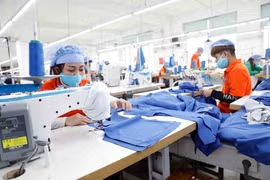
Technology, localisation key to boosting competitiveness of textile, footwear industries
Statistics from the Ministry of Industry and Trade (MoIT) show that the localisation rate of Vietnam’s textile and garment industry accounts for only about half of the value chain, meaning a significant portion of production revenue is spent on imported fabrics and other inputs.