Ample room remains for Vietnam–India logistics cooperation

The GTTCI expert noted that alongside logistics and integrated warehousing, e-commerce is expected to be a particularly high-growth sector in the coming years. He described it as a multi-billion-dollar market with significant untapped opportunities for cooperation between Vietnam and India.

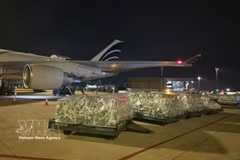
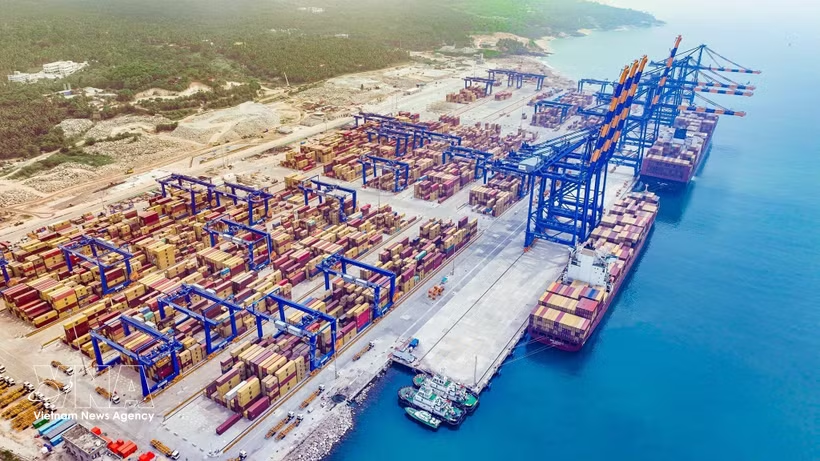
A cargo port in Thiruvananthapuram city, India (Photo: ANI/VNA)

New Delhi (VNA) – Bilateral ties between Vietnam and India are poised for strong growth, particularly in logistics, integrated warehousing, and e-commerce, Deepanker Parashar, Managing Director of AADE Trans Logistics Group, has said.

​In an interview granted to Vietnam News Agency (VNA) correspondents in New Delhi, Parashar, who is also a member of the Global Trade and Technology Council of India (GTTCI), said that General Secretary of the Communist Party of Vietnam Central Committee and State President To Lam’s State visit to India from May 5–7, along with high-level exchanges between the two countries’ leaders, has created fresh momentum for Vietnam–India relations and opened up new opportunities for substantive business cooperation.

According to Parashar, bilateral trade still has considerable room for expansion, as both Vietnam and India are dynamic economies with large young workforces. The younger generation in both countries will be a key driver of future growth and should be encouraged to engage more actively in business, entrepreneurship, and the development of trade linkages between the two economies.

The GTTCI expert noted that alongside logistics and integrated warehousing, e-commerce is expected to be a particularly high-growth sector in the coming years. He described it as a multi-billion-dollar market with significant untapped opportunities for cooperation between Vietnam and India.

However, to fully realise this potential, Parashar said both sides need to continue investing in human resource development, improving vocational and soft skills, and strengthening government support to create a more favourable environment for businesses to expand cooperation.

He stressed that efforts to advance bilateral economic relations should be translated into concrete actions and practical cooperation projects. The AADE Trans Logistics Group is currently seeking partners in Vietnam in the fields of logistics, integrated warehousing, and e-commerce, with the goal of helping strengthen trade connectivity between the two countries over the next five years.

Parashar expressed his belief that given the current momentum and the attention paid by the two countries’ senior leaders, Vietnam–India economic relations will continue to grow robustly in the years ahead./.

VNA

See more

Enterprises must disclose to investors the issuance plan, legal and investment risks and the rights and obligations of issuers and bondholders. (Photo: VNA)

Vietnam tightens rules on corporate bond issuance

Under Decree No 200/2026/ND-CP, enterprises issuing bonds will continue to operate under the principle of self-borrowing, self-repayment and self-responsibility, meaning issuers are fully accountable for the efficiency of capital use, debt repayment capacity and any disputes arising from bond issuance, use of funds, and payment of principal and interest.

A performance on The Huc bridge of the temple as part of a nighttime tourism programme to discover the Ngoc Son temple on Hoan Kiem Lake, downtown Hanoi. (Photo: VNA)

Hanoi adopts framework to boost night-time economy development

The resolution encourages a wide range of cultural, artistic and tourism activities, including performances, exhibitions, film screenings, presentations of traditional and intangible cultural heritage, and other programmes held in public spaces, pedestrian streets, heritage sites, theatres, cinemas and cultural venues.

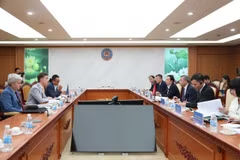
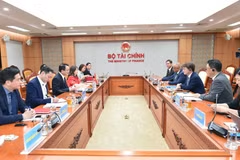
The meeting between Minister of Finance Ngo Van Tuan and Ambassador Julien Guerrier, head of the EU Delegation to Vietnam, on June 15. (Photo: thoibaotaichinhvietnam.vn)

Vietnam, EU enhance cooperation in green finance

Minister of Finance Ngo Van Tuan called on the EU to help facilitate Vietnamese firms' access to green finance, expand technical and financial assistance for green transition, and enhance cooperation in strategic technologies, innovation, digital finance and high-tech human resources development.

An overview of the working session between Deputy Finance Minister Tran Quoc Phuong and Kim Dongil, Director of ADB representing the Republic of Korea, Papua New Guinea, Sri Lanka, Taipei (China), Uzbekistan, Vanuatu and Vietnam. (Photo: Ministry of Finance)

Vietnam, ADB to advance strategic projects with strong economic impact

ADB has identified a pipeline of 27 projects for Vietnam through 2029, with total planned financing of approximately 4.6 billion USD. The projects focus on sectors that are among Vietnam’s priorities, including infrastructure, energy, urban development, agriculture and public sector management.

Illustrative photo (Photo: VNA)

Exports gain momentum from high-tech growth drivers

According to the Ministry of Industry and Trade, Vietnam’s exports reached 215.66 billion USD in the first five months of 2026, up 19.5% year-on-year. Twenty-six export items generated more than 1 billion USD in revenue each, including seven with turnover exceeding 10 billion USD.

Participants in the conference (Photo: VNA)

Vietnam, Tunisia target coffee, olive oil as trade ties deepen

Though geographically distant, the two countries share strategic locations in their respective regions, skilled human resources, and a strong commitment to expanding international trade, which form the bedrock for a lasting and mutually beneficial partnership.

Da Nang People’s Committee Chairman Nguyen Manh Hung (second from left) presents investment policy approval decisions and investment registration certificates for three infrastructure projects in FTZ Zones 2, 3 and 4. (Photo: VNA)

Da Nang promotes investment links for pioneering Free Trade Zone

The conference also highlighted the role of digital technologies in building next-generation FTZs. Proposed solutions included the adoption of artificial intelligence (AI), the Internet of Things (IoT), big data, cloud computing and digital customs systems to improve operational efficiency, streamline logistics, accelerate customs procedures and enhance transparency for investors.