Vietnam’s five-month trade surges despite global uncertainties

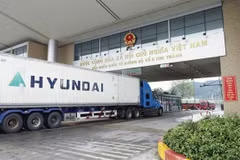
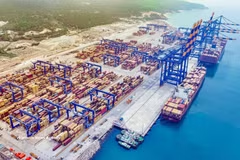
Despite geopolitical uncertainties, disruptions to global supply chains, stricter import standards in many markets and rising shipping costs, exports and imports continued to expand at a robust pace.

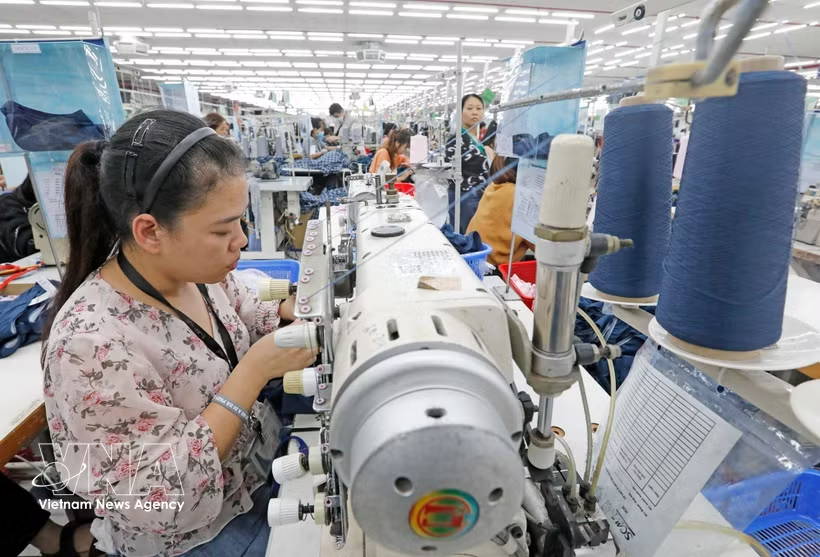
Apparel is a major contributor to Vietnam's exports. (Photo: VNA)

Hanoi (VNA) – Vietnam’s merchandise foreign trade posted impressive growth in the first five months of 2026, with total turnover rising by nearly 90 billion USD year-on-year.

Despite geopolitical uncertainties, disruptions to global supply chains, stricter import standards in many markets and rising shipping costs, exports and imports continued to expand at a robust pace.

In May, trade turnover exceeded 99 billion USD for the first time. As a result, the country’s total merchandise trade value in the January–May period climbed 25% from a year earlier to more than 445 billion USD.

Specifically, exports generated 215.66 billion USD, up 19.5% and equivalent to an increase of 35.13 billion USD while imports surged 30.8%, or more than 54 billion USD, to 229.46 billion USD.

The faster rise in imports in recent months led to a trade deficit of nearly 14 billion USD, compared with a surplus of over 5 billion USD recorded in the same period last year.

A notable feature of the export panorama was the dominance of the foreign direct investment (FDI) sector. Domestic enterprises earned 43.5 billion USD from exports, rising only 2.5% and accounting for 20.2% of total export revenue. Meanwhile, the FDI sector, including crude oil exports, generated 172.16 billion USD, climbing 24.7% and contributing 79.8% of the country’s overseas shipments.

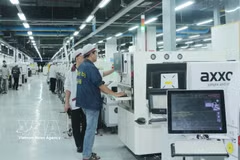
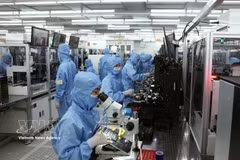
High-tech and industrial products remained the key growth drivers. Exports of electronics, computers and components went up 46.2% to 56.1 billion USD. Machinery, equipment, tools and spare parts increased 22.1% to nearly 27 billion USD, while shipments of phones and components reached 26.37 billion USD, up 17.7%. Transport vehicles and spare parts also recorded growth of 17.1%, approaching 8 billion USD.

Traditional labour-intensive sectors, including textiles, footwear, wood and wood products, continued to record trade surpluses but posted modest growth due to slow demand recovery and higher logistics and insurance costs. Their export values rose by just 0.4%, 0.2% and 2.9% from a year earlier, respectively.

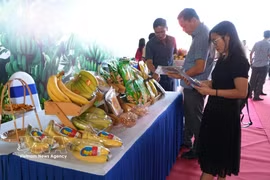
Agricultural exports maintained positive momentum thanks to efforts to improve product quality and meet increasingly stringent import requirements. Fruit and vegetable exports increased 20.4% while pepper shipments expanded 14.4%.

Fishery exports also sustained their recovery. The sector earned 1.02 billion USD in May alone, bringing total export revenue in the first five months to 4.67 billion USD, up 11% year-on-year.

According to the Vietnam Association of Seafood Exporters and Producers (VASEP), the double-digit growth reflects continued recovery although exporters still face cautious purchasing patterns, increasingly segmented markets and stricter compliance requirements.

China and Hong Kong (China) emerged as major growth drivers, importing 1.2 billion USD worth of Vietnamese fishery products during the period, up 40.5%. Rising demand for shrimp, pangasius, crab, molluscs and other high-value seafood products helped enterprises secure additional orders.

Vietnam’s major export markets all recorded double-digit growth thanks to improved market analysis, flexible production planning and effective utilisation of free trade agreements. Exports to the US, Vietnam’s largest market, reached 69.6 billion USD, up 21.6%. Shipments to the EU rose 13.2% to 26 billion USD while the value hit 30.1 billion USD in China, up 28.2%. Exports to the Republic of Korea, ASEAN and Japan climbed 14.7%, 16.9% and 14.2%, respectively.

The Agency of Foreign Trade under the Ministry of Industry and Trade attributed the strong performance to exporters’ effective use of major trade agreements like the EVFTA, CPTPP, and RCEP, which have helped expand market access and reduce tariff barriers.

However, looking ahead, challenges remain. Seafood exporters face uncertainty in the US and EU markets, where exports declined by 10% and 2.2%, respectively. Manufacturers are also closely watching Vietnam – US trade negotiations, particularly discussions on reciprocal tariff arrangements.

For 2026, the country targets export growth of 15–16%. Despite a sharp rise in overseas shipments in the first five months, imports of raw materials, machinery, and equipment have outpaced exports in recent months, widening the trade deficit. Nevertheless, experts believe this is not a cause for concern as the high import volume is to stockpile raw materials in preparation for the year-end production cycle./.

VNA

See more

Representatives of Ho Chi Minh City's tax agency address concerns and clarify tax-related issues raised by the FDI business community. (Photo: VNA)

Ho Chi Minh City moves to ease tax hurdles for FDI firms

The Ho Chi Minh City tax agency said it will maintain regular dialogue with businesses, push ahead with administrative reform and digital transformation, and identify implementation bottlenecks to recommend policy adjustments, facilitating investment and business activities for FDI enterprises.

A workshop on the Halal market is held in Ho Chi Minh City on June 16, 2026. (Photo: VNA)

Growing Halal market offers opportunities for Vietnamese businesses

The Halal market is becoming a promising avenue for businesses in Ho Chi Minh City. With its well-developed manufacturing, trade and service ecosystem and dynamic business community, the city is well positioned to strengthen its role in regional and global Halal supply chains.

Wistron Infocomm Vietnam Co., Ltd, an FDI enterprise, has invested in Dong Van III Industrial Park of Ninh Binh province since 2021, creating jobs for more than 12,800 workers. (Photo: VNA)

Vietnam seeks to position itself as leading destination for foreign investment

A significant shift in the recently issued Resolution 10 is the move from a strategy of attracting “more capital” towards attracting “higher-quality FDI”. The objective is no longer limited to investment volume but extends to absorbing advanced technologies, increasing domestic value creation, strengthening innovation capacity and accelerating modernisation in the economy.

Enterprises must disclose to investors the issuance plan, legal and investment risks and the rights and obligations of issuers and bondholders. (Photo: VNA)

Vietnam tightens rules on corporate bond issuance

Under Decree No 200/2026/ND-CP, enterprises issuing bonds will continue to operate under the principle of self-borrowing, self-repayment and self-responsibility, meaning issuers are fully accountable for the efficiency of capital use, debt repayment capacity and any disputes arising from bond issuance, use of funds, and payment of principal and interest.

A performance on The Huc bridge of the temple as part of a nighttime tourism programme to discover the Ngoc Son temple on Hoan Kiem Lake, downtown Hanoi. (Photo: VNA)

Hanoi adopts framework to boost night-time economy development

The resolution encourages a wide range of cultural, artistic and tourism activities, including performances, exhibitions, film screenings, presentations of traditional and intangible cultural heritage, and other programmes held in public spaces, pedestrian streets, heritage sites, theatres, cinemas and cultural venues.

A cargo port in Thiruvananthapuram city, India (Photo: ANI/VNA)

Ample room remains for Vietnam–India logistics cooperation

The GTTCI expert noted that alongside logistics and integrated warehousing, e-commerce is expected to be a particularly high-growth sector in the coming years. He described it as a multi-billion-dollar market with significant untapped opportunities for cooperation between Vietnam and India.

The meeting between Minister of Finance Ngo Van Tuan and Ambassador Julien Guerrier, head of the EU Delegation to Vietnam, on June 15. (Photo: thoibaotaichinhvietnam.vn)

Vietnam, EU enhance cooperation in green finance

Minister of Finance Ngo Van Tuan called on the EU to help facilitate Vietnamese firms' access to green finance, expand technical and financial assistance for green transition, and enhance cooperation in strategic technologies, innovation, digital finance and high-tech human resources development.

An overview of the working session between Deputy Finance Minister Tran Quoc Phuong and Kim Dongil, Director of ADB representing the Republic of Korea, Papua New Guinea, Sri Lanka, Taipei (China), Uzbekistan, Vanuatu and Vietnam. (Photo: Ministry of Finance)

Vietnam, ADB to advance strategic projects with strong economic impact

ADB has identified a pipeline of 27 projects for Vietnam through 2029, with total planned financing of approximately 4.6 billion USD. The projects focus on sectors that are among Vietnam’s priorities, including infrastructure, energy, urban development, agriculture and public sector management.

Illustrative photo (Photo: VNA)

Exports gain momentum from high-tech growth drivers

According to the Ministry of Industry and Trade, Vietnam’s exports reached 215.66 billion USD in the first five months of 2026, up 19.5% year-on-year. Twenty-six export items generated more than 1 billion USD in revenue each, including seven with turnover exceeding 10 billion USD.