Growing Halal market offers opportunities for Vietnamese businesses

The Halal market is becoming a promising avenue for businesses in Ho Chi Minh City. With its well-developed manufacturing, trade and service ecosystem and dynamic business community, the city is well positioned to strengthen its role in regional and global Halal supply chains.

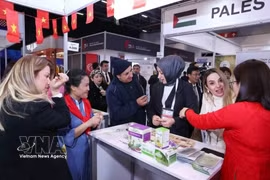
A workshop on the Halal market is held in Ho Chi Minh City on June 16, 2026. (Photo: VNA)

Ho Chi Minh City (VNA) – The rapidly expanding global Halal market is creating significant opportunities for Vietnamese businesses and export sectors capable of meeting its stringent requirements, heard a workshop held in Ho Chi Minh City on June 16.

Speaking at the event, organised by the Investment and Trade Promotion Centre of Ho Chi Minh City (ITPC), its Deputy Director Ho Thi Quyen said that amid global economic uncertainties, rising trade protectionism and increasingly strict standards and traceability requirements, diversifying export markets and identifying new growth drivers have become urgent priorities for businesses. In this context, the Halal market has emerged as one of the world’s most dynamic and promising economic sectors.

According to the State of the Global Islamic Economy Report 2024/2025 by US-based research and advisory firm DinarStandard, the global Muslim population has surpassed 2 billion people, accounting for more than a quarter of the world’s population. In 2023, Muslim consumers' spending on food, cosmetics, pharmaceuticals, tourism, modest fashion, and media and entertainment services reached 2.43 trillion USD and is projected to rise to 3.36 trillion USD by 2028.

Experts noted that Halal has evolved beyond a certification standard for food products into a comprehensive economic ecosystem covering manufacturing, trade, logistics, finance, tourism and services, making it one of the fastest-growing markets worldwide.

Quyen said the Halal market is becoming a promising avenue for businesses in Ho Chi Minh City. With its well-developed manufacturing, trade and service ecosystem and dynamic business community, the city is well positioned to strengthen its role in regional and global Halal supply chains.

However, she noted that the biggest challenge lies not in market demand but in businesses’ ability to meet technical requirements and standards. Many companies with export-ready products still face difficulties in establishing Halal management systems, controlling input materials, ensuring traceability, and preparing certification documentation.

Nguyen Thi Tra My from the Halal Certification Agency Vietnam said the Islamic consumer economy is emerging as a new driver of global trade growth. The market is forecast to reach 3.56 trillion USD by 2029, with food and beverages accounting for around 74% of total spending, followed by Muslim-friendly tourism, pharmaceuticals and cosmetics.

According to the expert, Halal products and services are increasingly regarded not only as religiously compliant goods but also as benchmarks for quality, safety and transparency. Consumers, including non-Muslims, are increasingly choosing Halal-certified products because of their traceability, hygiene standards, sustainability and social responsibility.

Many countries are also moving towards stricter Halal certification requirements for imported goods, particularly food and beverages. Indonesia will enforce mandatory Halal certification from October 17, 2026, while members of the Gulf Cooperation Council (GCC), along with Malaysia, Singapore and Türkiye, are tightening regulations on Halal certification and labelling.

Vietnam currently has around 1,300 Halal-certified enterprises, benefiting from abundant supplies of agricultural, forestry and aquatic products as well as processed foods. However, many firms still face challenges related to limited understanding of Halal culture and standards, inappropriate selection of certification bodies, and shortcomings in supply chain management and raw material control, My stated.

Experts recommended businesses to adopt a long-term approach by identifying target markets, selecting certification bodies recognised by importing countries, standardising production processes, and strengthening trade promotion through specialised international fairs and forums. Such efforts would help improve competitiveness and expand the presence of Vietnamese products in fast-growing Muslim markets, they said./.

VNA

See more

Czech Deputy Prime Minister and Finance Minister Alena Schillerová expresses her delight at meeting the Vietnamese community in Brno. (Photo: VNA)

MoU expected to support Vietnamese businesses in Czech Republic

The signing marked a new step forward in enhancing connectivity between Czech state management agencies and the Vietnamese business community and household businesses, helping citizens gain faster and more accurate access to legal regulations related to business activities in the Czech Republic.

Delegates at the France-Vietnam Business Forum 2026 (Photo: VNA)

FPT links Vietnamese, French businesses to advance AI transformation

Present in France since 2008, FPT now serves as a technology partner to major enterprises including La Poste, Air Liquide, Quadient, Sagemcom, SNCF and Geopost. It aims to become one of the top 50 IT firms in France while further expanding its footprint across French-speaking markets.

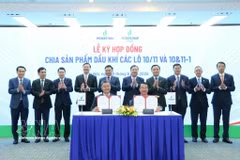
Participants at the signing ceremony (Photo: VNA)

Petrovietnam signs two major oil, gas agreements

The agreements underscore the commitment of Petrovietnam, the Petrovietnam Exploration Production Corporation (PVEP) and their partners to advancing oil and gas exploration, development and production activities, contributing to national energy security, optimising existing resources and creating new growth drivers for Vietnam’s energy industry.

At the investment promotion conference in Belgium on June 19 (Photo: VNA)

Tay Ninh seeks Belgian investment across sectors

Tay Ninh wishes to become a trusted partner of the Belgium business community, particularly in areas such as circular economy, clean energy, environmental technology, biotechnology and advanced agriculture.

The operation centre of the Vietnam International Financial Centre in Da Nang (Photo: VNA)

Da Nang seeks opportunities in emerging fintech, Web3 wave

With special policy mechanisms approved by the National Assembly, plans for a free trade zone, an international financial centre and regional semiconductor and AI hubs, Da Nang has significant opportunities to pilot new technology and financial models while maintaining effective risk controls.

The factory area of ​​Intel, a major investor in the Ho Chi Minh City High-Tech Park (Photo: VNA)

Ho Chi Minh City targets AI, semiconductor investment in new-generation FDI drive

To prepare for a new generation of FDI attraction in line with Resolution No. 10-NQ/TW on the development of the foreign-invested sector, the city is expanding its high-tech development space. A newly approved 194.84ha expansion area in Long Phuoc ward is being planned under a “Green–Clean–Digital” model, with the goal of achieving carbon neutrality before 2050.

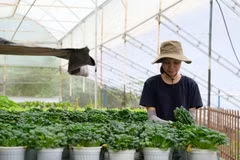
A worker harvest VietGAP-certified vegetables at a greenhouse farm in Da Lat, Lam Dong province, supplying both domestic and international markets. (Photo: VNA)

Lam Dong eyes opportunities in multi-trillion-dollar Halal market

Lam Dong boasts a diverse range of high-quality agricultural products, including vegetables, flowers, coffee, tea, fruit and processed food products, providing a strong foundation for developing Halal-certified goods and services for markets in the Middle East, South Asia, Southeast Asia and Africa.

Vietnam has a total of 374,816 electric vehicles (EVs) in circulation nationwide as of the end of May 2026 (Photo: VNA)

Electric vehicle adoption accelerates in Vietnam

In the period leading up to 2030, the construction sector will prioritise areas with strong potential for reducing urban air pollution, particularly rail and road transport. Relevant agencies are developing criteria for green rest stops, green railway stations, green seaports, and green airports. These standards are expected to be finalised in 2026 and widely applied from 2027.

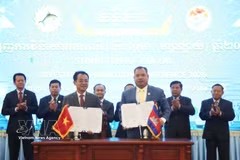
Within the framework of the conference, representatives from Cambodia's Stung Treng province and Phu Tai JSC of Vietnam's Gia Lai province sign a MoU on large-timber plantation investment research project (Photo: VNA)

Vietnamese, Cambodian localities boost investment cooperation

Permanent Vice Chairman of the Gia Lai People’s Committee Nguyen Tuan Thanh said the conference not only showcased Stung Treng’s investment potential and business environment, but also served as a practical platform for local authorities and enterprises of the two countries to exchange information, strengthen connections and explore new cooperation opportunities in investment, trade, agriculture, tourism, logistics and other sectors of mutual interest.

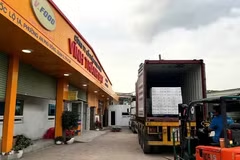
Container of ready-to-eat eggs exported to Japan by Vinh Thanh Dat (Photo: Thanhnien.vn)

Vietnamese poultry eggs enter Japanese market

The first shipment to Japan not only reflects Vinh Thanh Dat’s efforts to enhance the value of Vietnamese eggs but also opens new opportunities for processed egg products to access demanding international markets.

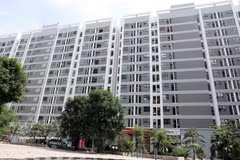
Vietnam is set to make long-term rental housing a key pillar of its social welfare strategy through 2030 - Illustrative image (Photo: VNA)

Vietnam advances long-term rental housing to meet growing housing demand

The accelerated development of social housing, along with the gradual formation of a long-term rental housing market, is expected to create a more diversified housing ecosystem that meets the needs of various groups, contributing to developing a more sustainable social welfare policy in the time to come