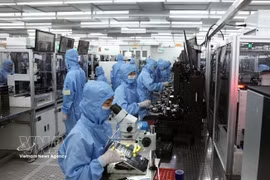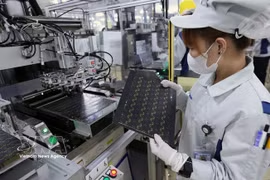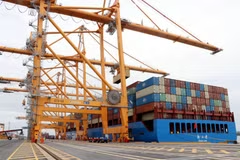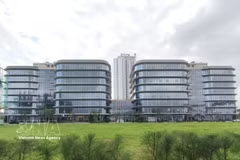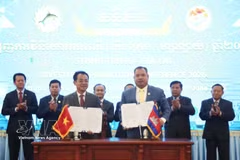
Hanoi (VNA) – Reforming policy thinking and reshaping investment incentives and support mechanisms are among the key strategies outlined in the Politburo’s Resolution No. 10-NQ/TW on the development of the foreign-invested economic sector, recently signed by Party General Secretary and State President To Lam.
The resolution states that the sector is an important component of the national economy, contributing not only medium- and long-term capital for development investment but also serving as a channel for acquiring advanced technologies and modern governance practices, improving human resources quality, and expanding market access.
Resolution 10 sets concrete targets through to 2030, aiming to place Vietnam among ASEAN’s best in terms of business and investment environment, competitiveness, innovation capacity, quality of public services, and ability to attract high-quality foreign investment projects.
Vietnam seeks to secure between 200 and 300 billion USD in registered foreign direct investment (FDI), equivalent to 40–50 billion USD annually. Of this total, 75% is expected to come from developed economies with strong technological capabilities, capital resources and modern governance standards. The number of multinational corporations from the Fortune 500 list operating in Vietnam is also expected to increase by 30%.
At the same time, the average localisation rate across key industrial sectors is targeted at 45–50%, while around 10,000 domestic enterprises are hoped to participate in value chains and supply networks of foreign-invested businesses.
Dr Phan Huu Thang, former Director of the Foreign Investment Agency under the Ministry of Planning and Investment (now the Ministry of Finance), said Resolution 10 helps define a new-generation FDI model for Vietnam amid intensifying global economic competition and major restructuring of international supply chains.
He noted that a significant shift in the resolution is the move from a strategy of attracting “more capital” towards attracting “higher-quality FDI”. The objective is no longer limited to investment volume but extends to absorbing advanced technologies, increasing domestic value creation, strengthening innovation capacity and accelerating modernisation in the economy.
“These targets are achievable if implemented in tandem with institutional reform, human capital development and enhanced absorptive capacity of the economy,” Thang said.
In practice, FDI inflows into Vietnam have continued to reach record levels. According to the Foreign Investment Agency, total registered FDI in the first five months of 2026 reached nearly 25 billion USD, up almost 35% year-on-year.
Disbursed FDI also posted strong growth to an estimated 9.75 billion USD, an increase of 9.6% compared with the same period last year and the highest level for the corresponding period over the past five years.
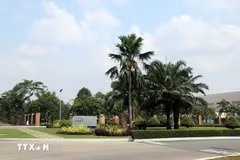
Professor Vo Xuan Vinh, Dean of the Institute of Business Research at the University of Economics Ho Chi Minh City, observed that investment activities by major firms such as Samsung and Aeon demonstrate that Vietnam is not only a destination for large-scale foreign capital but also a market capable of generating substantial returns for international investors.
“This reflects improvements in Vietnam's investment climate, market scale and its increasingly important position in global value chains,” he said.
“Vietnam possesses considerable advantages to attract foreign capital, including political and social stability and a secure investment environment. However, the more notable figure is the rise in disbursed capital. This shows that investors continue to honour their commitments because they have confidence in Vietnam’s investment environment and regard it as an attractive, profitable and long-term destination with limited political and social risks,” Vinh added.
Sharing a similar view, Dr Phan Huu Thang noted that the world is witnessing the beginning of comprehensive digital transformation with the rapid development of artificial intelligence (AI), semiconductor technology, biotechnology, the green economy, the circular economy, and energy transition. Consequently, multinationals are restructuring their supply chains by diversifying investment locations, reducing dependence on a single market, and prioritising countries with political stability and high-quality human resources. This trend presents major opportunities but also creates considerable competition pressure for the country in the coming years.
Assoc. Prof. Dr Nguyen Thuong Lang of the Institute of Trade and International Economics at the National Economics University said that the tasks and policy measures under Resolution 10 build upon and expand the foundations laid out in Resolution 50 issued in 2019, while providing more detailed institutional and policy guidance on foreign investment.
He stressed that the emphasis on improving investment quality, efficiency, innovation and technology transfer reflects a broader expectation that foreign investors should strengthen linkages with and support the development of domestic enterprises.
“Resolution 10 marks a shift towards a development model for the foreign-invested sector driven by innovation, green transition and enhanced national competitiveness,” he said./.
See more
VIFC-HCMC sets up advisory board with leading global experts
The advisory board will support research, provide policy advice and recommend strategic directions for the centre’s development, the VIFC-HCMC Executive Board said.
Hanoi's 100-year master plan charts path for sustainable growth
Under the plan, Hanoi aims to maintain annual gross regional domestic product (GRDP) growth of 11% during 2026–2035 and 2036–2045, before easing to 5% during 2046–2065 and 4.5% during 2066–2085.
HDBank secures 721 million USD in international syndicated loan
The Ho Chi Minh City Development Joint Stock Commercial Bank (HDBank – HoSE: HDB) has successfully raised 721 million USD in an international syndicated loan from international financial institutions in the form of a Social Loan.
New-generation industrial parks need to attract high-quality investors: Summit
Around the world, investors are increasingly choosing locations based not only on costs and logistics, but also on renewable energy, carbon performance, circular economy solutions and ESG standards, experts said.
Vietnam, Brazil seek ways to promote trade, investment cooperation
Vietnamese Ambassador to Brazil Bui Van Nghi informed that two-way trade reached 4.22 billion USD in the first six months of 2026, up 16.8% year-on-year. Brazil's exports to Vietnam exceeded 2 billion USD, rising 16.6%, while its imports from Vietnam totalled about 2.11 billion USD, an increase of 17%.
Kunming – Nha Trang air service resumes to boost tourism, connectivity
The restored Kunming–Nha Trang route is expected to cater to growing travel demand and facilitate tourism, trade and cultural exchanges between Vietnam and China.
WB offers strategic recommendations as Vietnam enters upper-middle-income group
Among the 218 economies assessed this year, Vietnam was one of only six to be upgraded to a higher income category by the WB Group. The move marks a notable milestone after 17 years in the lower-middle-income group, where Vietnam had remained since 2009.
International symposium explores future of regenerative supply chains
For Vietnam, the challenge is not simply adopting new technologies but ensuring that supply chains are sustainable and capable of generating long-term value.
Honda Vietnam posts strong car sales growth, leads motorcycle market
The company sold 172,299 motorcycles in June, up 4.7% from the same month last year, highlighting steady consumer demand even as the market gradually shifts towards greener transport options. For the first six months of 2026, motorcycle sales reached 515,743 units, up 0.6% year-on-year.
Ho Chi Minh City moves to develop Phu My 3 as first eco-industrial park
Developed under a strategic cooperation agreement between the Vietnamese and Japanese governments, the nearly 1,000-hectare industrial park is expected to become the city's first eco-industrial park under the country's new regulatory framework.
Plan issued to develop agricultural logistics system
A key target is that by 2030, all concentrated agricultural, forestry and fisheries production areas will have access to essential services, including product traceability, quarantine, testing, quality certification, processing and market development. The move reflects growing international demand for stricter food safety, quality and traceability standards, which have become increasingly important for agricultural exports.
Vietnamese electric car gets thumbs-up from French auto magazine
The magazine said the VF 2 retails at 188 million VND (7,200 USD) with the battery included, making it one of the most affordable electric cars in the Vietnamese market.
Vietnam, RoK boost micro-business cooperation
Vietnam's young population, dynamic market, and big growth potential are a perfect fit for the strengths that Korean micro-businesses bring in K-brands, technology, and service expertise, said KFME President Song Chi Young.
VinFast auto sales up 72% in H1
It marked the first time an automotive brand in Vietnam has exceeded 100,000 vehicle deliveries in the first half.
Vietnam's auto sales rise 15%, hybrid, imported vehicles continue to outperform
With auto loan interest rates remaining competitive, stable vehicle supply, and an increasingly diverse product range, Vietnam's automotive market is expected to maintain its growth momentum through the remainder of 2026. SUVs, MPVs, and hybrid vehicles are likely to remain the main drivers of overall market sales.
Vietnamese firms urged to enhance competitiveness to tap US market opportunities
To convert these opportunities into growth, it is a must for Vietnam to continue improving its investment climate, upgrading logistics and energy infrastructure, accelerating digital transformation and developing a highly skilled workforce that meets requirement of emerging technology sectors, an expert has said.
Gia Lai positions itself as magnet for sustainable investment
Vice Chairman of the provincial People's Committee Nguyen Huu Que said ESG is no longer a communications message or a cost burden, but an essential requirement for accessing global capital. Gia Lai has chosen ESG as a pillar for building new competitive advantages and achieving sustainable development.
Vietnam Airlines adjusts flights to/from Taiwan due to Typhoon Bavi
Vietnam Airlines said weather-related schedule changes are unavoidable and are made to ensure the safety of passengers and crew.
Suntory PepsiCo inaugurates 300-million-USD plant in southern Tay Ninh province
Built on nearly 20 hectares at Huu Thanh Industrial Park, the facility is the company's largest and most advanced plant in Vietnam and the biggest production site in Suntory PepsiCo's Asian manufacturing network. The factory has a designed annual production capacity of over 1.24 billion litres and is equipped with highly automated production, filling and warehousing systems.
Ho Chi Minh City promotes UAV applications to develop low-altitude economy
With its enlarged development space, Ho Chi Minh City now combines strengths in urban development, industry and services with high-tech agriculture, the marine economy, logistics and diverse ecological areas. These conditions provide an ideal testing ground for UAV applications in urban management, land administration, environmental monitoring, disaster prevention and response, agriculture, logistics and public services.