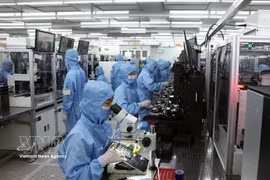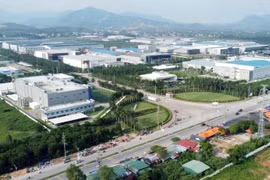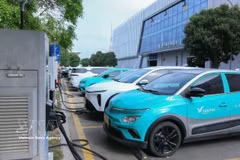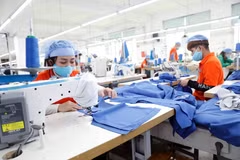
Hanoi (VNA) – Vietnam is placing greater emphasis on strengthening ties between foreign-invested enterprises and domestic businesses as it seeks to enhance competitiveness, increase local value creation and secure a larger role in global value chains during the 2026–2030 period.
Data from the Foreign Investment Agency under the Ministry of Finance show that Vietnam was home to 46,534 active FDI projects as of the end of April, with combined registered capital topping 543.1 billion USD. Disbursed capital reached 357.6 billion USD, accounting for nearly two-thirds of total registered investment.
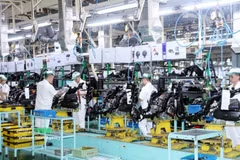
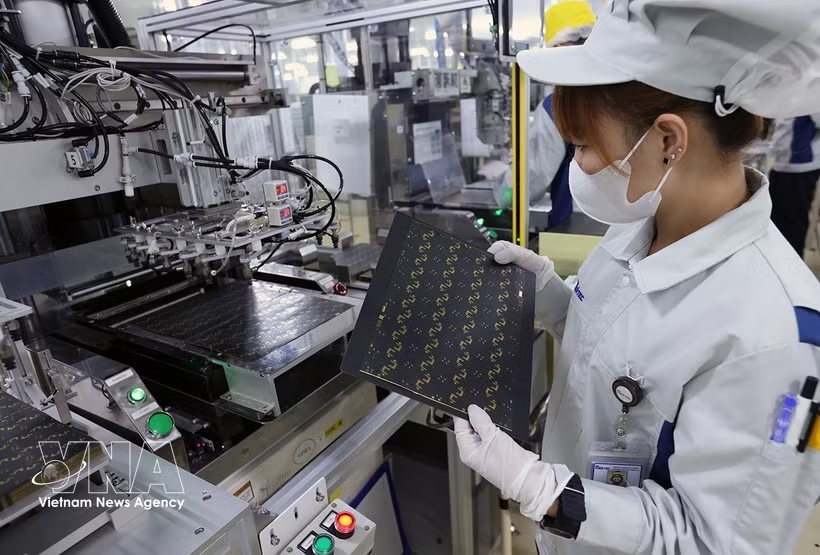
Foreign investors now operate across 19 of the country’s 22 economic sectors, with manufacturing and processing continuing to dominate, attracting nearly 334.8 billion USD, or 61.6% of total FDI commitments.
According to Hoang Van Cuong, Vice Chairman of the Vietnam Economic Science Association, the FDI sector has evolved into a major driver of economic growth over nearly four decades of reform, contributing roughly one-fifth of GDP, more than 70% of exports and millions of jobs.
While Vietnam has become a strategic manufacturing hub for many global corporations, Cuong noted that connections between foreign-invested companies and local suppliers remain relatively weak. As a result, localisation rates are still modest, Vietnamese firms have limited participation in global supply chains and technology spillovers have fallen short of expectations.
Nguyen Duc Hien, Deputy Head of the Party Central Committee’s Policy and Strategy Commission, said insufficient integration between FDI enterprises and domestic businesses has constrained technology absorption and reduced the broader economic benefits of foreign investment.
He argued that fostering stronger partnerships between the two sectors should be a core pillar of Vietnam’s next stage of development.
Ho Sy Hung, Chairman of the Vietnam Chamber of Commerce and Industry (VCCI), echoed the assessment, describing weak FDI-domestic business linkages as a significant obstacle to improving the quality of foreign investment inflows.
As global supply chains are reshaped by geopolitical shifts, technological rivalry and sustainability demands, multinational corporations are increasingly seeking investment destinations that offer resilient, transparent and sustainable business ecosystems rather than simply low production costs.
Experts said Vietnam should introduce targeted incentives to attract investment in high-tech industries, renewable energy, green growth and the circular economy, while tightening screening of projects that are resource-intensive, environmentally damaging or generate limited added value.
Hung stressed that Vietnam’s future competitiveness will depend less on cheap labour and more on the strength of its domestic business sector. In particular, supporting industries need to be upgraded to meet the quality, technological and governance requirements of multinational manufacturers.
Vietnamese firms, meanwhile, should move beyond basic participation in production networks and expand into higher-value activities such as design, research and development (R&D), and innovation to strengthen their position within global value chains.
Hien said attracting next-generation FDI will require a more integrated approach that links foreign investors with domestic industrial ecosystems through stronger supporting industries, greater technology transfer and deeper supply-chain connections.
He also highlighted the importance of institutional reform, a more predictable and competitive investment climate, and the development of a highly skilled workforce.
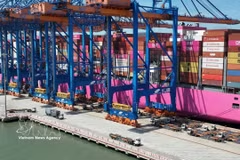
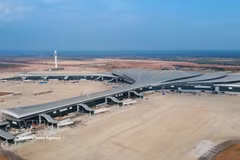
Looking ahead to 2026–2030, Vietnam plans to shift from a low-cost labour model towards one centred on high-quality human capital, while accelerating investment in strategic infrastructure, including the North–South Expressway, high-speed railways, Long Thanh International Airport, seaport and logistics networks, renewable energy projects, LNG facilities and digital infrastructure.
These investments are expected to strengthen Vietnam’s appeal to technology-intensive, high-value FDI while creating the conditions for closer and more productive collaboration between foreign investors and domestic enterprises./.