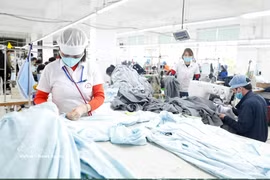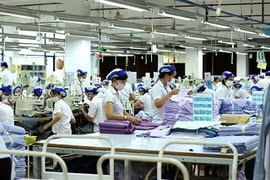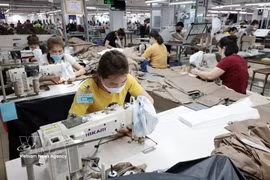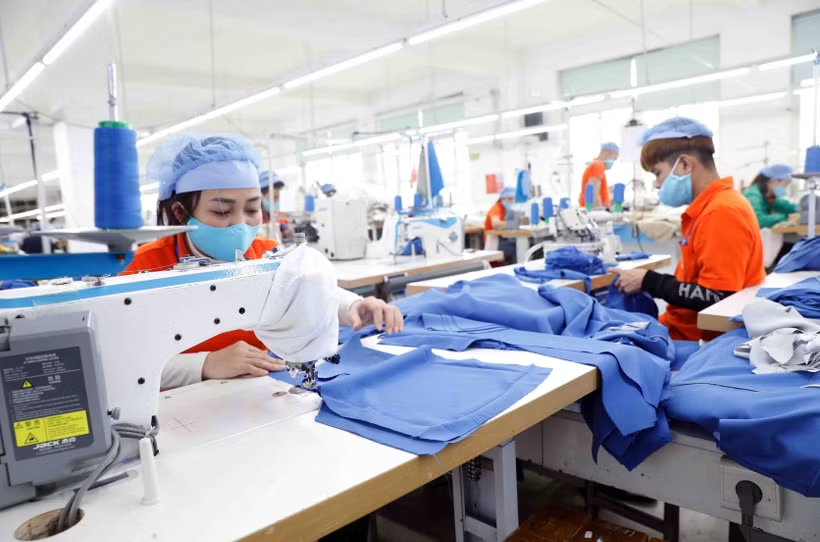
Hanoi (VNA) – Vietnamese textile, garment and footwear enterprises need to accelerate technological innovation, strengthen self-sufficiency in raw materials and move into higher value-added segments of global supply chains to enhance competitiveness and increase localisation rates, according to industry experts.
Heavy dependence on imported materials remains a major challenge. Statistics from the Ministry of Industry and Trade (MoIT) show that the localisation rate of Vietnam’s textile and garment industry accounts for only about half of the value chain, meaning a significant portion of production revenue is spent on imported fabrics and other inputs.
The reliance on foreign materials not only limits profit margins but also leaves enterprises vulnerable to geopolitical disruptions and rising logistics costs. At the same time, major markets such as the US and the European Union are introducing increasingly stringent requirements on sustainability and product traceability, reducing the competitiveness of labour-intensive production models.
Against this backdrop, the Vietnam Textile and Apparel Association (VITAS) has urged enterprises to prioritise technological upgrading. VITAS Chairman Vu Duc Giang said the enterprise’s competitiveness in the new era depends on the ability to operate production systems efficiently, rather than on output volume alone. He called for stronger investment in modern production facilities, automation, robotics and artificial intelligence, while promoting international cooperation, advanced manufacturing methods and greener production processes.
VITAS Vice Chairman Truong Van Cam stressed that Vietnam’s textile and garment sector must focus on developing domestic material supplies, upgrading products and increasing added value amid intensifying competition among exporting countries.
Experts noted that addressing bottlenecks in upstream segments, particularly weaving, dyeing and finishing, is essential for meeting rules of origin under new-generation free trade agreements.
Tran Thu Huong from the MoIT’s Industry Agency said dyeing and finishing are high-tech sectors of the industry that remain the weakest links, requiring costly wastewater treatment systems. Strategic investment in these segments is therefore critical to raising localisation rates.
Several localities, including Ninh Binh province, are developing specialised industrial parks equipped with large-scale wastewater treatment facilities that meet international standards to support sustainable textile and dyeing projects.
Regarding the domestic market, Director General of the Agency for Domestic Market Management and Development Tran Huu Linh noted that foreign brands account for roughly half of Vietnam’s apparel and footwear market. He said domestic firms can strengthen their position by improving design, building brands, expanding distribution channels and increasing localisation.
Large enterprises have already demonstrated the benefits of technological transformation. The Vietnam National Textile and Garment Group (Vinatex) has identified green transition as a core strategy, focusing on digital technology, energy efficiency and ESG standards. Modern wastewater treatment systems and automated environmental monitoring have helped improve environmental performance while reducing energy consumption.
The Garment 10 Corporation is also promoting digitalisation, green transformation and brand development to enhance added value.
In the footwear sector, businesses are investing in domestic leather production, environmentally friendly materials and smart manufacturing technologies, including 3D design, laser cutting and intelligent warehouse management.
According to Phan Thi Thanh Xuan, Vice Chairwoman and Secretary General of the Vietnam Leather, Footwear and Handbag Association, companies are diversifying distribution channels and expanding their presence on e-commerce platforms through digital management solutions.
Experts agreed that technological innovation, greater localisation and green transformation are essential for Vietnam’s textile, garment and footwear industries to move beyond low-value processing, achieve quality-driven growth and strengthen the position of Vietnamese products in global supply chains./.