Hanoi (VNA) – Nearly four decades after the first foreign direct investment (FDI) projects arrived in Vietnam, the foreign-invested sector has become a key driver of economic growth. Yet in a rapidly changing global landscape, the challenge is no longer simply attracting more capital, but maximising the value, technology and capabilities generated by that capital flow.
Politburo Resolution No. 10-NQ/TW, issued on June 8, 2026, outlines a strategic restructuring of foreign investment attraction to Vietnam, signalling a shift from broad-based attraction to selective engagement aimed at enhancing national competitiveness and development capacity.
While recognising the foreign-invested sector as “an important component of the national economy”, the resolution also acknowledges shortcomings in the quality, efficiency and management of FDI inflows, which have yet to fully match Vietnam’s potential or meet the demands of a new growth model centred on science and technology, innovation, digital transformation, green transition and greater strategic autonomy.
A key breakthrough of the resolution is requiring foreign-invested economic development to be integrated into the country’s broader development strategy.
The shift reflects guidance from Party General Secretary and State President To Lam, who recently called for foreign affairs and economic cooperation to move from “attracting” resources to “selecting” and upgrading them, with priority given to high-tech investment, technology transfer and deeper linkages with domestic enterprises.
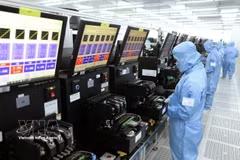
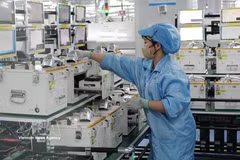
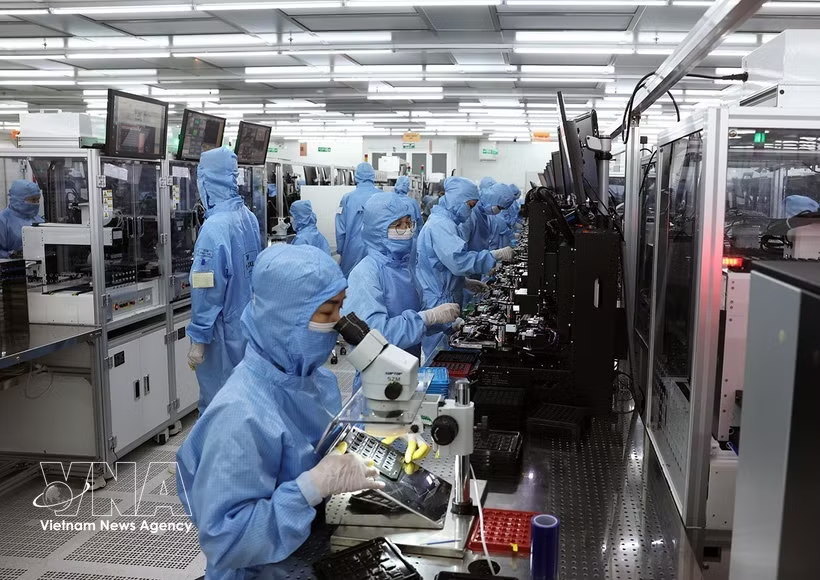
The resolution identifies a range of strategic sectors for investment priority, including electronics, semiconductor chips and digital equipment; artificial intelligence, big data, cloud computing, the Internet of Things and blockchain; advanced biotechnology and biomedicine; energy and advanced materials technologies; green industries; modern logistics and supply-chain services; financial and commercial services; innovation activities; and other high-value-added sectors.
Significantly, the resolution places foreign-invested economic development within the broader objective of strengthening Vietnam’s strategic autonomy by transforming external capital into domestic productive capacity.
Under this approach, FDI is expected not only to contribute capital but also to help upgrade production capabilities, expand market access, enhance resilience to external shocks and strengthen Vietnam’s position in global value chains. The resolution also signals a fundamental shift in investment attraction policy, calling for a transition “from a mindset focused primarily on attracting capital to one on developing a national strategic investment platform”.
It advocates moving away from investment promotion based on administrative boundaries towards approaches built around industrial clusters, value chains and innovation ecosystems. Quality, efficiency, technology transfer, participation in supply chains and value creation are identified as the primary criteria for evaluating investment projects.
The resolution further calls for a gradual shift from input-based incentives to support mechanisms linked to investors’ fulfilment of commitments, including project lifecycle management and stronger connections with domestic businesses.
This means Vietnam’s competitiveness will increasingly depend on institutional quality, policy implementation, workforce skills and the ability to develop industry clusters and innovation ecosystems rather than solely on preferential incentives.
Investors will be welcomed not simply for the capital they bring, but for their capacity to contribute technology, expertise and new opportunities to the Vietnamese economy.
Particular emphasis is placed on project lifecycle management and stronger linkages between foreign-invested enterprises and domestic firms. The goal is to ensure that the FDI sector becomes a catalyst for helping Vietnamese businesses integrate more deeply into supply chains and improve their competitiveness.
To realise these ambitions, the resolution assigns a series of tasks, including improving awareness of the role of foreign-invested enterprises, refining institutions, improving the business environment, developing high-quality human resources, upgrading infrastructure, promoting green and digital economy development, encouraging technology transfer and strengthening linkages with domestic enterprises.
However, translating policy objectives into concrete results will require determined implementation at both central and local levels. Success will depend on whether quality, technology transfer, domestic linkages and value creation become the core criteria guiding investment selection, management and investor support.
More than a policy document on foreign-invested economic development, Resolution No. 10-NQ/TW represents a significant shift in Vietnam’s development thinking, from an economy relying heavily on low-cost advantages to one driven by knowledge, technology and endogenous strength.
If implemented effectively, it could help generate a new wave of high-quality FDI while supporting Vietnam’s transition to a new growth model through 2030 and towards its 2045 development vision./.