Vietnam’s 100-year vision must reflect development aspirations: Top leader

The vision should answer major questions about what kind of developed nation Vietnam seeks to become, what foundations must be preserved, what new growth drivers should be cultivated, what breakthroughs are required, what risks the country must prepare for, and what values should be protected and promoted.

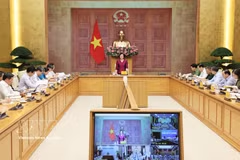
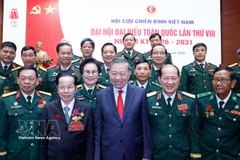
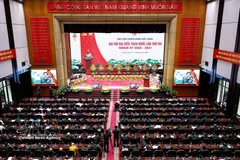
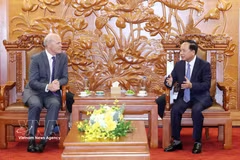
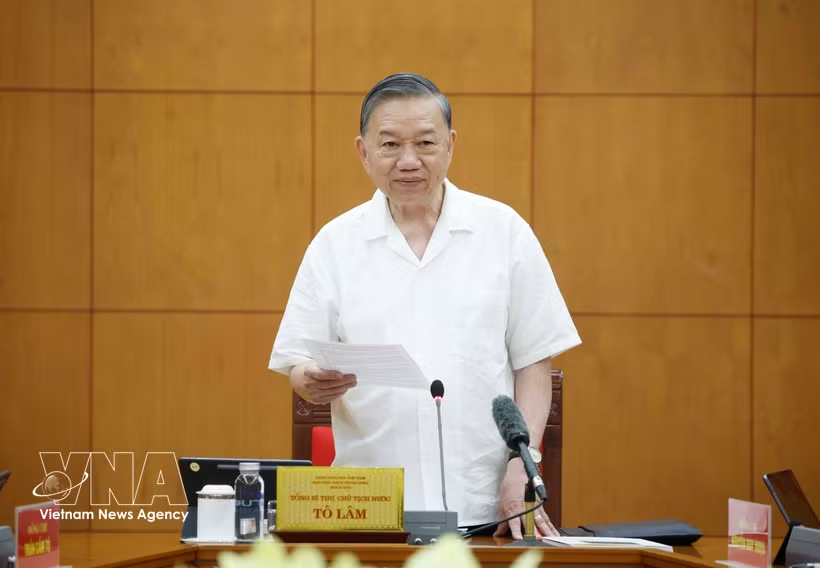
Party General Secretary and State President To Lam addresses the meeting (Photo: VNA)

Hanoi (VNA) - Party General Secretary and State President To Lam on June 17 stressed that Vietnam’s development vision for 2030–2130 must continue to embody the nation’s aspirations for growth and prosperity, while being grounded in theory and practical experience and long-term strategic thinking.

Chairing a meeting of the permanent members of the Steering Committee responsible for reviewing 100 years of the Communist Party of Vietnam’s leadership of the Vietnamese revolution (1930–2030), defining leadership orientations for the following century (2030–2130), and assessing 40 years of implementing the Platform for national construction during the transition to socialism, General Secretary and State President Lam, who heads the committee, highlighted the significance of the task.

He noted that despite limited time, a large workload and demanding political, theoretical and practical requirements, initial draft documents and detailed outlines had been completed, providing an important foundation for the next stages of work.

The leader urged the drafting team to fully incorporate feedback and continue refining the documents in a scientific, objective and responsible manner.

He emphasised that the review of 100 years of Party leadership is a task of exceptional importance and must be firmly grounded in historical truth.

However, he said, the exercise should go beyond recounting events or compiling a chronological record. More importantly, it should identify overarching lessons, key conclusions and enduring patterns that help explain Vietnam’s revolutionary path, the Party’s leadership role, the strength of the people and national unity, and the country’s future development trajectory.

According to the Party and State leader, the review must generate new insights and theoretical contributions beyond previous assessments. It should clarify how the Party’s theoretical understanding has evolved during the 1930–2030 period, what lessons have been elevated to a higher level of generalisation, what new theoretical issues have emerged, and what strategic orientations should guide the country’s development over the next 100 years.
vnanet-potal-tong-bi-thu-chu-tich-nuoc-to-lam-lam-viec-voi-thuong-truc-ban-chi-dao-tong-ket-100-nam-dang-lanh-dao-cach-mang-viet-nam-8832701-1.jpg
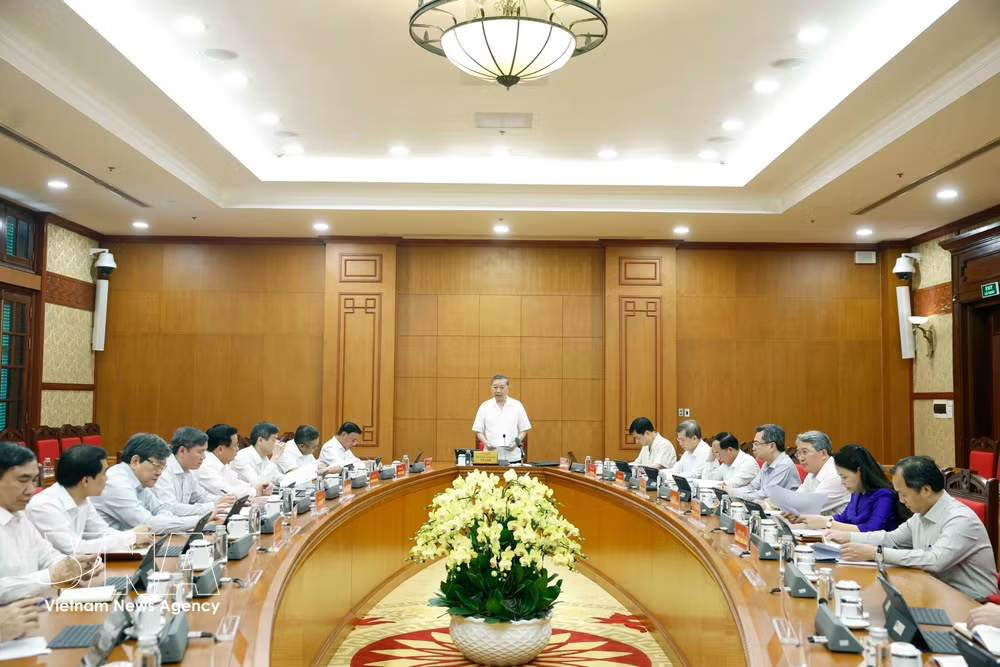
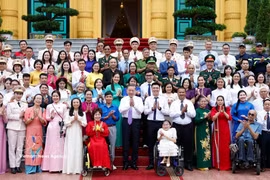
Party General Secretary and State President To Lam chairs the meeting of the permanent members of the Steering Committee responsible for reviewing 100 years of the Communist Party of Vietnam’s leadership of the Vietnamese revolution (1930–2030), defining leadership orientations for the following century (2030–2130), and assessing 40 years of implementing the Platform for national construction during the transition to socialism in Hanoi on June 17 (Photo: VNA)

He stressed the need for a clear articulation of the relationship between the review of 100 years of Party leadership and the assessment of 40 years of implementing the national development platform, stressing that the two processes are closely linked but should neither be treated separately nor merged in a way that obscures their distinct objectives.

The review of the platform’s implementation, he said, should be placed within the broader context of the Party’s century-long leadership, identifying which principles have been validated by practice, which require further refinement and which new issues demand theoretical innovation.

While highlighting achievements, it should candidly address shortcomings, limitations and unresolved challenges, drawing lessons from both successes and failures.

He called for a deeper examination of the fundamental factors that enabled the Party to lead the country to victories amidst difficult circumstances, and for the distillation of lessons with genuine theoretical and strategic value.

Particular emphasis, he said, must be placed on defining a long-term vision and development orientation for the next century.

“The vision for the next 100 years must continue to reflect the aspirations of the Vietnamese nation,” he said. It should answer major questions about what kind of developed nation Vietnam seeks to become, what foundations must be preserved, what new growth drivers should be cultivated, what breakthroughs are required, what risks the country must prepare for, and what values should be protected and promoted.

On implementation, the Party and State leader instructed review groups to work proactively and simultaneously rather than sequentially. Each group should establish clear plans, responsibilities, deadlines and coordination mechanisms.

He also stressed the importance of collecting and analysing historical documents, data and testimonies.

The process should draw on the knowledge and experience of researchers, scientists, experts, practitioners, historical witnesses, veteran revolutionaries and generations of leaders and managers, with the combination of archival records, witness accounts, academic research and practical experience, and effective use of domestic and international archives, existing research and specialised reviews, he underscored./.
VNA

See more

Prime Minister Le Minh Hung (right) and S. Kudryashov, General Director of Zarubezhneft (Photo: VNA)

Prime Minister meets leaders of major Russian enterprises

During his meeting with Rosatom Director General Alexey Likhachev, PM Hung expressed his sincere thanks for the cooperation, support, and significant contributions of Rosatom and the Russian side to the development of Vietnam's atomic energy sector over the past four decades.

An overview of the event (Photo: VNA)

Ho Chi Minh City wishes for stronger ties with Russia

The Vietnam–Russia relationship, founded on a longstanding tradition of friendship and elevated to a Comprehensive Strategic Partnership, has withstood the test of time and remained resilient amid global changes

Deputy Prime Minister Pham Thi Thanh Tra chairs a meeting of the Steering Committee for the War Invalids and Martyrs Day celebrations (July 27, 1947–2027) (Photo: VNA)

Deputy PM calls for practical actions to honour war heroes

Gratitude must be transformed into practical, effective, and meaningful actions. All activities should aim to provide the best possible care for relatives of martyrs, war invalids, sick veterans, and people with meritorious services to the revolution, said Deputy Prime Minister Pham Thi Thanh Tra.

 Contest on Japanese law launched for Vietnamese community in Japan

Contest on Japanese law launched for Vietnamese community in Japan

Nearly 700,000 Vietnamese are currently living, studying, and working in Japan. The vast majority integrate well into local society, respect Japanese laws and customs, pursue personal and professional development, and contribute to the host country's socio-economic growth.

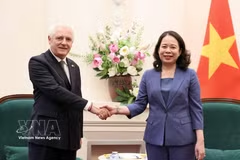
Vice State President Vo Thi Anh Xuan (R) receives outgoing Argentine Ambassador Marcos Antonio Bednarski (Photo: VNA)

Vietnam praises Comprehensive Partnership with Argentina: Vice State President

Vice State President Vo Thi Anh Xuan highlighted the importance of strengthening links among business associations, enterprises, and localities through cultural exchanges, tourism, and trade promotion activities. Vietnam also seeks expanded cooperation with Argentina in science and technology, innovation, education and training, culture, tourism, and people-to-people exchanges, she said.

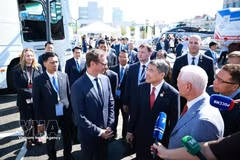
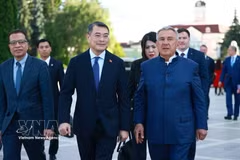
Prime Minister Le Minh Hung on June 17 morning (local time) visits the "Made in Tatarstan" exhibition in Kazan, the capital of Russia's Republic of Tatarstan. (Photo: VNA)

Prime Minister visits Tatarstan's industrial and high-tech exhibition

Prime Minister Le Minh Hung on June 17 morning (local time) visited the "Made in Tatarstan" exhibition in Kazan, the capital of Russia's Republic of Tatarstan, as part of his trip to Russia to attend a summit marking the 35th anniversary of ASEAN-Russia relations and conduct bilateral activities.

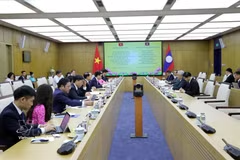
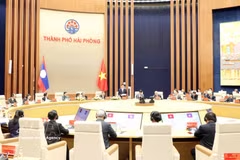
The working session between Hai Phong authorities and the Lao delegation led by Deputy Prime Minister and Minister of Justice Khamphan Phommathat on June 17 (Photo: VNA)

Hai Phong, Lao localities deepen cooperative ties

Hai Phong has already established friendship and cooperation agreements with the Lao provinces of Vientiane and Oudomxay, which cover Party and administration building, education - training, healthcare, tourism, investment, and trade. On the education front, the city runs scholarships for 134 students from the two provinces.

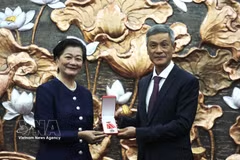
Vietnamese Ambassador to Cambodia Nguyen Minh Vu (R) presents the Friendship Order to former Cambodian Ambassador to Vietnam Chea Kimtha. (Photo: VNA)

Former Cambodian Ambassador to Vietnam awarded Friendship Order

During her tenure as Cambodian Ambassador to Vietnam from 2023 to 2026, Chea Kimtha made significant contributions to promoting the bilateral relations, advancing Party, State and people-to-people diplomacy, and strengthening connections among ministries, sectors and localities of both countries to effectively implement bilateral agreements.

The 7th expanded conference of justice agencies of Vietnamese and Lao border provinces is held in the northern port city of Hai Phong on June 17, 2026. (Photo: VNA)

Vietnam, Laos enhance legal, judicial cooperation in border areas

All pairs of border provinces have signed cooperation agreements or memoranda of understanding, many of which have been effectively implemented. Exchanges and meetings between local justice departments and civil judgment enforcement agencies have also been increasingly promoted, he said.

Vietnamese Prime Minister Le Minh Hung (centre) meets with Head of the Republic of Tatarstan Rustam Minnikhanov (right). (Photo: VNA)

Vietnamese Prime Minister meets with Head of Republic of Tatarstan in Kazan

PM Hung emphasised that Vietnam always treasures ​​its traditional friendship and Comprehensive Strategic Partnership with Russia, and wants to maintain and strengthen cooperation in various fields for the common benefit of both nations, and for stability and development in the region and the world.

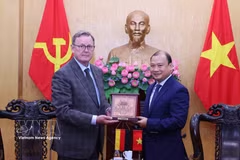
Standing Vice President of the Ho Chi Minh National Academy of Politics Le Hai Binh presents a gift to Bodo Ramelow, Vice President of the German Bundestag. (Photo: VNA)

Vietnam, Germany deepen educational cooperation

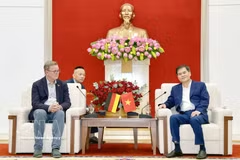
German businesses operating in Vietnam have consistently expressed their satisfaction with the country's dynamic and stable economy, as well as their confidence in its long-term growth prospects, said Vice President of the German Bundestag Bodo Ramelow.

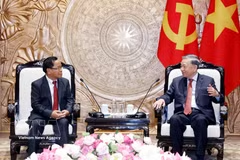
General Secretary of the Communist Party of Vietnam (CPV) Central Committee and State President To Lam (right) receives Lao Deputy Prime Minister and Minister of Justice Khamphan Phommathat. (Photo: VNA)

Top leader calls for stronger Vietnam–Laos judicial cooperation

The top leader stressed that ministries, sectors and localities of the two countries, including the two justice ministries, had made important contributions to the bilateral ties. Vietnam consistently regards strengthening relations with Laos as a strategic priority and stays ready to share development experience with its neighbouring nation.

Politburo member, Secretary of the Party Central Committee and head of the committee's Commission for Information, Education and Mass Mobilisation Trinh Van Quyet holds a meeting with Canadian Ambassador to Vietnam Jim Nickel on June 16, 2026. (Photo: VNA)

Vietnam, Canada seek deeper cooperation in media, education and innovation

Vietnam is taking a range of coordinated measures to unlock new drivers of development as it works towards achieving its two centenary goals. Along this journey, the country places great importance on cooperation with Canada, particularly in science and technology, innovation, and the training of all-level officials.