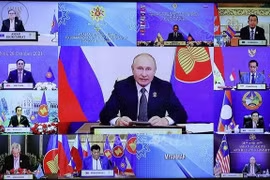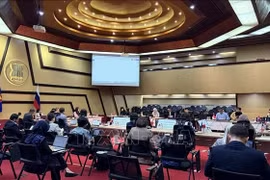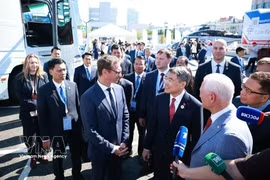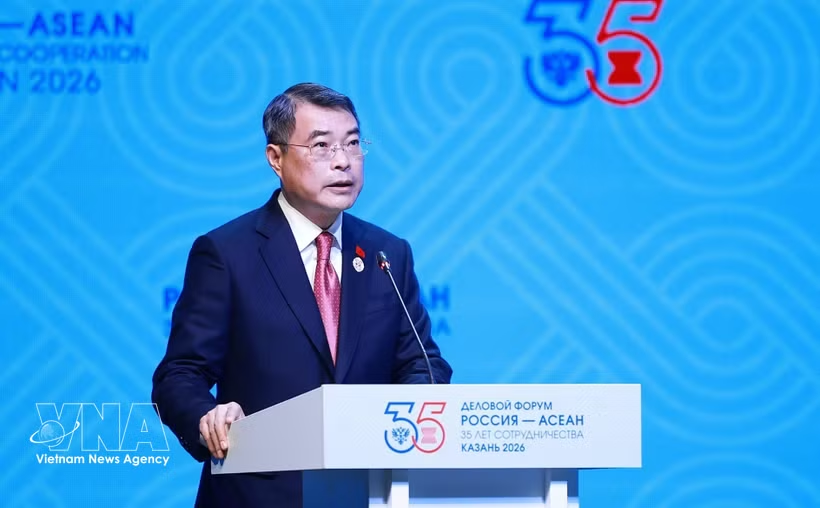
Kazan (VNA) – Prime Minister Le Minh Hung on June 17 called for stronger cooperation between ASEAN and Russia in building resilient supply chains, advancing energy partnerships, and promoting innovation and digital transformation, as he addressed the opening session of the ASEAN-Russia Business Forum in Kazan, Russia.
The event formed part of the PM’s trip to attend the ASEAN-Russia Commemorative Summit marking the 35th anniversary of relations between the two sides.
Addressing the gathering, PM Hung said the forum provided a valuable opportunity for ASEAN and Russia to exchange strategic perspectives aimed at fostering broader, more substantive, more connected and more resilient future cooperation amid global changes.
Noting that the world is undergoing rapid and complex transformations, he stressed the importance of building trusted partnerships, stable markets and resilient supply chains capable of withstanding external disruptions.
On the basis of the complementary strengths and potential of ASEAN and Russia, the Vietnamese leader proposed three key directions for cooperation.
First, he called for stronger coordination in developing sustainable supply chains and expanding trade and investment.
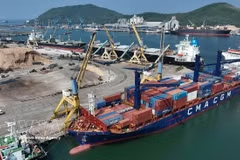
According to the PM, ASEAN and Russia should work together to build stable, flexible and resilient supply chains while developing transport routes linking Russia’s Far East with Southeast Asia, including seaports and railway networks. Such connectivity would help facilitate trade, narrow geographical distances and unlock new opportunities for investment and business cooperation.
He also encouraged businesses to make fuller use of existing economic cooperation mechanisms, particularly free trade agreements between the EAEU and several ASEAN member states.
Drawing on Vietnam’s experience with the Vietnam-EAEU Free Trade Agreement, Hung affirmed that Vietnam stands ready to serve as a bridge in promoting stronger economic ties between ASEAN and the EAEU, as well as between ASEAN and Russia.
Second, the PM proposed positioning energy a key pillar of ASEAN-Russia cooperation.
He noted that energy security remains one of the most pressing challenges to the growth and sustainable development of nations, while highlighting significant potential for collaboration in clean energy, liquefied natural gas (LNG), hydrogen, offshore wind power and energy-efficiency technologies.
Energy has long been a cornerstone of the Vietnam-Russia partnership, he said, expressing Vietnam looks forward to working with Russia and fellow ASEAN members on viable projects, particularly in clean energy and green technologies, thereby contributing to regional energy security and stability.
Third, Hung underscored the growing importance of technology, innovation and digital transformation as new drivers of growth.
This will be one of the most important areas of cooperation between ASEAN and Russia in the years ahead, the PM said.
ASEAN as a whole, and Vietnam in particular, is among the fastest-growing digital markets in the world. In Vietnam, innovation and science and technology have been identified as key drivers of development in the new era.
Against this backdrop, Vietnam particularly welcomes and stands ready to facilitate deeper cooperation with Russian enterprises in areas such as artificial intelligence (AI), cybersecurity, digital education, and digital healthcare.
The PM also encouraged ASEAN and Russia to advance innovation cooperation programmes, support technology companies and young start-ups, and foster a vibrant innovation ecosystem that connects the business communities on both sides.
He encouraged businesses from ASEAN and Russia to continue making long-term investments, build new value chains and work together to turn potential into concrete projects, connectivity into business opportunities and mutual trust into a new driver of growth.
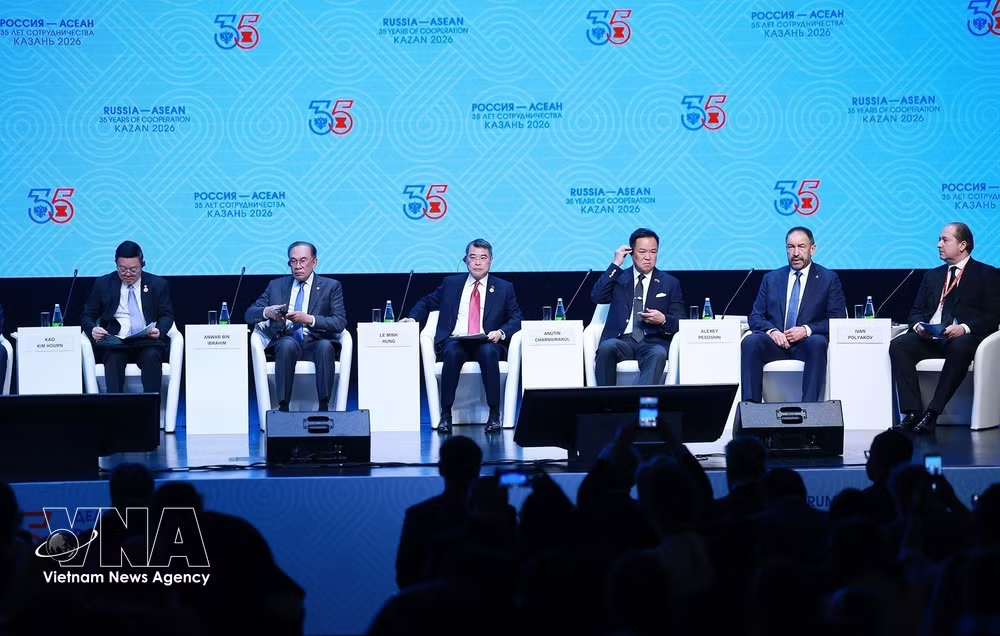
Speaking at the forum, Malaysian Prime Minister Anwar Ibrahim stressed that no country can effectively address global challenges alone amid rising geopolitical tensions. He called for greater dialogue, trust-building, practical cooperation and support for a rules-based multilateral trading system.
Thai Prime Minister Anutin Charnvirakul highlighted the importance of connectivity, trade, investment and people-to-people exchanges, while ASEAN Secretary-General Kao Kim Hourn proposed focusing on energy security, food security, supply chain connectivity, the digital economy and digital transformation.
Business representatives at the forum noted that with a combined population of around 850 million people, ASEAN and Russia possess substantial potential to expand economic and investment cooperation and strengthen participation in global supply chains, particularly in energy, food, digital technology and artificial intelligence.
Held in Kazan, the capital of the Republic of Tatarstan and one of Russia’s major economic and cultural centres, the forum serves as an international platform for discussions on trade, investment and economic cooperation between Russia and ASEAN member states, while promoting collaboration within the ASEAN-Eurasian Economic Union (EAEU) partnership framework.
The opening session drew ASEAN leaders, senior officials from Russia and Tatarstan, as well as representatives of business associations, research institutions and enterprises from both sides, including the Chamber of Commerce and Industry of the Russian Federation, the Russia-ASEAN Business Council, the ASEAN Business Advisory Council and the ASEAN Centre at the Moscow State Institute of International Relations (MGIMO).
Russian President Vladimir Putin sent a message to the forum, affirming that cooperation between Russia and ASEAN, including exchanges between the ASEAN Business Advisory Council and the Russia-ASEAN Business Council, has continued to develop steadily and create a solid foundation for future collaboration.
He expressed confidence that decisions adopted at the ASEAN-Russia Commemorative Summit would help boost trade, investment and industrial cooperation while strengthening direct dialogue between business communities from both sides.
The forum featured discussions on cross-border information technology and artificial intelligence (AI), financial technology and smart cities, international trade, food security, transport and logistics connectivity, ASEAN-EAEU cooperation in energy, infrastructure and industry, as well as cultural and social values.
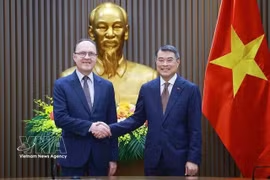
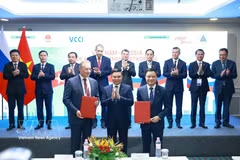
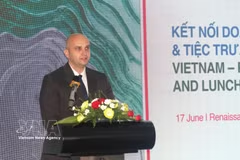
On the same day, Prime Minister Hung met with the Vietnamese community in Tatarstan, held meetings with executives of several major Russian companies, and attended the Vietnam–Russia Investment and Business Connectivity Programme, along with a number of other activities./.