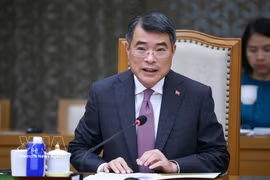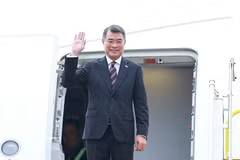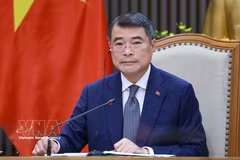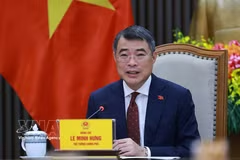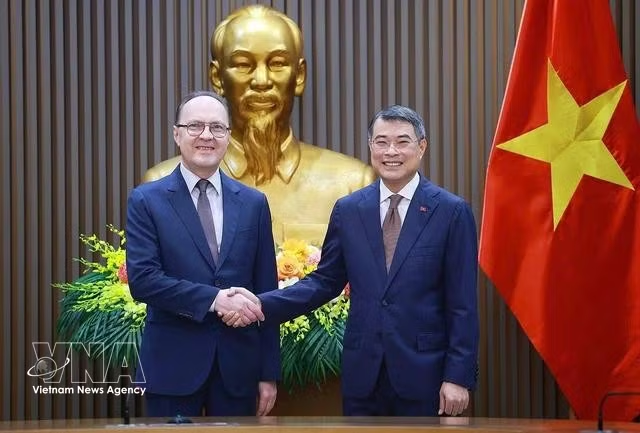
Hanoi (VNA) – Prime Minister Le Minh Hung’s upcoming trip to Russia from June 16–18 for the ASEAN–Russia Commemorative Summit marking the 35th anniversary of dialogue relations and bilateral activities underscores Vietnam’s commitment to the ASEAN–Russia Strategic Partnership and highlights its role as a bridge fostering closer cooperation between the grouping and Russia.
Thirty-five years of ASEAN–Russia partnership
The Association of Southeast Asian Nations (ASEAN) and Russia established dialogue relations in 1991 and elevated ties to a Strategic Partnership in 2018. Since then, cooperation has expanded across political-security, economic and socio-cultural pillars.
Political and security cooperation has deepened through regular high-level dialogue, Russia’s active participation in ASEAN-led mechanisms and joint efforts to combat transnational crime, cybersecurity threats and drug trafficking. The two sides have held five summit meetings since 2005.
Economic ties have also strengthened through trade and investment programmes and cooperation between ASEAN and the Eurasian Economic Union (EAEU). Russia remains an important ASEAN partner in areas such as energy and food security.
Implementation of the ASEAN–Russia Comprehensive Plan of Action, extended through 2026, reached 82% during 2021–2025. Two-way trade totalled 17.81 billion USD in 2025. Both sides are working to finalise the ASEAN–Russia Plan of Action for 2026–2030 to guide future cooperation.
People-to-people exchanges have expanded through cultural, educational and academic initiatives, including youth and young diplomats’ forums.
The commemorative summit in Kazan on June 17–18 takes place amid a rapidly evolving global environment, with ongoing conflicts continuing to affect peace, security, economic growth, trade and supply chains.
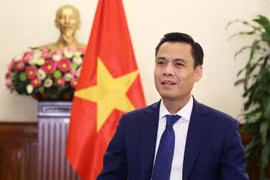
According to Deputy Foreign Minister Dang Hoang Giang, head of the ASEAN Senior Officials’ Meeting (SOM) delegation of Vietnam, the summit will focus on three key priorities.
First, leaders will conduct a comprehensive review of ASEAN–Russia relations, assess achievements and challenges, identify new priorities and propose practical measures to strengthen mutually beneficial cooperation, particularly in energy security and connectivity across the broader Eurasian region.
Second, ASEAN and Russian leaders will exchange views on regional and international issues of common concern to deepen mutual understanding, strengthen strategic trust and address shared challenges in accordance with international law.
Third, the summit is expected to adopt key documents that will shape ASEAN–Russia cooperation in the coming years and better meet the development needs of both sides.
Vietnam’s active role
As an important bridge between Russia and ASEAN, Vietnam has consistently supported cooperation between the two sides.
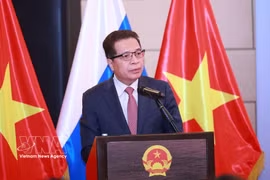
Vietnamese Ambassador to Russia Dang Minh Khoi noted that Vietnam has proposed numerous initiatives to strengthen ASEAN–Russia relations and supported Russia’s deeper engagement with ASEAN institutions. Vietnam’s traditional friendship with Russia has also helped facilitate broader cooperation.
Vietnam supports expanding collaboration in trade, energy, science and technology, education and training, responses to non-traditional security challenges, and cooperation between ASEAN and organisations such as the EAEU, the Shanghai Cooperation Organisation (SCO) and BRICS.
PM Hung’s participation reflects Vietnam’s foreign policy of independence, self-reliance, peace, cooperation and diversified international relations, while reaffirming its strong support for ASEAN–Russia ties and its longstanding partnership with Russia.
Giang said the visit aims to leverage Vietnam’s role as a bridge, promote consensus and generate fresh momentum for ASEAN–Russia cooperation. This is particularly significant as Vietnam helped build ASEAN consensus for the summit and will serve as ASEAN coordinator for relations with Russia during 2027–2030.
Vietnam will advocate a practical, balanced and results-oriented approach, focusing on trade, science and technology, digital transformation, non-traditional security, education, tourism, people-to-people exchanges and energy cooperation.
The country also seeks to expand cooperation between ASEAN and the wider Eurasian region. As the first ASEAN member to sign a free trade agreement with the EAEU in 2015, Vietnam has valuable experience in promoting trade, investment, logistics and business connectivity.
Vietnam will also engage in discussions on issues affecting peace, stability, energy security and development, aiming to strengthen understanding and trust between ASEAN and Russia through dialogue and respect for international law.
Ekaterina Koldunova, Director of the ASEAN Centre at the Moscow State Institute of International Relations, said the summit offers an opportunity for Russia and ASEAN countries to exchange initiatives and identify new avenues for cooperation. She noted that discussions will cover not only ASEAN–Russia relations but also broader cooperation with the EAEU, particularly in areas such as energy, interregional cooperation, health care, biotechnology, food security, education and creative industries.
Ambassador Khoi expressed his belief that the summit would set strategic directions for a new phase of ASEAN–Russia cooperation and create fresh momentum for mutually beneficial collaboration while providing a platform to discuss key regional and international issues./.
VNA