Top leader calls for modernising Party ideological work amid digital transformation

Top leader calls for modernising Party ideological work amid digital transformation

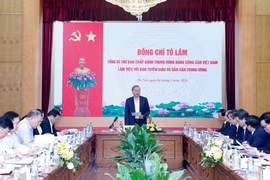
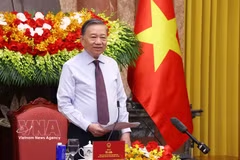
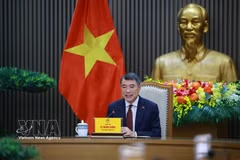
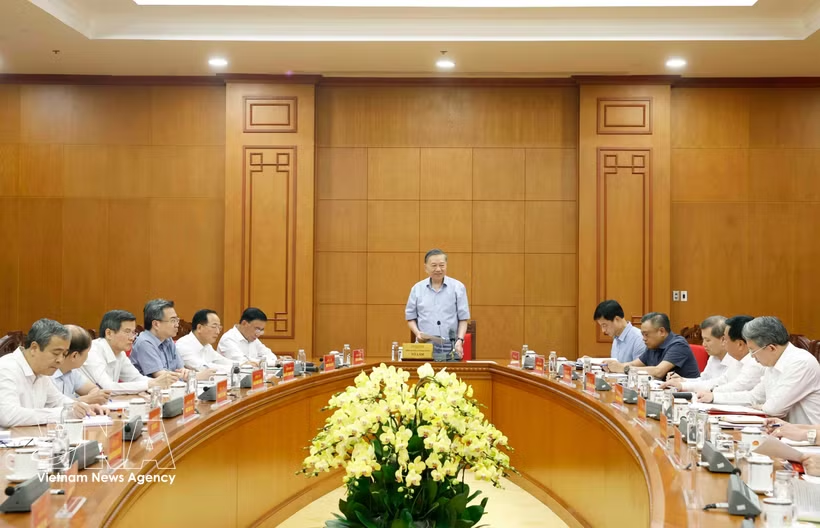
Party General Secretary and State President To Lam chairs a working session in Hanoi on June 15, 2026, to provide comments on the draft strategy for the Party’s ideological work in the context of digital transformation. (Photo: VNA)

Hanoi (VNA) – Party General Secretary and State President To Lam on June 15 chaired a working session with the Party Central Committee’s Commission for Information, Education and Mass Mobilisation to provide comments on the draft strategy for the Party’s ideological work in the context of digital transformation.

Participants focused discussions on several issues, including the position, scope and nature of the strategy; pillars relating to the political and ideological foundation; protection of the Party’s ideological foundation in cyberspace; and implementation mechanisms.

Concluding the session, General Secretary and President Lam affirmed that formulating the strategy is an objective and urgent requirement with long-term significance.

The overarching requirement, he stressed, is to ensure that ideological work truly becomes an essential leadership capability of the Party in the digital era, contributing to safeguarding the Party’s ideological foundation, strengthening social consensus and public trust, and supporting the successful achievement of national development goals.

Expressing broad agreement with the draft’s overall approach, the top leader requested that it clearly reflect a shift in thinking to meet the objectives of enhancing public confidence, political communication modernisation, and dialogue and persuasion. It should also help use data to understand developments and improve forecasting, early warning and proactive guidance from an early stage and from afar. He also stressed the need to avoid turning ideological work into an overly technical exercise.

Technology, data and artificial intelligence, he said, are highly important tools, but cannot replace political steadfastness, theoretical foundations, revolutionary ethics, the capacity for dialogue, the exemplary responsibility and persuasive ability of officials and Party members.

The strategy, he added, should adopt the guiding principle of being proactive, sharp, persuasive, and effective.

General Secretary and President Lam underlined that the overall objective is to build a modern, proactive, professional and effective system of Party ideological work that operates coherently in all circumstances, based on a solid political foundation, unified digital data, modern political communication, substantive political theory education, and a contingent of officials possessing political mettle, intellectual capacity, digital competence and a strong sense of exemplary responsibility.

He suggested that a long-term task should be to unify awareness and responsibility across the Party regarding ideological work under new conditions, making clear that this is a highly important Party-building task directly linked to leadership capacity, governance capability, implementation of resolutions and consolidation of public trust. It should not be regarded solely as the responsibility of agencies in charge of communications, mass mobilisation, media, technology or culture. Party committees, particularly their leaders, must take direct responsibility for leadership, supervision and implementation.
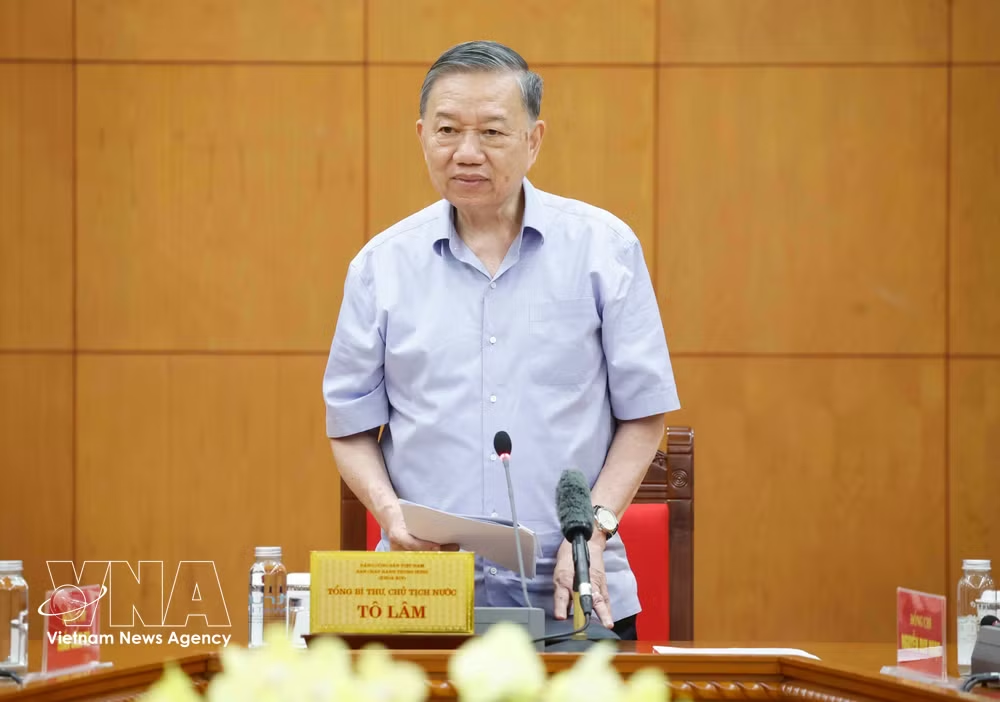
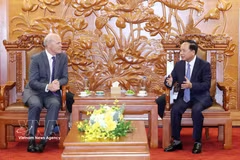
Party General Secretary and State President To Lam speaks at the working session in Hanoi on June 15, 2026. (Photo: VNA)

Party General Secretary and State President To Lam speaks at the working session in Hanoi on June 15, 2026. (Photo: VNA)

The top leader stated that a digital data ecosystem should be developed for ideological work, public opinion, journalism, communications, study of Party resolutions, grassroots feedback and information systems, ensuring interoperability, security and confidentiality to directly support Party committees in leadership and direction. The application of technology and artificial intelligence should remain controlled and guided by ethical standards, with technology serving people rather than replacing political responsibility.

It is also necessary, he noted, to strengthen analytical, forecasting and early-warning capabilities. This is the key step in shifting ideological work from a reactive to a proactive approach, moving from dealing with issues after they arise to providing guidance from an early stage and from afar. Priority should be given to promptly identifying ideological issues, public sentiment, opinion hotspots, harmful information, campaigns aimed at manipulating perceptions, technology-generated false content, and livelihood-related issues that could be exploited or distorted.

A longer-term task, the top leader said, is to build a positive information ecosystem and promote the role of the people. This includes mobilising the strength of the press and media, officials and Party members, intellectuals, artists, trusted figures, positive influencers and all sections of society to disseminate accurate and constructive information, uphold what is right and rebut what is wrong. The people, he stressed, are not merely recipients of information but also participants in building trust, safeguarding the Party’s ideological foundation and shaping a strong public support base in cyberspace.

He also emphasised the need to build a capable workforce, improve institutions and reform evaluation methods, including standardising the competencies of officials engaged in ideological work, among other tasks.

The General Secretary and President requested the commission to urgently finalise the proposal with the spirit of being commensurate in scope, clear in responsibilities, feasible in implementation, measurable in outcomes and accountable in execution, for early submission to the Politburo./.
VNA

See more

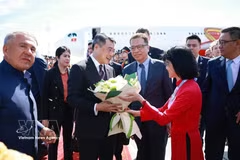
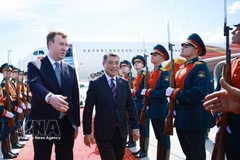
Head of the Republic of Tatarstan Rustam Minnikhanov (left) welcomes Vietnamese Prime Minister Le Minh Hung (second, left) at Gabdulla Tukay Kazan International Airport in Kazan. (Photo: VNA)

Vietnamese Prime Minister meets with Head of Republic of Tatarstan in Kazan

PM Hung emphasised that Vietnam always treasures ​​its traditional friendship and Comprehensive Strategic Partnership with Russia, and wants to maintain and strengthen cooperation in various fields for the common benefit of both nations, and for stability and development in the region and the world.

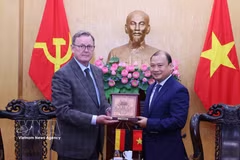
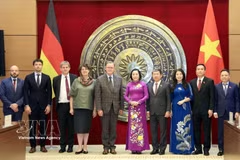
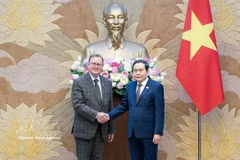
Standing Vice President of the Ho Chi Minh National Academy of Politics Le Hai Binh presents a gift to Bodo Ramelow, Vice President of the German Bundestag. (Photo: VNA)

Vietnam, Germany deepen educational cooperation

German businesses operating in Vietnam have consistently expressed their satisfaction with the country's dynamic and stable economy, as well as their confidence in its long-term growth prospects, said Vice President of the German Bundestag Bodo Ramelow.

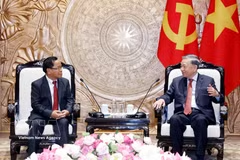
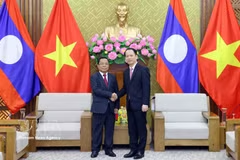
General Secretary of the Communist Party of Vietnam (CPV) Central Committee and State President To Lam (right) receives Lao Deputy Prime Minister and Minister of Justice Khamphan Phommathat. (Photo: VNA)

Top leader calls for stronger Vietnam–Laos judicial cooperation

The top leader stressed that ministries, sectors and localities of the two countries, including the two justice ministries, had made important contributions to the bilateral ties. Vietnam consistently regards strengthening relations with Laos as a strategic priority and stays ready to share development experience with its neighbouring nation.

Politburo member, Secretary of the Party Central Committee and head of the committee's Commission for Information, Education and Mass Mobilisation Trinh Van Quyet holds a meeting with Canadian Ambassador to Vietnam Jim Nickel on June 16, 2026. (Photo: VNA)

Vietnam, Canada seek deeper cooperation in media, education and innovation

Vietnam is taking a range of coordinated measures to unlock new drivers of development as it works towards achieving its two centenary goals. Along this journey, the country places great importance on cooperation with Canada, particularly in science and technology, innovation, and the training of all-level officials.

Prime Minister Le Minh Hung is welcomed at Gabdulla Tukay Kazan International Airport in Kazan, the capital of the Republic of Tatarstan, Russia on June 16 afternoon (local time). Photo: VNA

Prime Minister arrives in Kazan to attend ASEAN–Russia Commemorative Summit

As an important bridge between Russia and ASEAN, Vietnam has consistently been among the most active supporters for expanding Russia’s cooperation with ASEAN. The country has proposed numerous initiatives and recommendations to strengthen ASEAN–Russia relations and has supported Russia’s more active participation in ASEAN-led mechanisms.

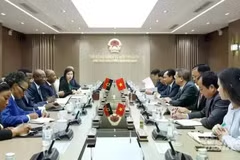
Vietnamese Minister of Justice Hoang Thanh Tung (R) and Lao Deputy Prime Minister and Minister of Justice Khamphan Phommathat meet in Hanoi on June 16. (Photo: VNA)

Vietnamese, Lao justice ministers vow deeper collaboration during talks

Vietnamese Minister of Justice Hoang Thanh Tung urged deeper exchanges of experience in legal development, enforcement, judicial reform, personnel training, and digital transformation, as well as coordinated steps to fast-track the approval and launch of the Vietnamese Government’s technical assistance project to strengthen the capacity of Lao judicial officials.

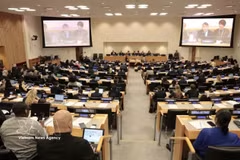
An overview of the 36th meeting of States Parties to the United Nations Convention on the Law of the Sea (Photo: VNA))

Vietnam presides over opening session of 36th meeting of States Parties to UNCLOS

Against the backdrop of mounting challenges facing the oceans, including climate change, marine pollution, biodiversity loss, maritime security concerns, and the impacts of emerging technologies, Permanent Deputy Foreign Minister Nguyen Minh Vu called for stronger international cooperation and greater resource mobilisation to protect the oceans and ensure a peaceful, secure, and sustainable marine environment.

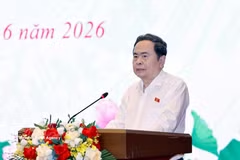
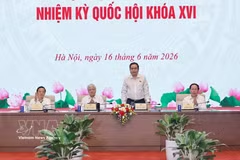
NA Chairman Tran Thanh Man speaks at the conference (Photo: VNA)

Conference mulls over legislative roadmap for 16th NA’s term

In his keynote speech, NA Vice Chairman Nguyen Khac Dinh presented the conclusion as a strategic vision for legal reform in the new development period. It spells out concrete goals, nine major orientations, six bundles of tasks and solutions, and assigns specific duties to the relevant bodies.

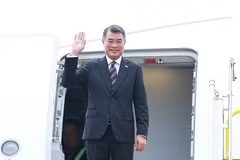
Prime Minister Le Minh Hung departs Hanoi on June 16, 2026 to attend the ASEAN–Russia Commemorative Summit and conduct bilateral activities in Kazan, Russia from June 16 to 18. (Photo: VNA)

PM departs for ASEAN – Russia Commemorative Summit

PM Hung’s participation in this summit once again reflects Vietnam’s consistent foreign policy of independence, self-reliance, resilience, peace, friendship, cooperation and development, as well as the diversification and multilateralisation of external relations in line with the spirit of the 14th National Party Congress.

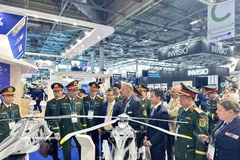
Deputy Defence Minister Senior Lieutenant General Nguyen Truong Thang and the Vietnamese delegation are briefed by a French partner on a combat helicopter model at Eurosatory 2026. (Photo: VNA)

Vietnam promotes defence cooperation at Eurosatory 2026

During the event, the Vietnamese delegation met with major French defence firms, including Airbus and UNAC, to discuss technology transfer, human resource training, technical support and defence industry development. Vietnam also invited international partners to participate in the Vietnam International Defence Expo 2026, scheduled to be held in Hanoi this December.

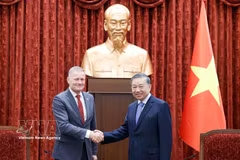
Party General Secretary and State President To Lam receives Danish Ambassador to Vietnam Nicolai Prytz in Hanoi on June 15, 2026. (Photo: VNA)

Top Vietnamese leader receives outgoing Danish Ambassador

Party General Secretary and State President To Lam emphasised that the friendship nurtured over decades, coupled with shared development visions, particularly in the green economy, maritime economy and circular economy, as well as growing connections in culture, sports, tourism and people-to-people links, will continue to serve as a solid foundation for deeper and more productive relations between Vietnam and Denmark.