Efforts needed to safeguard data security in digital era

Vietnam’s cybersecurity landscape has witnessed a notable shift in recent years. While the number of cyberattacks recorded in 2025 showed signs of decline, the proportion of organisations suffering actual damage rose to 52.3%. Cyberattacks increasingly target critical sectors, including banking, finance, energy, telecommunications, and government agencies.

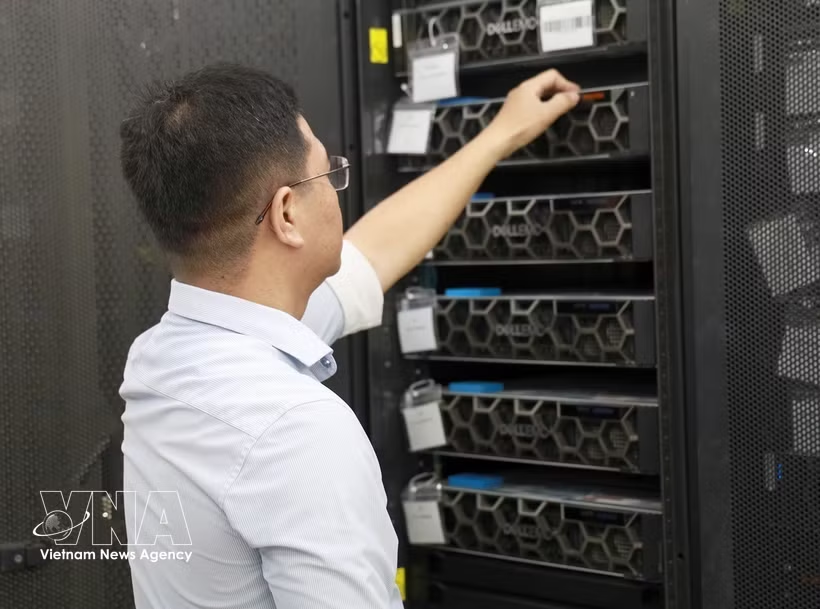
An engineer at the Digital Transformation Centre under the Khanh Hoa provincial Department of Science and Technology performs equipment maintenance. (Photo: VNA)

Hanoi (VNA) – Vietnam has strengthened its legal framework in recent years to ensure data security amid growing cyber threats targeting data.

In the digital era, data has emerged as a strategic resource underpinning the digital economy, national competitiveness, and social stability. Consequently, it has become a prime target for cybercriminals seeking to manipulate behaviour, steal financial assets, undermine public trust, and weaken a nation’s digital sovereignty.

Vietnam’s cybersecurity landscape has witnessed a notable shift in recent years. While the number of cyberattacks recorded in 2025 showed signs of decline, the proportion of organisations suffering actual damage rose to 52.3%. Cyberattacks increasingly target critical sectors, including banking, finance, energy, telecommunications, and government agencies.

According to the Cybersecurity and High-Tech Crime Prevention Department under the Ministry of Public Security (A05), more than 502 million data records were exposed during the third quarter of 2025 alone, the highest figure ever recorded in the country. Such data breaches not only threaten privacy and information security but also provide raw material for increasingly sophisticated AI-powered fraud schemes.

Vu Duy Hien, Deputy Secretary-General and Chief of Office of the National Cybersecurity Association, noted that cyberattacks have evolved from disrupting systems to stealing data, exploiting digital identities, and manipulating user behaviour. As a result, cybersecurity incidents now pose risks that extend beyond economic losses, affecting social trust, national security, and the legitimate rights of citizens in cyberspace.

Experts attribute many recent data leaks to weaknesses in data governance. Common shortcomings include excessive data collection without adequate safeguards, weak access-control mechanisms, insufficient monitoring and early-warning systems, and inadequate assessment of risks associated with data storage, processing, and transfer across multiple platforms and environments.

Against this backdrop, data protection must be integrated into risk governance and management, and security strategies of every public institution, organisation, and enterprise. Effective protection requires comprehensive oversight throughout the entire data lifecycle - from collection and storage to processing, sharing, and deletion - while ensuring transparency, accountability, and traceability.

The National Assembly’s adoption of the Law on Data, effective from July 1, 2025, the Law on Personal Data Protection, effective from January 1, 2026, and the Cybersecurity Law 2025, which will take effect on July 1, 2026, marks a significant step toward building a modern, responsible, and secure data governance system.

These legal documents establish a unified mechanism for regulating data collection, processing, storage, sharing, and cross-border transfers, while addressing fragmentation in data management across sectors. They also provide a stronger foundation for international cooperation, foster trust in Vietnam’s data environment, support digital economic development, and better protect the lawful rights and interests of citizens.

Alongside legal safeguards, technological self-reliance remains essential to strengthening national resilience in cyberspace. Experts stress that enhancing domestic cybersecurity capabilities and promoting responsible digital behaviour among users are equally important. As observed by Nguyen Le Thanh, founder and CEO of cybersecurity firm Verichains, the simple act of taking a few seconds to verify information before sharing it remains a vital line of defence that no artificial intelligence system can fully replace.

Ensuring data security in the digital era therefore requires a comprehensive approach that combines robust legal frameworks, technological autonomy, and heightened public awareness. Only through such coordinated efforts can countries effectively safeguard data sovereignty and maintain public trust in an increasingly interconnected world./.


VNA
See more

A worker from Hanoi branch of the Viettel Construction Corporation is connecting and installing 5G BTS station equipment. (Photo: VNA)

Vietnam expects digital economy to contribute 30% of GDP by 2030

The country also aims to support at least 500,000 small and medium-sized enterprises in digital transformation, develop a minimum of five digital technology companies capable of competing with counterparts in advanced economies, and establish at least five operational data exchanges.

The international conference takes place in Varna city, Bulgaria, from June 10 to 12. (Photo: VNA)

Vietnam hopes to enhance nuclear energy cooperation with Bulgaria: ambassador

Highly valuing Bulgaria's extensive experience in operating the Kozloduy nuclear power plant and training specialised personnel, Ambassador Nguyen Thi Minh Nguyet proposed boosting bilateral cooperation in specialist training, scientific research, and the sharing of management, operational, and nuclear safety expertise.

Visitors explore agricultural production equipment on display at Agri & Biotech Vietnam 2026 in Ho Chi Minh City. (Photo: VNA)

Agri-biotech exhibition series underway in Ho Chi Minh City

In addition to the exhibition activities, Agri & Biotech Vietnam 2026, lasting until June 12, is set to host a series of specialised forums and seminars. Topics of particular interest to businesses include farming exports, sustainable development of the pepper and spice industries, low-emission agriculture, carbon credits, the circular economy, biotechnology and innovative start-ups.

At Expo Tel Aviv in Israel (Photo: VNA)

Digital transformation fuels demand for cybersecurity talent

According to the National Cybersecurity Association (NCA), cyberattacks are rising in both frequency and severity. Attackers are targeting critical infrastructure, personal data, and public services with increasingly advanced methods. This isn't just a technical glitch, but a systemic vulnerability requiring a workforce that can analyse and respond in real time.

Billionaire Eric Schmidt, former Chairman and CEO of Google and former Chairman of the US National Security Commission on Artificial Intelligence (NSCAI) (Photo: NIC/VietnamPlus)

Vietnam well-positioned to become global AI hub: Eric Schmidt

Vietnam possesses significant advantages and strong potential to emerge as a global centre for artificial intelligence (AI), according to billionaire Eric Schmidt, former Chairman and CEO of Google and former Chairman of the US National Security Commission on Artificial Intelligence (NSCAI).

Vietnamese Ambassador to Austria Vu Le Thai Hoang speaks at the event. (Photo: VNA)

Vietnam shows off homegrown humanoid robots in Austria

The event paired a robotics showcase with an innovation networking session, spotlighting Vietnamese companies’ research, development and technological mastery in robotics, automation and artificial intelligence.

Vietnamese delegates at the 2026 IEEE International Conference on Robotics and Automation (ICRA 2026). (Photo: VNA)

Vietnamese tech draws attention at Austria robotics forum

Representing Vietnam were VinRobotics and VinDynamics, two tech subsidiaries of Vingroup. They showcased "Make in Vietnam" humanoid robots, demonstrating the country’s growing capacity to integrate into the global robotics value chain.

Deputy Prime Minister Ho Quoc Dung speaks at the meeting of the Government task force on strategic technology development on June 4. (Photo; VNA)

Deputy PM demands tangible results in strategic tech development

Deputy PM Ho Quoc Dung pressed ministries and agencies to rapidly convert their assigned tasks into concrete action plans with clearly defined responsibilities, and effectively launch projects that create strategic technology products capable of sharpening national competitiveness.

A panel discussion on “Digital trust in the AI era: Security starts with the users” at the Digital Trust in Finance 2026 forum (Photo: nhandan.vn)

Protecting users crucial in building digital trust: Experts

In Vietnam, digital transformation in the finance and banking sector is accelerating cashless payments, expanding access to financial services, improving market transparency and supporting economic growth and macroeconomic management.