Vietnam, Iran seek stronger cooperation in ICT, AI, nanotechnology

Vietnamese Ambassador to Iran Nguyen Luong Ngoc said greater understanding of each side’s strengths and potential, particularly in AI and information technology, will provide a solid foundation for expanding future cooperation.

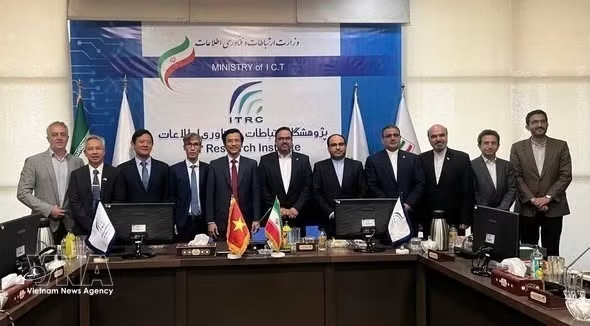
Vietnamese Ambassador to Iran Nguyen Luong Ngoc (fifth from left) meets with representatives from Iran’s ICT Research Institute. (Photo: VNA)

Hanoi (VNA) – Vietnam and Iran are set to step up cooperation in information and communications technology (ICT), artificial intelligence (AI), and nanotechnology following a series of meetings between Vietnamese Ambassador to Iran Nguyen Luong Ngoc and Iranian officials and research institutions.

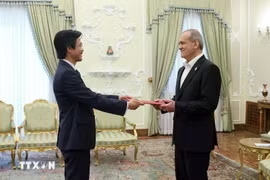
During a meeting with Iranian Minister of Information and Communications Technology Sattar Hashemi, the two sides discussed measures to strengthen cooperation in science, technology, and ICT in line with the digital transformation and knowledge-based economy development strategies of their countries.

Hashemi highlighted Iran’s significant role in the Gulf region’s digital ecosystem and expressed the country’s readiness to implement AI cooperation programmes with regional partners.

According to the minister, major telecommunications operators and digital service platforms such as Snapp! and Digikala, each serving more than 30 million users, generate rich data resources that are crucial for the development of AI applications.

He also said that despite facing international sanctions, Iran has built a highly adaptive financial technology ecosystem and continues to maintain its momentum in innovation.

Ambassador Ngoc also met with leaders of Iran’s ICT Research Institute, one of the country’s leading centres for digital technology research. Discussions focused on potential cooperation in AI, cybersecurity, information technology, quantum technology, and telecommunications.

At the meeting with the institute’s president, Mohammad-Hossein Sheikhi, both sides stressed the need for a memorandum of understanding to facilitate expert exchanges, knowledge sharing, and stronger links between research centres in the two countries.

Ngoc said greater understanding of each side’s strengths and potential, particularly in AI and information technology, will provide a solid foundation for expanding future cooperation. He affirmed that the Vietnamese Embassy in Iran stands ready to help connect Vietnamese research institutes, universities, and technology enterprises with Iranian partners.

Sheikhi introduced the institute’s research capabilities and expressed his hope to strengthen scientific and research cooperation with Vietnamese counterparts.
As part of efforts to promote science and technology partnerships, Ngoc also met with M. Haji Zeinolabedini, Director General for International Cooperation and Export Development at Iran’s ICT Ministry, to discuss opportunities in high technology and innovation.

The ambassador’s meetings are expected to open up new prospects for cooperation in science, technology, and digital transformation while enhancing connectivity between government agencies, research institutes, and technology enterprises of both countries./.

VNA

See more

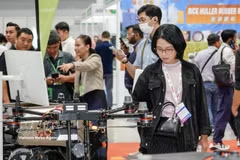
Visitors explore agricultural production equipment on display at Agri & Biotech Vietnam 2026 in Ho Chi Minh City. (Photo: VNA)

Agri-biotech exhibition series underway in Ho Chi Minh City

In addition to the exhibition activities, Agri & Biotech Vietnam 2026, lasting until June 12, is set to host a series of specialised forums and seminars. Topics of particular interest to businesses include farming exports, sustainable development of the pepper and spice industries, low-emission agriculture, carbon credits, the circular economy, biotechnology and innovative start-ups.

At Expo Tel Aviv in Israel (Photo: VNA)

Digital transformation fuels demand for cybersecurity talent

According to the National Cybersecurity Association (NCA), cyberattacks are rising in both frequency and severity. Attackers are targeting critical infrastructure, personal data, and public services with increasingly advanced methods. This isn't just a technical glitch, but a systemic vulnerability requiring a workforce that can analyse and respond in real time.

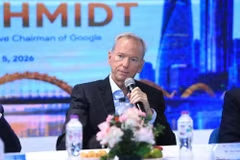
Billionaire Eric Schmidt, former Chairman and CEO of Google and former Chairman of the US National Security Commission on Artificial Intelligence (NSCAI) (Photo: NIC/VietnamPlus)

Vietnam well-positioned to become global AI hub: Eric Schmidt

Vietnam possesses significant advantages and strong potential to emerge as a global centre for artificial intelligence (AI), according to billionaire Eric Schmidt, former Chairman and CEO of Google and former Chairman of the US National Security Commission on Artificial Intelligence (NSCAI).

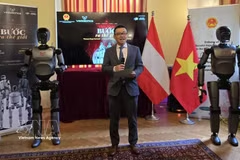
Vietnamese Ambassador to Austria Vu Le Thai Hoang speaks at the event. (Photo: VNA)

Vietnam shows off homegrown humanoid robots in Austria

The event paired a robotics showcase with an innovation networking session, spotlighting Vietnamese companies’ research, development and technological mastery in robotics, automation and artificial intelligence.

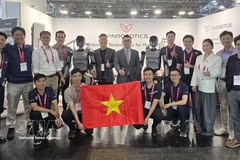
Vietnamese delegates at the 2026 IEEE International Conference on Robotics and Automation (ICRA 2026). (Photo: VNA)

Vietnamese tech draws attention at Austria robotics forum

Representing Vietnam were VinRobotics and VinDynamics, two tech subsidiaries of Vingroup. They showcased "Make in Vietnam" humanoid robots, demonstrating the country’s growing capacity to integrate into the global robotics value chain.

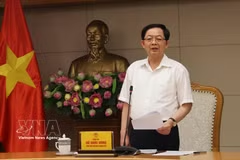
Deputy Prime Minister Ho Quoc Dung speaks at the meeting of the Government task force on strategic technology development on June 4. (Photo; VNA)

Deputy PM demands tangible results in strategic tech development

Deputy PM Ho Quoc Dung pressed ministries and agencies to rapidly convert their assigned tasks into concrete action plans with clearly defined responsibilities, and effectively launch projects that create strategic technology products capable of sharpening national competitiveness.

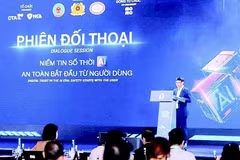
A panel discussion on “Digital trust in the AI era: Security starts with the users” at the Digital Trust in Finance 2026 forum (Photo: nhandan.vn)

Protecting users crucial in building digital trust: Experts

In Vietnam, digital transformation in the finance and banking sector is accelerating cashless payments, expanding access to financial services, improving market transparency and supporting economic growth and macroeconomic management.

Illustrative image

Proactive cybersecurity essential in age of AI-powered crime: experts

According to Dr. Le Minh Nghia, Chairman of the Vietnam Financial Consulting Association (VFCA), AI has become a key driver reshaping the global financial industry. In Vietnam, the technology is already widely used in banking and finance for credit analysis, electronic customer identification (eKYC), risk management, service personalisation and real-time transaction processing.

Dr Nguyen Huu Ha, Deputy Director of the Gia Lai Department of Science and Technology, speaks at the scientific workshop on recent advances in the study of strongly correlated electron systems opened in the central province on June 1, 2026. (Photo: VNA)

Global physicists discuss strongly correlated electron materials advances

The workshop aims to achieve three key objectives providing a platform for academic exchange and strengthening collaboration between leading international scientists and young researchers, including doctoral students; promoting multidimensional scientific dialogue on major open questions in the field; and initiating new directions for international research cooperation with the active participation of Vietnam's physics community.