Conference mulls over legislative roadmap for 16th NA’s term

In his keynote speech, NA Vice Chairman Nguyen Khac Dinh presented the conclusion as a strategic vision for legal reform in the new development period. It spells out concrete goals, nine major orientations, six bundles of tasks and solutions, and assigns specific duties to the relevant bodies.

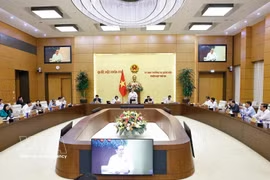
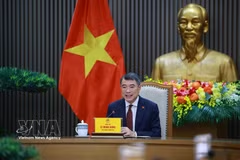
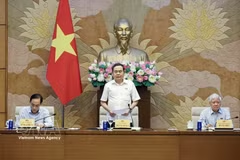
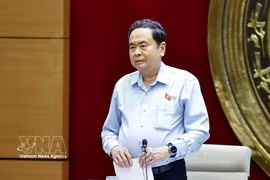
NA Chairman Tran Thanh Man speaks at the conference (Photo: VNA)

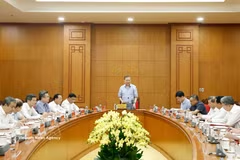
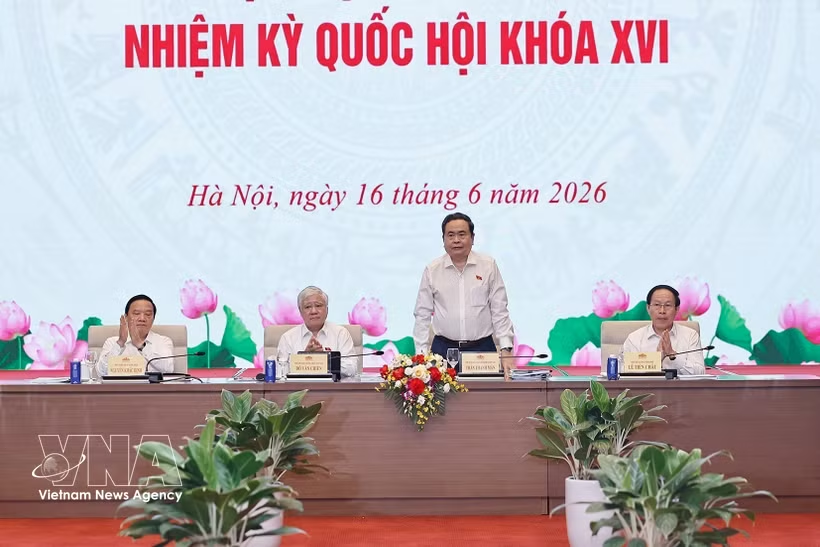
Hanoi (VNA) - National Assembly (NA) Chairman Tran Thanh Man chaired a conference on the implementation of legislative orientations for the 16th legislature term in Hanoi on June 16.

The gathering disseminated the Politburo’s Conclusion No.17-KL/TW and laid out the plan, core priorities, and policy tools needed to keep the lawmaking agenda on track.

Blueprint for a transparent. coherent legal system

In his keynote speech, NA Vice Chairman Nguyen Khac Dinh presented the conclusion as a strategic vision for legal reform in the new development period. It spells out concrete goals, nine major orientations, six bundles of tasks and solutions, and assigns specific duties to the relevant bodies.

The ultimate goal is a legal framework comprehensive enough to deliver Vietnam’s socio-economic targets for 2026–2031, mirroring the strategic direction set at the 14th National Party Congress. By 2030, the country intends to put in place a democratic, fair, transparent, coherent, and feasible legal system that facilitates development and engages both citizens and businesses in national development.

Looking further out to 2045, Vietnam aims to develop a high-quality, advanced and modern legal system that reflects domestic realities and meets international benchmarks.

According to Dinh, the success of this legislative term will directly shape the quality of Vietnam’s institutional framework for development and heavily influence whether the country hits its strategic milestones for 2030 and 2045.

The conclusion groups nine key orientations into three main priorities. The first is to deepen the institutional framework for a socialist rule-of-law state. That means further restructuring the state apparatus, effectively operating the three-tier administrative model, pushing for greater decentralisation and delegation of authority, and reinforcing accountability and oversight of power.

The second is a revamp of development institutional framework to spur rapid, sustainable economic expansion and sharpen national competitiveness. Lawmakers will focus on refining the socialist-oriented market economy mechanism, creating a legal environment conducive for sci-tech, innovation, and digital transformation, pooling resources for growth, ensuring a stable and transparent business climate, and finetuning laws on natural resources, environmental protection, green growth, and sustainable development.

The third is to harden the legal foundation for national defence-security, diplomacy, and global integration, contributing to safeguarding sovereignty, national interests, and a peaceful, stable environment while lifting Vietnam’s standing in the global arena.

Driving fundamental change in lawmaking

Dinh highlighted the six tasks contained in the conclusion, calling for a fundamental reset of how lawmakers think. The shift is from an administrative management to a service-oriented, pro-development mindset. Lawmaking, he insisted, must become the “breakthrough of breakthroughs” in institutional reform, abandon the mentality of “ban it if it can’t be managed” and replace excessive pre-approval gatekeeping with controlled risk management.

Under this approach, laws stop being instruments of state control and start enabling business activity, trimming compliance costs, fueling innovation, and unlocking resources for development. Institutional reform must also come with strict safeguards to stamp out corruption, wastefulness, vested interests, and policy profiteering in the legislative process.

Another priority is tightening the loop between lawmaking and enforcement. Regular reviews of enforcement outcomes should use economic performance and gains in living standards as the real barometer of policy success, thus systematically identifying and clearing the institutional bottlenecks that choke off growth.

He ended with a call for the broad use of sci-tech, innovation, and artificial intelligence across the legislative process. The move is meant to modernise lawmaking, raise transparency and efficiency, and deliver a high-quality legal system capable of meeting the demands of a digitally driven economy and society./.
VNA

See more

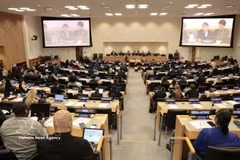
An overview of the 36th meeting of States Parties to the United Nations Convention on the Law of the Sea (Photo: VNA))

Vietnam presides over opening session of 36th meeting of States Parties to UNCLOS

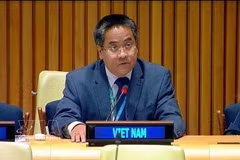
Against the backdrop of mounting challenges facing the oceans, including climate change, marine pollution, biodiversity loss, maritime security concerns, and the impacts of emerging technologies, Permanent Deputy Foreign Minister Nguyen Minh Vu called for stronger international cooperation and greater resource mobilisation to protect the oceans and ensure a peaceful, secure, and sustainable marine environment.

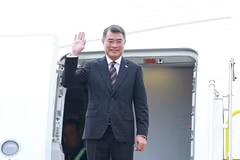
Prime Minister Le Minh Hung departs Hanoi on June 16, 2026 to attend the ASEAN–Russia Commemorative Summit and conduct bilateral activities in Kazan, Russia from June 16 to 18. (Photo: VNA)

PM departs for ASEAN – Russia Commemorative Summit

PM Hung’s participation in this summit once again reflects Vietnam’s consistent foreign policy of independence, self-reliance, resilience, peace, friendship, cooperation and development, as well as the diversification and multilateralisation of external relations in line with the spirit of the 14th National Party Congress.

Deputy Defence Minister Senior Lieutenant General Nguyen Truong Thang and the Vietnamese delegation are briefed by a French partner on a combat helicopter model at Eurosatory 2026. (Photo: VNA)

Vietnam promotes defence cooperation at Eurosatory 2026

During the event, the Vietnamese delegation met with major French defence firms, including Airbus and UNAC, to discuss technology transfer, human resource training, technical support and defence industry development. Vietnam also invited international partners to participate in the Vietnam International Defence Expo 2026, scheduled to be held in Hanoi this December.

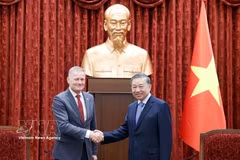
Party General Secretary and State President To Lam receives Danish Ambassador to Vietnam Nicolai Prytz in Hanoi on June 15, 2026. (Photo: VNA)

Top Vietnamese leader receives outgoing Danish Ambassador

Party General Secretary and State President To Lam emphasised that the friendship nurtured over decades, coupled with shared development visions, particularly in the green economy, maritime economy and circular economy, as well as growing connections in culture, sports, tourism and people-to-people links, will continue to serve as a solid foundation for deeper and more productive relations between Vietnam and Denmark.

Party General Secretary and State President To Lam speaks at the working session with the education sector in Hanoi on June 15. (Photo: VNA)

Top leader urges education sector to make fundamental shift in mindset

Implementation of Resolution 71 must be carried out with strict discipline, regular inspections and continuous monitoring. The Ministry of Education and Training should establish a transparent system for tracking implementation through specific and regularly updated indicators. Each objective must be translated into concrete tasks, resources, timelines and responsible agencies.

Prime Minister Le Minh Hung (R) receives Russian Ambassador to Vietnam Gennady Bezdetko in May 2026. (Photo: VNA)

Vietnam - bridge in advancing ASEAN–Russia relations

Prime Minister Le Minh Hung’s upcoming visit to Russia from June 16–18 for the ASEAN–Russia Commemorative Summit marking 35 years of dialogue relations highlights Vietnam’s commitment to the ASEAN–Russia Strategic Partnership and its role in strengthening cooperation between the bloc and Russia.

A bird's eye view of Hanoi capital (Photo: VNA)

📝 OP-ED: Democracy and happiness – core values for building public trust

At the heart of the model is the principle that all policies must be designed for the people, rooted in the people’s aspirations and dedicated to serving their interests. Citizens will play an active role in governance through access to information, participation in decision-making, oversight of public affairs and equitable access to development outcomes. In this context, democracy and happiness of the people are not only development goals but also the most accurate benchmarks for evaluating the effectiveness of local governance and the capacity of grassroots authorities to serve their communities.