Chinese scholar praises Vietnam’s two-tier local government model

As long as Vietnam remains committed to a people-centred development philosophy, its administrative reforms will deliver positive results. The country’s evolving governance model is opening new opportunities for the world to engage with Vietnam while enabling Vietnam to integrate more deeply with the world, further highlighting the attractiveness and vitality of its institutional development.

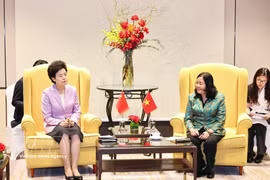
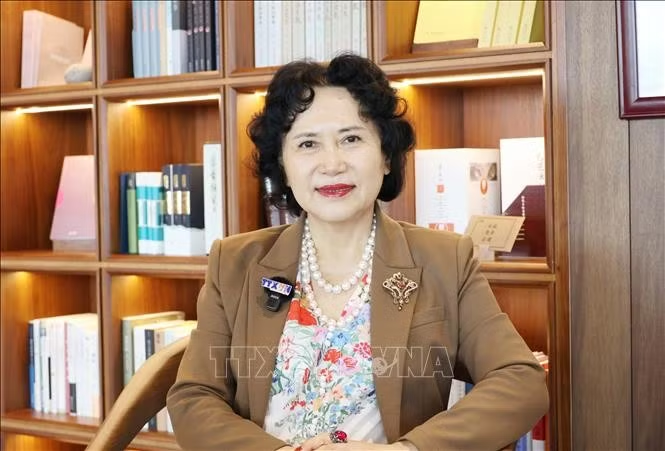
Tao Yitao, senior professor at Shenzhen University, former Deputy Secretary of the university’s Party Committee, and Director of the China Centre for Special Economic Zone Research. (Photo: VNA)

Beijing (VNA) – A Chinese scholar has spoken positively of Vietnam’s newly adopted two-tier local administration model, describing it as a bold administrative reform that demonstrates the Government’s determination to streamline governance and improve administrative efficiency.

In an interview with the Vietnam News Agency (VNA)'s correspondent in China, Tao Yitao, senior professor at Shenzhen University, former Deputy Secretary of the university’s Party Committee, and Director of the China Centre for Special Economic Zone Research, said the model reflects Vietnam’s strong commitment to simplifying administrative management.

According to Tao, one of the most significant advantages of the new system lies in its ability to improve governance efficiency through a flatter administrative structure.

First, eliminating intermediate levels and allowing provincial authorities to directly oversee commune-level administrations could, in theory, significantly reduce administrative costs and improve the transmission of policies.

Second, the model facilitates more direct allocation of resources and decentralisation of public services. By enabling resources to reach the grassroots level without unnecessary intermediary intervention, it can accelerate service delivery and contribute to improving people's living standards.

From the perspective of institutional economics, Tao said reducing administrative layers is not merely a matter of streamlining institutions. Rather, it involves a redistribution of governance responsibilities and transaction costs. Vietnam’s decision to abolish the district level and reorganise local administration into a two-tier provincial-communal structure reflects an ambitious political reform aimed at reducing information loss and addressing concentration of authority within traditional delegation chains.

The reform is intended to create a more direct connection between the State’s policy objectives and grassroots implementation.

The Chinese expert cautioned that one year is far too short a period to determine the ultimate success or failure of such a far-reaching reform. However, the model’s innovative nature lies in its willingness to move beyond dependence on a district-level system that has existed for centuries.

Its deeper significance is that it highlights a fundamental principle: administrative reform ultimately leads back to political reform. Unless power is effectively decentralised and accountability strengthened through legal mechanisms, simply adding or removing administrative layers may not be sufficient to achieve the intended goals of reform.

To address challenges in the coming years, Tao proposed three priorities for Vietnam’s next stage of reform to ensure stable and sustainable progress.

The first is to establish a scientifically balanced relationship between authority, financial resources and personnel so that responsibilities, powers and benefits remain aligned.

She argued that when provincial governments delegate responsibilities to commune-level administrations, they must also transfer corresponding financial resources. A standardised fiscal transfer system, for example, could help ensure that local governments possess sufficient capacity to perform public service functions. In addition, local authorities should be granted greater autonomy in personnel appointment and evaluation to strengthen self-governance.

Second, Vietnam should take advantage of digital technologies to compensate for the expanded management scope and build a digital government capable of overcoming organisational limitations.

Third, Tao emphasised the need to strengthen the professional capacity of grassroots civil servants. As administrative structures become leaner, management tasks at the commune level are becoming more complex. Enhanced training programmes and efforts to attract professional management talent, particularly in finance, urban planning and public services, would help improve local governments’ planning, implementation and emergency response capabilities.

The professor expressed confidence that as long as Vietnam remains committed to a people-centred development philosophy, its administrative reforms will deliver positive results. The country’s evolving governance model is opening new opportunities for the world to engage with Vietnam while enabling Vietnam to integrate more deeply with the world, further highlighting the attractiveness and vitality of its institutional development./.
VNA

See more

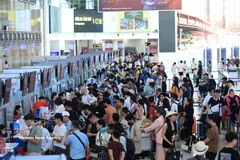
People queue to check in at the Noi Bai International Airport in Hanoi. (Photo: VNA)

Passengers to be compensated for flight delays from next month

Per the new decree, a flight is regarded as delayed when its actual departure time is more than 15 minutes later than the scheduled departure time. A “long delay” is defined as a delay of four hours or more from the scheduled departure time.

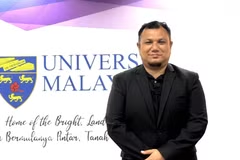
Associate Professor Dr Saaidal Razalli Bin Azzuhri, deputy head of the Faculty of Computer Science and Information Technology at the University of Malaya (Photo published by VNA)

Malaysian expert outlines roadmap for Vietnam to become digitally sovereign nation

Vietnam should establish a clear national expert pathway that allows AI engineers, cybersecurity specialists and data architects to advance professionally and expand their influence without having to move into administrative management roles. Such a model would enable them to remain technical leaders while enjoying career stability and professional recognition.

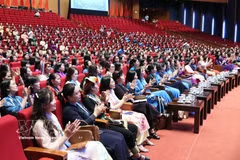
Delegates joining the 14th National Congress of the Vietnam Women's Union (VWU) (Photo: VNA)

Exhibition honours Vietnamese women’s journey of resilience, global integration

Organised within the framework of the 14th National Congress of the Vietnam Women's Union (VWU), the exhibition underscores the enduring role of women as a key force in struggles for national independence, post-war reconstruction, and socio-economic development, while reaffirming their growing position in the era of integration and globalisation.

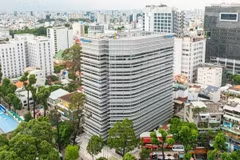
An image of Daikin Air Tower in Ho Chi Minh City. The building is the first project globally to secure the highest level of platinum status across three prestigious certification systems. (Photo: cafef.vn)

Green building trend flourishes in Ho Chi Minh City's real estate landscape

The International Finance Corporation (IFC) highlighted the city's dominance in green-certified building floor space in Vietnam, reflecting the rapid expansion of the green building market with 780 completed green buildings encompassing over 18.69 million sq.m by 2025, predominantly certified by EDGE and LEED.

Biological samples are collected from martyrs' remains at the Hue martyrs' cemetery for DNA analysis. (Photo: VNA)

Hue: 500-day campaign samples 1,456 unidentified martyrs

Vice Chairman of the Hue People's Committee Nguyen Van Manh said the large-scale sampling campaign will help build a national DNA database for martyrs, providing a foundation for future identity verification while helping restore the names of unknown fallen soldiers and easing the decades-long anguish of their families.

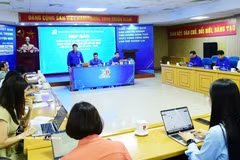
At the press conference on the 13th National Congress of the Ho Chi Minh Communist Youth Union in Hanoi on June 15 (Photo: VNA)

13th National Congress of Ho Chi Minh Communist Youth Union to take place next week

The Congress, which will take place in Hanoi, is an important political event for the Union and a major gathering for young people nationwide, Permanent Secretary of the Ho Chi Minh Communist Youth Union Central Committee and President of the Vietnam Students' Association Nguyen Minh Triet said at a press conference on June 15.

A youth union member assists a resident in handling administrative procedures at a public administrative service centre in Ho Chi Minh City. (Photo: VNA)

Over 3,400 administrative procedures, business conditions cut or simplified

Since April, the Government has issued 11 resolutions abolishing 56 conditional business lines. Compared to the 2025 Law on Investment, the number of conditional business sectors has been reduced by more than 28%, from 198 to 142. The resolutions also revised regulations governing 14 conditional business and investment sectors.

Khanh Hoa spreads sustainability awareness among young students (Photo: VNA)

📝OP-ED: Protecting children in digital age: Facts speak louder than distortions

The digital environment delivers clear gains: online birth registration, broader access to educational resources beyond classrooms and borders, and deeper integration into social life via national databases on law, education, health care, and population data. But it also introduces hazards such as harmful content, cyberbullying, online sexual harassment, personal data breaches, privacy violations, and potential psychological fallout from excessive screen time.

Illustrative image (Photo: Viettel Telecom)

Unverified mobile subscriptions hit by service suspension from June 15

Preliminary figures show that more than 93 million mobile numbers had completed ownership verification by the morning of June 15, while over 2 million numbers were identified as not being used by their registered owners. Around 18 million subscriptions had yet to confirm their status and were therefore subject to the suspension of outgoing calls and text messages.

A corner of Ho Chi Minh City (Photo: VNA)

“Era of nation's rise”: An aspiration grounded in evidence, practice

Vietnam’s development track record shows that the “era of the nation's rise” is a political and theoretical marker of a new development phase. It represents a commitment, a rallying cry for progress, and a shared duty of the Party, people, and army to deliver a strong, prosperous Vietnam by 2045.

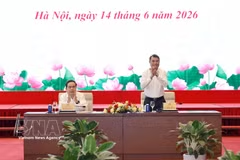
NA Chairman Tran Thanh Man (left) and PM Le Minh Hung at the meeting with leaders of press agencies in Hanoi on June 14. (Photo: VNA)

NA, Government leaders meet with heads of press agencies

The press has taken a leading role in defending the Party’s ideological foundation, countering wrongful and hostile stances, and raising the volume and quality of mainstream information, contributing to a healthy, humane and responsible media environment, said NA Chairman Tran Thanh Man.

The UN Group of Friends for Combating Technology-facilitated Trafficking in Persons, makes its debut at a ceremony in New York on June 12 (Photo: VNA)

Vietnam joins UN group on combating technology-facilitated human trafficking

The ambassador affirmed that Vietnam attaches great importance to cooperation with countries, the UN, UNODC, and relevant partners in combating human trafficking. He also noted that the participation of several ASEAN countries as founding members reflects the region’s shared commitment to implementing the ASEAN Convention Against Trafficking in Persons, Especially Women and Children (ACTIP).

Prime Minister Le Minh Hung launches nationwide campaign for sustainable double-digit growth in Ho Chi Minh City on June 13. (Photo: VNA)

PM launches nationwide campaign for sustainable double-digit growth

Prime Minister Le Minh Hung called on ministries, sectors and localities to promptly translate the emulation movement into practical action plans and programmes, ensuring that emulation becomes not merely a campaign but a driving force for action, an ecosystem for discovering good models, replicating successful models and best practices.

NA Vice Chairwoman Nguyen Thi Thanh guides a student on how to use an English reading pen at the gift presentation event in Dien Bien province on June 12. (Photo: VNA)

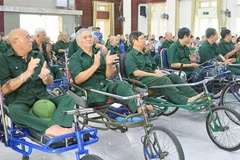
NA Vice Chairwoman presents gifts to Dien Bien policy beneficiary families

Vice Chairwoman Nguyen Thi Thanh urged policy beneficiary families to carry forward revolutionary traditions, serve as role models for younger generations, and steer their children to follow Party’s guidelines and the State’s laws and policies, contributing to a more prosperous and civilised province.