Malaysian expert outlines roadmap for Vietnam to become digitally sovereign nation

Vietnam should establish a clear national expert pathway that allows AI engineers, cybersecurity specialists and data architects to advance professionally and expand their influence without having to move into administrative management roles. Such a model would enable them to remain technical leaders while enjoying career stability and professional recognition.

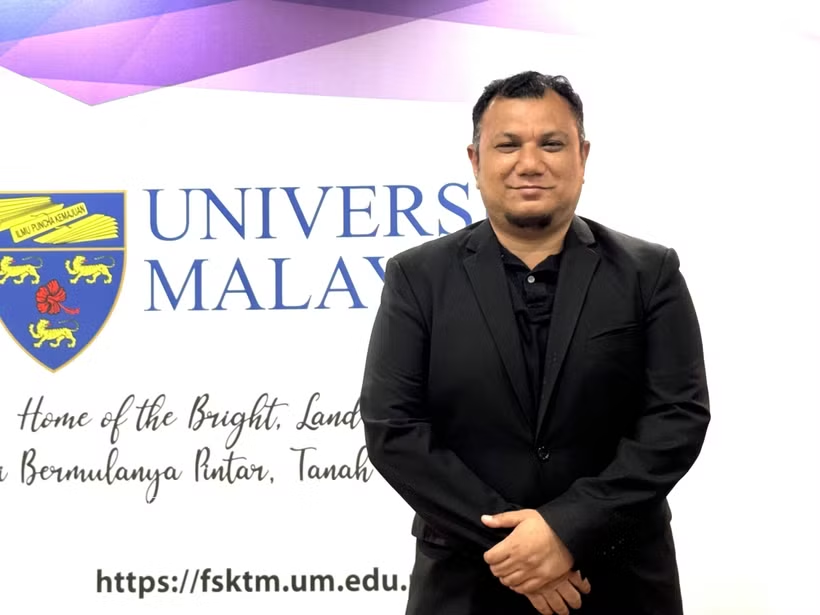
Associate Professor Dr Saaidal Razalli Bin Azzuhri, deputy head of the Faculty of Computer Science and Information Technology at the University of Malaya (Photo published by VNA)

Kuala Lumpur (VNA) - Vietnam needs a bold strategy to build technological sovereignty through talent attraction, education reform, and deeper international cooperation, according to Associate Professor Dr Saaidal Razalli Bin Azzuhri, deputy head of the Faculty of Computer Science and Information Technology at the University of Malaya.

Speaking to the Vietnam News Agency correspondents in Kuala Lumpur, the expert said the priority is to rethink how the country attracts and retains highly skilled digital talent.

For top data architects and technology specialists, competitive salaries alone are no longer enough. Many seek non-financial incentives such as purpose, autonomy, recognition, and opportunities for personal growth.

Rather than relying solely on attractive compensation packages, Vietnam should offer talented professionals a national mission, such as helping build sovereign digital infrastructure. Linking technical work to the country’s long-term development and strategic goals can provide a powerful sense of purpose and encourage long-term commitment, he said.

Equally important is technical freedom. Outstanding scientists and engineers want opportunities to design complex systems, tackle national-scale challenges and contribute meaningful research, rather than being constrained by rigid administrative structures.

To support this, Vietnam should establish a clear national expert pathway that allows AI engineers, cybersecurity specialists and data architects to advance professionally and expand their influence without having to move into administrative management roles. Such a model would enable them to remain technical leaders while enjoying career stability and professional recognition.

Dr Saaidal also proposed a talent mobility model linking government agencies, universities and the private sector. Under this approach, experts could spend time working in government to understand practical needs before returning to research institutions or technology companies to apply and update their knowledge. This will help ensure that expertise remains relevant in a rapidly evolving technological landscape, he explained.

He emphasised that autonomy, respect and a clear technical career path are the most sustainable factors for attracting and retaining high-quality digital talent.

The Malaysian academic argued that Vietnam must strengthen cooperation among government, universities and businesses through a “Triple Helix” model to develop engineers capable of contributing directly to technology creation.

The ultimate objective, he said, is for Vietnam to move from being a technology user to becoming a technology contributor.

Rather than training engineers merely to operate packaged software, educational institutions should equip graduates with the skills to understand, modify, secure and contribute to global open-source projects.

In this model, the government would provide strategic direction by defining national missions, funding research and building sovereign computing infrastructure. It should also support open-source initiatives in key sectors such as artificial intelligence, cybersecurity, digital government, cloud computing and chip design.

Universities, meanwhile, need to shift from theory-based teaching to project-based learning centred on real engineering challenges. Student performance should increasingly be measured through practical contributions, including coding, debugging, technical documentation and accepted pull requests on international platforms.

Technology companies form the third pillar of the ecosystem. Beyond recruiting graduates, businesses should serve as mentors, provide real-world industry challenges and offer students opportunities to work with advanced semiconductor and cloud-computing platforms.

Under this approach, graduates would leave university not only with academic degrees but also with publicly verifiable portfolios demonstrating their coding contributions and experience solving real-world problems, said the expert.

Alongside strengthening domestic capabilities, Dr Saaidal highlighted the importance of expanding international cooperation, particularly with Malaysia.

He said the two countries could build on their strengths in semiconductor manufacturing, chip design and electric vehicles by establishing joint research laboratories and promoting expert exchange programmes.

Such collaboration will help optimise resources, accelerate innovation and strengthen Southeast Asia’s position in the global technology landscape, he concluded./.

VNA

See more

Officers and personnel of the People's Public Security Force visit an exhibition showcasing the achievements of the People's Security Force. (Photo: VNA)

Public security anniversary events begin in Hanoi

Through music, storytelling and stage performances, the programme paid tribute to generations of officers and personnel who have contributed to safeguarding national security and maintaining peace and stability. It also offered the public a closer look at the force’s specialised responsibilities and the quiet sacrifices made in service of the nation.

Three war memorabilia items, including a certificate of merit and bravery certificates, are handed over to the Ho Chi Minh City Steering Committee for the Search, Recovery and Identification of Martyrs’ Remains. (Photo: VNA)

500-day campaign receives war memorabilia, martyr records

The donated materials include files on three martyrs’ personal belongings, burial records and maps identifying the graves of 21 martyrs at K76A Hospital, and decoded documents relating to Unit 962, linked to artefacts unearthed during excavation work at Le Thi Rieng Park in Hoa Hung ward.

Defendant Ho Van Phuong Tam at the trial. (Photo: VNA)

Man jailed for smashing Nguyen Dynasty throne armrest

According to the indictment, Tam bought an admission ticket to the citadel around noon on May 24, 2025. Once inside Thai Hoa Palace, he climbed over a protective barrier, sat on the "Nguyen Dynasty Throne", and broke off the front-left armrest before striking the artifact further and shattering the broken section into multiple pieces.

A civil servant helps a resident complete administrative procedures in Gia Lam commune, Hanoi. (Photo: VNS/VNA)

Nearly 700 administrative procedures abolished

By the end of May this year, localities across had implemented simplification measures for 411 administrative procedures, including abolishing 86 processes, amending or supplementing 111 and retaining 214, contributing to improved efficiency of the State administrative apparatus as well as helping citizens and businesses.

Outstanding overseas Vietnamese youth and student delegates pose for a group photo at the Monument of President Ho Chi Minh and Quang Binh people in Dong Hoi ward, Quang Tri province, in 2025. (Photo: VNA)

Over 100 overseas Vietnamese youth to join Vietnam Summer Camp 2026

The programme will introduce delegates to Vietnam's rich cultural heritage, including UNESCO-recognised sites such as the Complex of Hue Monuments, My Son Sanctuary, Hoi An Ancient Town and Hue Royal Court Music. It combines heritage tours with history lessons, cultural experiences and Vietnamese language activities to strengthen participants' understanding of their roots and foster national pride.

A network of 1,837 AI-powered cameras has been deployed in Hanoi to ease traffic congestion, improve traffic management, modernise urban infrastructure and promote a more civilised urban environment. (Photo: VNA)

Vietnam handles over 2.39 million traffic violations in H1

According to the Traffic Police Department, the country recorded 7,773 traffic accidents during the six-month period, killing 4,877 people and injuring 4,486. Compared with the same period last year, accidents fell by 17.4%, fatalities by 8.4% and injuries by 28%.

A portrait of Poldi Sosa Schmidt, late President of the Argentina–Vietnam Culture Institute (Photo: VNA)

Vietnamese Embassy holds memorial ceremony for Argentine friend Poldi Sosa Schmidt

Speaking at the event, Ambassador Ngo Minh Nguyet lauded Poldi’s unwavering dedication over nearly six decades in support of the Vietnamese people. Her contributions ranged from participating in the international anti-war movement to promoting cultural and educational exchanges and people-to-people cooperation between Vietnam and Argentina.

Nguyen Thanh Nam at the Investigation Security Agency under the Hanoi Department of Public Security. (Photo: VNA)

Two investigated over alleged anti-State propaganda

According to investigators, the two allegedly produced, stored and distributed numerous video clips and a book entitled "Chuyen voi Thanh – loi ke moi ve anh sang" (Stories with Thanh – a new account of light).